

More
Checking your session
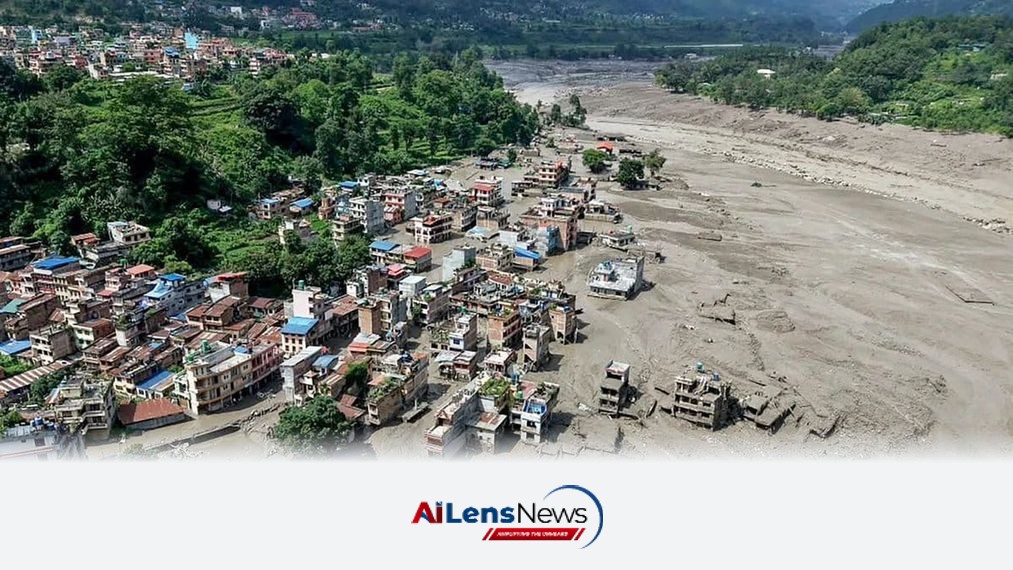



A recent report from Kishtwar's District Disaster Management Authority reveals critical gaps in flood risk management, emphasizing the need for immediate action to address glacial lake hazards.
New Delhi, India Aug 29, 2026 ALN: Sometime on a Wednesday morning this month, a wall of water came down the Bhotekoshi on the Nepal-China border. It began with a magnitude 4.4 tremor about a hundred kilometres north of Kathmandu. Minutes later, researchers believe, an ice avalanche broke loose in the Lhende Khola and pushed a surge into Rasuwa and Nuwakot. By the time the water reached the plains, it had taken out hydropower stations and buried villages, and a mudslide in Gyirong county on the Tibetan side added to the count. Officials in both countries have confirmed at least 98 dead (at the time of writing this column), with hundreds missing. Early Indian reports suggested more than a hundred Indian nationals were on the Kailash pilgrim route that runs through the same valley.
The detail that should trouble Indian planners is not the death toll. It is that the same stretch of river did this in July 2025, when a supraglacial lake drained upstream in Tibet and killed nine people. Fourteen months, twice. The mountain gave the same warning on two occasions, and on both it was filed as an isolated tragedy rather than read as a pattern.
I have been thinking about that pattern because of a document produced by the District Disaster Management Authority in Kishtwar: its Glacial Lake Outburst Flood Risk Management Plan for 2024-25. It is a serious piece of work by the district’s own officials, and it is unusually candid. It is also, read closely, an inventory of everything that has not yet been built. Kishtwar is known to most Indians for its mountain scenery and, increasingly, for its dams. Very few know that it holds the largest concentration of glacial lakes anywhere in Jammu and Kashmir. By the DDMA’s own assessment, the district contains 197 glacial lakes, 36.08 percent of every glacial lake in the Union Territory, spread over roughly 392 hectares in the upper Chenab basin. Most are small. About 91 percent are under five hectares. The risk sits with the exceptions, the ones still growing as the glaciers behind them retreat.
The plan singles out four. Mundiksar and Hangu are classified High Risk. An unnamed lake near 33.94°N, 76.02°E, and Patla Pani are classified Moderate Risk. These are not activist estimates. They were compiled by the district administration with the UT’s disaster management department and cross-checked against the seventeen-parameter scoring framework the Central Water Commission finalized in October 2024, which weighs lake size, dam type, seismic exposure, freeboard, and distance to habitation.
Mundiksar is the one worth sitting with. At about 4,071 metres and 39.44 hectares, it has expanded visibly over four decades as its parent glacier has pulled back, a change the plan’s own satellite comparisons from 1980 to 2020 document in detail. It is on the National Disaster Management Authority’s lake registry.
And yet, by the plan’s own expedition record, current as of November 2024, no field survey report had been received for any of Kishtwar’s three most concerning lakes. Mundiksar, Hangu, and the unnamed lake were all assigned to the Central University of Jammu for physical assessment. All three appear in the district’s own table as “Not Received”. Two lakes elsewhere in the valley, Sheshnag and Sona Sar, had their reports filed on schedule. Kishtwar’s had not.
This is not a failure of scientists. It is a resourcing gap, and the plan says so plainly: the district “lacks access to advanced technology and equipment” and depends on national institutions for timely data. The scale of that gap is easy to state. Across all Himalayan river basins in India, the CWC’s satellite programme actively tracks 902 glacial lakes and water bodies. Of those, 15 glacial lakes and 16 water bodies fall within the whole of Jammu and Kashmir. One district holds 197. On the UT’s own 24-lake priority watchlist, Kishtwar contributes three, against nine for Ganderbal and eight for Anantnag. Its share of formal study attention has not caught up with its share of the hazard.
What makes this a national question rather than a district one is what sits downstream. Kishtwar is becoming one of India’s most important hydropower corridors, home to the Pakal Dul, Kiru, Kwar, and Dangduru projects under Chenab Valley Power Projects Limited. The DDMA’s plan states directly that these face real exposure to GLOF-driven surges, sediment loads, and structural damage. India has committed enormous public capital to harnessing the Chenab. The same report that documents the risk to that investment is the one whose surveys on the critical lakes remain incomplete.
Add one more fact and the calculus changes again. Kishtwar sits in Seismic Zone IV. A flood here would not require an unusual monsoon. A moderate earthquake could destabilize an already weakened moraine dam on its own, which is precisely the sequence that played out in Nepal this month. Two independent hazards capable of triggering each other are harder to predict and far more expensive to manage than either alone.
The plan does not stop at description, to its credit. It calls for automated real-time sensors on high-risk lakes, an early warning system built with the India Meteorological Department, controlled drainage and reinforcement of unstable moraine dams, and evacuation mapping done before rather than after an event. It points to Section 10.3.6 of the NDMA’s 2020 GLOF guidelines, which allows District Planning and Development Council funds to be earmarked for exactly this work. Every one of these is sound. Not one is self-executing. A plan that recommends a drainage tunnel is not a drainage tunnel, and a committee that meets twice a year is not a sensor transmitting live data from 4,000 metres.
The plan names five tehsils as most exposed: Padder, Machail, Dachhan, Marwah, and Warwan. Marwah and Warwan it calls “Shadow Areas,” the district’s own term for places so remote that emergency response is stretched thin in ordinary times, let alone during a flood that arrives with minutes of notice. I did not expect to find my own family’s valley on that list. Dachhan is on it, in the district’s own words, and I cannot write around that. It is also the reason I think the rest of the country should read this document rather than wait for it to be quoted in a post-disaster inquiry. Kishtwar has what Rasuwa did not: a report that already names the lakes, the villages, and the projects at risk. Disasters are rarely sudden. They begin years earlier, in surveys marked “Not Received,” while the lakes keep expanding on a schedule of their own.
Lokesh Dhar is a public policy researcher and consultant.
To learn more about the latest developments in Climate Change, stay updated with our exclusive reports and analyses on AILensNews.

A recent study highlights the severe effects of climate change on food security …
Extreme heat and drought are severely impacting agriculture and water levels acr…
The recent flash flood in Nepal's Rasuwa district serves as a critical alert for…

Recent flash floods and landslides highlight the interconnectedness of the Himal…
World leaders convene for a pivotal climate summit to discuss strategies for com…