

More
Checking your session




Thousands of Punjab government employees staged a mass protest demanding the implementation of the dearness allowance and restoration of the Old Pension Scheme, prompting a stern response from Chief Minister Bhagwant Mann.
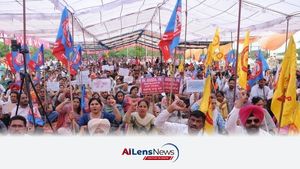
Chandigarh, India Aug 28, 2026 ALN: In a significant demonstration of discontent, lakhs of Punjab government employees took to the streets on Thursday, opting for mass casual leave to voice their demands for overdue dearness allowance (DA) and the reinstatement of the Old Pension Scheme. This protest marks a pivotal moment in the ongoing struggle between the workforce and the state government.
The employees, representing various departments, gathered in large numbers, expressing their frustration over the lack of action from the Bhagwant Mann-led government. The protestors not only called for the immediate release of the pending DA but also sought assurances regarding other critical service matters, including job security and pension reforms. The scale of the protest reflects a broader sentiment among public sector workers, who feel marginalized and unheard in the current political climate.
In response to the escalating protests, Chief Minister Bhagwant Mann has indicated a tough stance. The government is reportedly considering measures to address the situation, although specific actions have yet to be disclosed. This decision comes amid growing pressure from the employee unions, which have threatened to escalate their protests if their demands are not met. The government’s reaction is critical, as it not only affects the current situation but also sets a precedent for how similar issues might be handled in the future.
The demand for the Old Pension Scheme has gained momentum in recent years, with many employees arguing that the new pension system is inadequate for their retirement needs. The Old Pension Scheme, which provides a fixed percentage of the last drawn salary as pension, is seen as a more secure option for many workers. Under the new system, which was implemented in many states across India, employees have raised concerns about the uncertainty and variability of their future pensions, which are linked to market performance and other factors.
Furthermore, the issue of dearness allowance has become increasingly pressing, as inflation continues to rise. Employees argue that the current DA does not reflect the cost of living, making it essential for the government to revise it to ensure financial stability for the workforce. The rising prices of essential commodities have eroded the purchasing power of many government employees, leading to heightened dissatisfaction and calls for action.
The mass leave taken by government employees has led to disruptions in various public services, affecting citizens who rely on government operations for essential services. Schools, hospitals, and administrative offices have reported reduced staff availability, raising concerns about the impact on daily operations. In particular, the education sector has faced significant challenges, with many schools unable to function normally, potentially affecting students' learning and academic progress.
Moreover, the healthcare system has also been strained, with hospitals experiencing staff shortages that could impact patient care. The administrative offices, responsible for processing various government services, have seen delays, which could hinder citizens' access to essential services. These disruptions highlight the interconnectedness of government employee welfare and public service delivery, underscoring the need for a resolution that addresses both employee grievances and public needs.
As the situation develops, the government’s next steps will be crucial in determining whether the unrest can be resolved amicably or if further protests will ensue. Employee unions have stated that they are prepared to intensify their actions if their demands are not adequately addressed. This readiness to escalate protests indicates a deep-seated frustration among workers and a willingness to fight for their rights, which could lead to prolonged unrest if not managed effectively.
In conclusion, the ongoing protests by Punjab government employees highlight the urgent need for dialogue and resolution regarding their demands for dearness allowance and pension reforms. The response from the Bhagwant Mann government will be closely watched as both sides navigate this challenging situation. The outcome of this conflict will not only affect the current workforce but could also have long-term implications for government employment policies and labor relations in Punjab and beyond. As the state grapples with these issues, it remains to be seen how the government will balance fiscal responsibilities with the needs of its employees, a challenge that is emblematic of broader economic and social issues facing many regions today.
To learn more about the latest developments in Labour & Employment, stay updated with our exclusive reports and analyses on AILensNews.
In Punjab, nearly four lakh government employees and pensioners are mobilizing f…

In response to ongoing protests by government employees, the Punjab government i…

Navdeep Suri, a retired Indian diplomat, expresses concerns over the electoral r…
The Punjab bandh initiated by the Qaumi Insaaf Morcha commenced peacefully, with…

Contractual employees of Punjab Roadways and PRTC have initiated a strike, causi…