

More
Checking your session
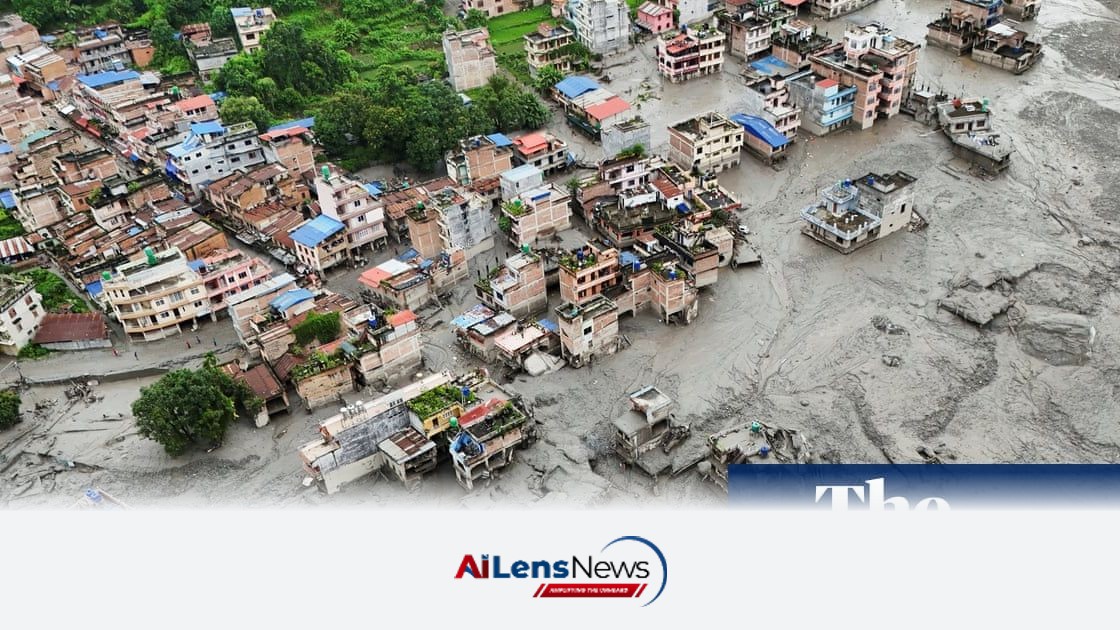



A devastating flash flood triggered by a glacial collapse in the Nepal-Tibet region has left nearly 1,400 people missing, primarily tourists, and resulted in at least 356 fatalities.
New Delhi, India Aug 27, 2026 ALN: Rescuers are currently engaged in a desperate search for nearly 1,400 individuals, mostly tourists, who are unaccounted for following a catastrophic flash flood that struck the Nepal-Tibet region. The disaster, which has claimed at least 356 lives, obliterated entire villages and swept through valleys, leaving a trail of destruction.
The search and rescue operations have been severely hampered by the destruction of numerous bridges and approximately 25 miles (40 km) of roads in this mountainous area, which is popular among trekkers and pilgrims. Many of the missing are reported to be from countries including India, the United States, the United Kingdom, Australia, and Canada.
Videos captured during the disaster depict a massive wall of water cascading down the border, overwhelming those attempting to escape. In Nepal, trucks were overturned, and homes, roads, and power plants were swept away. Officials in Tibet expressed fears of “major casualties” following a mudslide that affected a border crossing.
Rescue teams have discovered bodies hundreds of miles downstream from the disaster zone, particularly in the Chitwan district of Nepal, near the Tibetan border. Many injured individuals have been airlifted to Kathmandu for urgent medical care. By Thursday morning, the Nepali army had successfully rescued over 100 people from flood-affected areas using helicopters.
David Fisher, the head of the Nepal delegation of the International Federation of the Red Cross, reported that entire villages and market areas had been completely wiped out. In the affected regions, houses, trees, and vehicles were either submerged or buried under mudslides, while helicopters hovered overhead throughout the day to assist in rescue operations.
The sheer power and speed of the surging waters left little time for residents to flee. Those from the severely affected areas of Nuwakot and Dhading gathered outside a Nepali army training center, which served as the base for helicopter rescue operations, seeking information about missing family members.
Police reported that nearly 600 foreigners were among the 826 individuals missing in Nepal. Among those unaccounted for are 177 from India, 63 from the US, 34 from Australia, 33 from the UK, and 25 from Canada. On the Tibetan side of the border, Chinese state media reported that at least 558 individuals were missing, including at least 260 foreign nationals.
As of Thursday afternoon, Nepali authorities confirmed that 353 bodies had been recovered, while three fatalities were reported on the Tibetan side. Many victims were on a pilgrimage to Kailash Mansarovar, a revered high-altitude site in Tibet.
Initial reports suggested that an earthquake might have triggered the collapse of a glacier, leading to the floods. However, the US Geological Survey later clarified that what was initially recorded as a 4.4-magnitude earthquake was actually a seismic shock caused by the collapse of glacial rock and ice, along with the flow of debris.
An initial analysis of satellite imagery indicated that a landslide of ice and rock initiated the debris-laden flood in the Lhende River, located about 12 miles (20 km) northeast of the Nepal-China Rasuwagadhi border crossing. Experts warn that the risk of such catastrophic events is heightened by the extreme topography of the Himalayas.
Survivors have shared harrowing accounts of their experiences during the flood. Bibek Kumal, a laborer working downstream from the worst-hit Rasuwa district, recounted how he started running as a wall of water approached. He managed to survive by clinging to a mango tree amidst the mud and debris.
Another survivor, Keshav Prasad Baral, described the terrifying moment when a massive surge of mud approached his home. Despite his efforts to save his wife, she was swept away, and he was rescued hours later by a helicopter. “My wife is still somewhere beneath the mud. She’s gone,” he lamented.
The United Nations Secretary-General, António Guterres, announced that UN teams and partners were mobilizing supplies and personnel to assist affected communities. The US government pledged $500,000 in emergency aid. Meanwhile, officials in Tibet deployed nearly 800 emergency workers and 150 vehicles, along with sniffer dogs and speedboats, to bolster rescue efforts.
As the search continues, the scale of the devastation and the number of missing persons highlight the urgent need for international support and effective disaster response strategies in the region.
To learn more about the latest developments in Natural Disasters, stay updated with our exclusive reports and analyses on AILensNews.

Following a summer of drought, storms have led to significant flooding in Englan…
A glacier collapse in Nepal has triggered devastating flash floods, with experts…

The unprecedented July 2026 floods in Upper Assam highlight the complex interpla…

As the UK experiences record temperatures of 38.1C, Greece battles wildfires fue…

As wildfires rage across England, experts call for government-led initiatives to…