

More
Checking your session
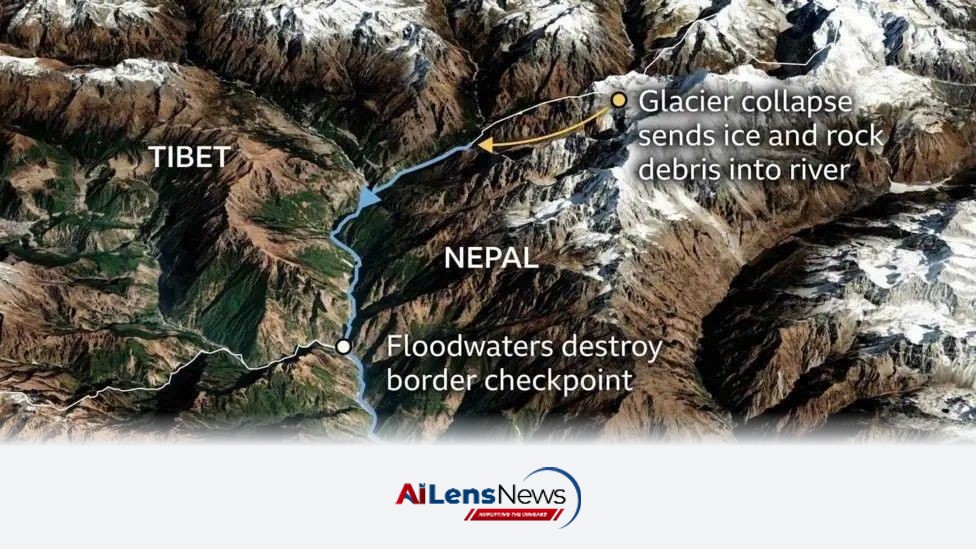



Preliminary investigations reveal that a collapsed glacier triggered devastating floods along the Nepal-Tibet border, resulting in significant loss of life and highlighting climate change concerns.
New Delhi, India Aug 27, 2026 ALN: Preliminary investigations have pointed to a collapsed glacier as the cause of the flash flood on the Nepal-Tibet border, highlighting the issue of rapidly melting Himalayan ice, scientists have reported.
Initial reports of an earthquake led many to believe that a tremor had caused a landslide, which in turn caused the flood that has killed at least 389 people. However, the US Geological Survey clarified that the disaster was caused by a "glacial collapse," which occurs when a glacier or part of a glacier disintegrates.
The impact of the collapsed glacier hitting the bottom of a valley was so powerful that it registered a magnitude of 5.2, according to USGS data and scientists who have analyzed the event. This magnitude indicates a significant release of energy, comparable to minor earthquakes, demonstrating the force with which the glacier fragmented and fell.
Dr. Simon Cook, a glacier expert with the University of Dundee, indicated that his team detected that the lower part of a glacier in Nepal near the Langtang Lirung peak—approximately 15km (9 miles) west of the flood site—had collapsed. The region is known for its stunning landscapes, but it is also susceptible to the effects of climate change, which has been causing glaciers in the Himalayas to melt at an alarming rate.
He estimated that the glacier collapsed in a northwesterly direction and then traveled westwards downstream. This movement of ice is not uncommon in glacial dynamics, but the scale and speed of this event were extraordinary. An analysis by the International Centre for Integrated Mountain Development (ICIMOD), an intergovernmental scientific institution, suggested there could have been "an ice-rock avalanche originating from a high-altitude area." This caused a "large volume of ice and rock debris" to enter the Lende Khola, a tributary of the Bhote Koshi river, generating a sudden surge in the river carrying water, sediment, and large boulders downstream.
The centre found that water levels in rivers downstream rose by between seven and nine meters within a span of 30 minutes, and several water monitoring stations were washed away or damaged. This rapid increase in water levels is indicative of the potential for catastrophic flooding, which can lead to widespread destruction of infrastructure, loss of life, and long-term ecological impacts.
Mike Searle, a professor of earth sciences at Oxford University, explained that the entire process—from landslide to flood—could have taken hours or even days. "The sheer wave of debris suggests there could have been a landslide first; the water built up, dammed the river, and then it burst in one huge great flood," he noted. This sequential process highlights the interconnectedness of geological and climatic factors that can lead to such disasters.
The topography of the area may have exacerbated the flood. Searle pointed out that Langtang Lirung sits on the crest of the high Himalayas, with "incredibly steep valleys" on both sides of the mountain, which could have funneled the water at higher speeds. The steep gradients in the Himalayas can amplify the effects of any sudden influx of water, leading to flash floods that can devastate communities located in valleys below.
It remains unclear what specifically caused the glacier to collapse. Searle mentioned that Langtang Lirung, like the rest of the Himalayas, has been slowly rising due to long-term tectonic movement, where one plate has been pushing another plate up. "It's like putting a jack under the car, and then jacking it up," he explained. This tectonic activity is a natural process that has shaped the Himalayas over millions of years, but it can also create instability in the region's glaciers, particularly as temperatures rise.
As the mountain rises, the glacier becomes steeper, making it inevitable that parts will fall off. However, these are usually smaller chunks that temporarily block rivers and are easily flushed out. In this disaster, the entire glacier seems to have collapsed "in one go," which Searle described as "very unusual." This unprecedented event raises concerns about the stability of other glaciers in the region, as similar occurrences could lead to further catastrophic flooding in the future.
He emphasized that while floods occur regularly, this event was on a much larger scale. Wednesday's incident likely resulted from "two different processes—tectonics with the Himalayas uplifting, and climate change with increasingly high temperatures and melting glaciers." The interplay between these factors underscores the complexity of natural disasters in the context of a changing climate.
"The whole thing is combining to form these catastrophic disasters that we are now seeing on a regular basis," he concluded. The implications of this event are profound, as it not only highlights the immediate dangers posed by glacier collapses but also raises questions about the long-term sustainability of water resources in the region. As glaciers continue to melt, the availability of freshwater for millions of people downstream could be at risk, potentially leading to conflicts over water resources, displacement of communities, and significant impacts on agriculture and livelihoods.
Furthermore, the incident serves as a stark reminder of the urgent need for comprehensive climate action and disaster preparedness strategies in vulnerable regions such as the Himalayas. Local governments and international organizations must work together to develop early warning systems, improve infrastructure resilience, and enhance community awareness of the risks associated with climate change and geological instability. The lessons learned from this disaster could inform future research and policy initiatives aimed at mitigating the impacts of similar events in the future.
To learn more about the latest developments in Climate & Environment, stay updated with our exclusive reports and analyses on AILensNews.

Romania's Cernavodă nuclear power station is shut down due to extremely low wate…

Firefighters in France face escalating wildfires in Gironde, with a new heatwave…

Authorities have ordered the evacuation of tens of thousands from the Cap Ferret…

Around 12,000 people have been evacuated in France as wildfires rage, claiming l…

China has evacuated over 1.7 million residents as Typhoon Bavi approaches, promp…