

More
Checking your session
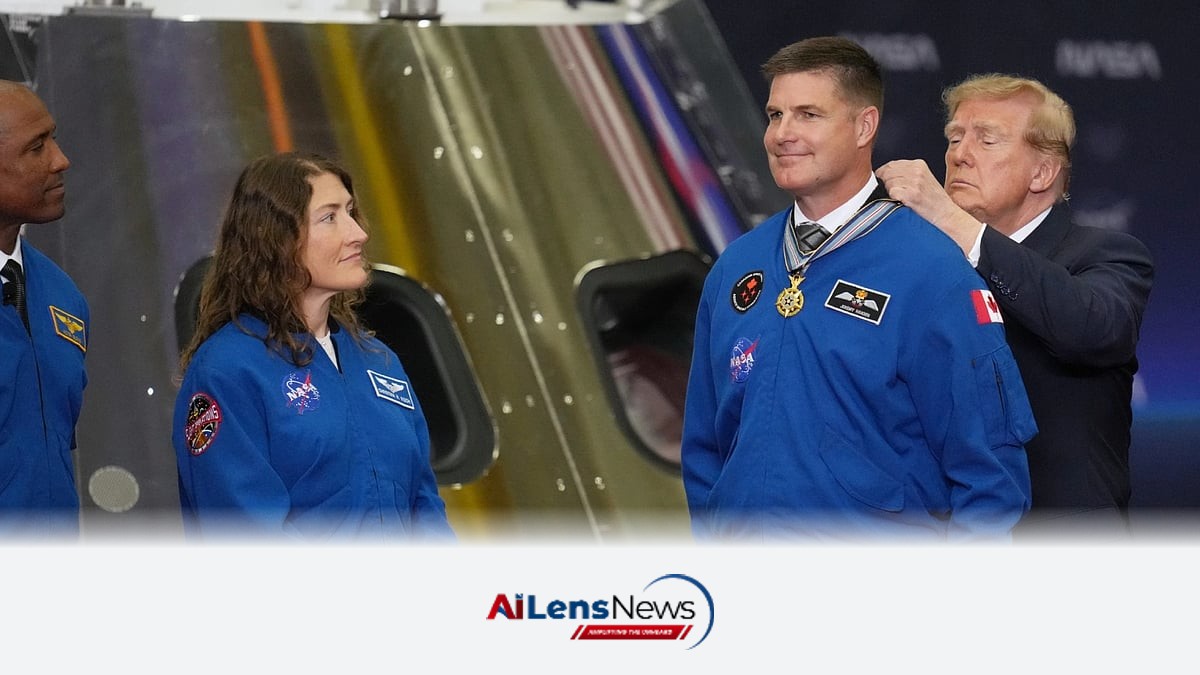



During a visit to NASA's Mission Control, President Trump announced the establishment of a military Space Academy and interacted with astronauts aboard the ISS.
New Delhi, India Aug 29, 2026 ALN: US President Donald Trump announced the formation of a new military Space Academy and interacted with astronauts onboard the International Space Station (ISS), including Anil Menon, during a visit to NASA’s Mission Control in Houston. This announcement marks a significant step in the United States' ongoing efforts to expand its presence and capabilities in space, particularly in the realm of military operations and strategic space exploration.
“This is a great honour, to be with you is a great honour and I just want to thank Jessica, Anil, Jack - great Americans, great patriots, brave people,” Trump said, making a call to the orbital laboratory from the Mission Control at Johnson Space Centre on Friday. The interaction highlighted the importance of teamwork and collaboration in the field of space exploration, as well as the critical role that astronauts play in advancing scientific knowledge and technological innovation.
NASA astronauts Jack Hathaway, Anil Menon, and Jessica Meir are part of Expedition 75 to the International Space Station. This mission is significant as it continues the long-standing tradition of international cooperation in space, with astronauts from various backgrounds working together to conduct experiments and research that benefit all of humanity. Trump called the crew a group of "pioneers" for their efforts in space exploration, underscoring the notion that their work is not just about scientific discovery, but also about inspiring future generations to pursue careers in science, technology, engineering, and mathematics (STEM).
After his brief remarks, Trump had NASA astronaut Anna Menon, Anil Menon's wife, and Duke Brady, Jessica Meir's husband, briefly interact with the ISS crew. “Hi, it’s Anna. Great to see you guys up there. We love you guys. You’re doing a great job,” she said. This personal touch added a human element to the event, reminding viewers that behind the space suits and scientific missions are families and loved ones who support these astronauts in their endeavors.
The President also offered to welcome the astronauts to the White House when they return, a gesture that reflects the administration's commitment to recognizing and honoring the contributions of those who serve in the field of space exploration. This invitation could serve as a platform for the astronauts to share their experiences and insights with policymakers, potentially influencing future space policy and funding decisions.
Menon, a colonel in the US Space Force, told Trump he was proud to serve in space and shared his experiences about the spacewalk he completed earlier this week. Spacewalks, or extravehicular activities (EVAs), are critical for maintaining and upgrading the ISS, as well as for conducting scientific experiments that can only be performed in the unique environment of space. Menon's pride in his role highlights the increasing integration of military personnel into space missions, reflecting a broader trend of national security considerations shaping space exploration initiatives.
Trump also announced the formation of the new Space Academy – a “top line” school with tough admission standards and a “beautiful” campus to train the next generation of civilian and military aerospace experts. This initiative is positioned as a counterpart to established military academies like West Point, Annapolis, and the Air Force Academy, which have long been the training grounds for the nation’s military leaders. The proposed Space Academy could play a pivotal role in developing the skills and knowledge necessary for future space operations, particularly as the US seeks to maintain its leadership in an increasingly competitive global space landscape.
“You think of West Point, and you think of Annapolis, and you think of the Air Force Academy and you think of the Coast Guard Academy. It’s great. They’re all great, but we’re going to now have a Space Force (academy),” the US President announced. The establishment of a Space Academy could also serve to attract talented individuals to the Space Force, which has been a relatively new branch of the military, officially established in December 2019. This move could enhance recruitment efforts and ensure that the US has a skilled workforce capable of addressing the challenges of future space missions.
Menon expressed his enthusiasm for the future of space exploration, stating that he was “so proud and excited” that the United States was preparing for missions beyond low-Earth orbit. “We are going to pave the way to our next journey to the Moon, Moon Base and Mars,” he said. “And thank you for propelling us in that direction.” This sentiment reflects the growing ambition of NASA and the US government to establish a sustainable human presence on the Moon and eventually send astronauts to Mars, which are critical steps in the broader vision of human exploration of the solar system.
“I want to get a moustache like that,” Trump told astronaut Hathaway, referring to Hathaway's facial hair. “Absolutely, sir. I appreciate it. Yeah, the moustache is a lot of fun,” Hathaway replied. This light-hearted exchange contributed to the camaraderie and positive atmosphere of the event, showcasing the human side of space exploration and the personal connections formed among those involved in these groundbreaking missions.
Trump was in Houston to present the Congressional Space Medal of Honor to the four-person crew of the Artemis II mission, which travelled around the moon in April, setting a new record distance from Earth for a manned space mission. The Artemis II mission is part of NASA's broader Artemis program, which aims to return humans to the Moon and establish a sustainable presence there by the end of the decade. The recognition of the Artemis II crew underscores the significance of their achievements and the importance of continued investment in space exploration initiatives.
The formation of the Space Academy and the ongoing missions to the ISS and beyond are indicative of a renewed focus on space as a critical domain for national security, scientific advancement, and international collaboration. As the United States navigates the complexities of space policy, the actions taken today will have lasting implications for the future of space exploration and the role of military and civilian entities in shaping the next frontier of human endeavor.
To learn more about the latest developments in Space & Astronomy, stay updated with our exclusive reports and analyses on AILensNews.
Jared Isaacman shares insights on the Nancy Grace Roman Telescope and its potent…

Space weather significantly affects technologies on Earth, prompting a dedicated…
As NASA transitions from the International Space Station, it is adapting astrona…
China has postponed the Chang’e-7 lunar mission, originally set to explore the m…

The Northeast India Space Workshop 2026 aims to position the region as a key pla…