

More
Checking your session
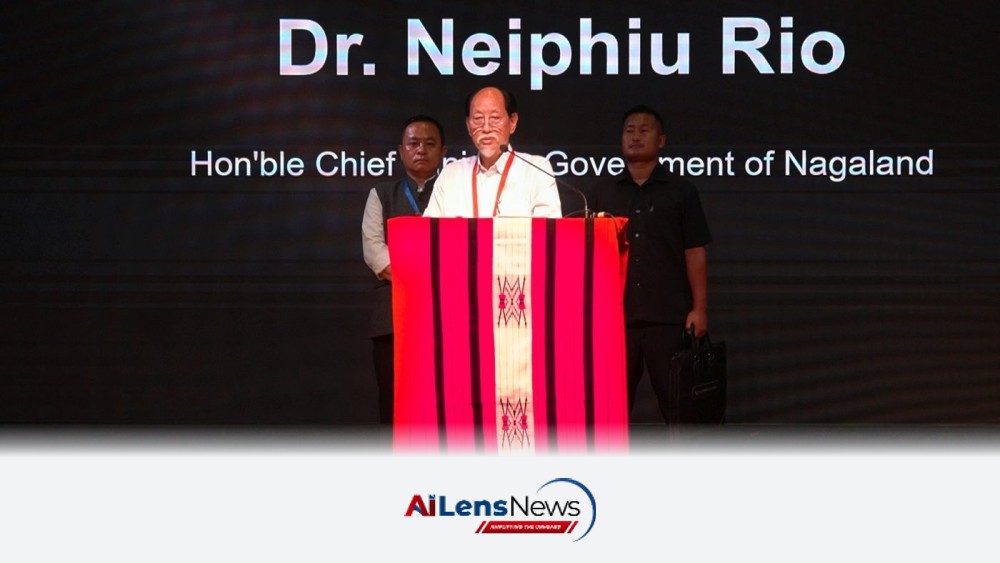



Chief Minister Neiphiu Rio emphasizes the need for a balanced approach to the Inner Line Permit system, ensuring protection for indigenous communities while attracting investment.
Kohima, India Aug 29, 2026 ALN: Asserting that "cannot live in isolation," Chief Minister Neiphiu Rio called for a balanced implementation of the Inner Line regime, commonly known as the ILP. The balance he implied was one that protects indigenous Naga communities while welcoming outside investors to help build the state’s economy.
He made the comment on August 29, day 2 of the national seminar on the Bengal Eastern Frontier Regulation (BEFR), 1873, organised by the Inner Line Regulation Commission-Naga Students’ Federation (ILRC-NSF) in Dimapur. Rio also cautioned against the misuse of the special Constitutional provisions enjoyed by the state, mentioning in particular "benami" businesses run by non-indigenous people in collusion with Nagas. According to him, it only serves tax evasion and hurts the economy of the state.
The Chief Minister highlighted the Guwahati High Court’s June 16, 2026, decision to uphold the extension of the ILP to Dimapur, Chümoukedima, and Niuland as a legal victory. He said that the ruling reinforced the constitutional significance of Article 371(A) in preserving Naga identity and customary practices. "We have to bring a system of using this BEFR 1873, a system which will protect the Indian citizens, also protect the indigenous Nagas, and mutual interest for development," Rio said. As a minority in the national context, he reiterated the importance of the protective regulation to the Nagas.
Turning to border issues, Rio reiterated his government’s opposition to fencing the Indo-Myanmar border, calling the proposal impractical for Naga communities divided by the arbitrary boundary. He cited the village of Longwa in Mon district, where the traditional chief’s house is physically divided between India and Myanmar. "If it is fenced, it is not possible to survive," Rio said. It has had family members and agricultural fields scattered on both sides of the international border.
Rio also addressed the state’s contested petroleum issue and urged tribal bodies to allow the extraction of the reserves. While petroleum operations on the side have been halted since 1994 due to the unresolved Indo-Naga political issue, Assam continues extraction on its side of a shared oil-rich belt and even on the DAB, unilaterally.
On June 11, 2026, Assam and New Delhi signed what was termed as a "Tripartite" Memorandum of Understanding (MoU) to jointly conduct petroleum operations in the DAB, splitting revenue 50-50. While the three may have arrived at a consensus, the idea of oil extraction has remained a highly contested affair on home turf, facing opposition from the tribal hohos and Naga Political Groups, stalling exploration.
Rio further brought up a long-lost term, "equi-closeness," an expression for a facilitative policy coined during his first term as Chief Minister. According to him, through the equi-closeness policy, his government seeks to facilitate negotiations with all stakeholders, both "overground and underground," on a level platform.
ILP Commission
The Inner Line Regulation Commission-Naga Students’ Federation (ILRC-NSF) submitted a representation to the Chief Minister seeking reforms in the implementation of the ILP system. According to the ILRC-NSF, the primary hurdle to the regulation lies in its administration rather than the law itself.
Citing the enforcement challenge, it urged the state government to enact a statute constituting a dedicated "autonomous Inner Line Regulation Commission" vested with full powers to enforce the 1873 regulation. It held that the prevailing enforcement system is fragmented among the Home Department, district administrations, police, municipal bodies, and trade licensing authorities.
While stating that the allegedly fragmented nature of enforcement has rendered it inefficient, it said that the government has no dependable data to track implementation.
In the absence of a centralised authority, the ILRC-NSF stated that student civil society organisations have had to shoulder the burden of enforcement. The representation noted that this lack of official machinery has allowed unscrupulous individuals to harass non-indigenous residents under the guise of ILP vigilance.
To learn more about the latest developments in Political Controversies, stay updated with our exclusive reports and analyses on AILensNews.
Prashant Bhushan discusses the complexities of the Inner Line regime at a semina…
The recent seminar on the Inner Line Permit regime highlights the ongoing debate…

Uttar Pradesh Assembly Speaker Satish Mahana faces backlash for leaving the dais…

The Naga Students’ Federation calls for a dedicated authority to enforce the Inn…
The BJP has criticized the Congress for its decision to sing only two stanzas of…