

More
Checking your session
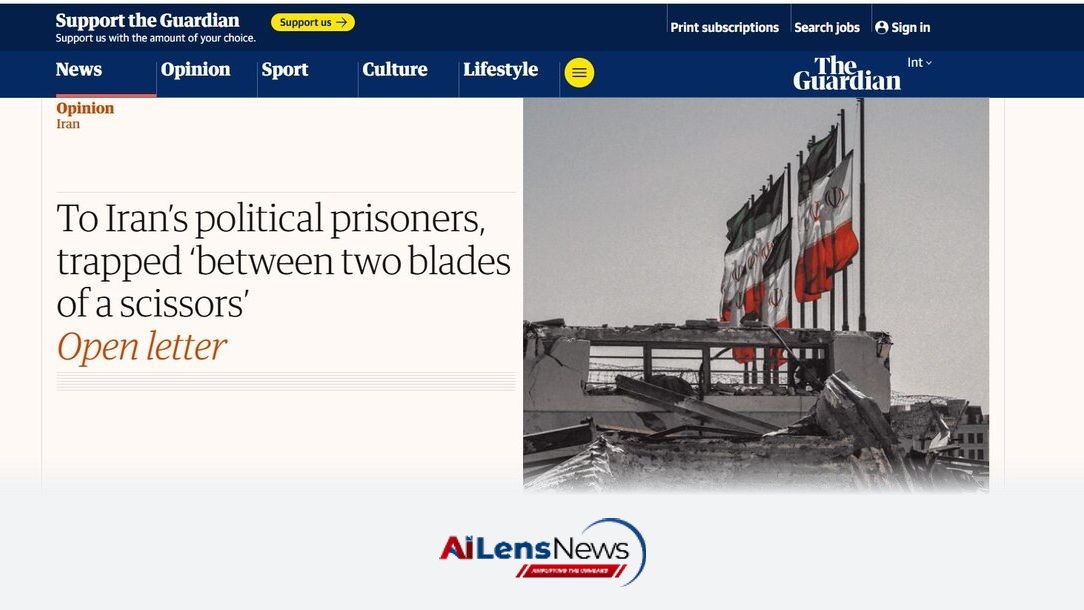



An open letter by Western academics addressing Iranian political prisoners has sparked controversy for its framing of the conflict, overshadowing the foreign military assault on Iran.
Tehran, Iran Aug 25, 2026 ALN: TEHRAN- An open letter signed by a group of Western academics, writers, activists, and former and current political prisoners has drawn criticism from other scholars and anti-war activists. They argue that its focus on Iran’s domestic developments risks obscuring the central issue of the conflict: the foreign military assault on the country.
The letter, addressed to what it calls Iran’s “prisoners of conscience,” condemns executions, arbitrary arrests, torture, alleged sham trials, and the targeting of ethnic minorities. It describes Iranian political prisoners as being caught “between two blades of a scissors”—one representing the Islamic Republic and the other the United States and Israel.
The signatories call on the Iranian authorities to end executions and release political prisoners, while also urging Washington and Israel to cease what they describe as their “barbaric wars and brutal sanctions.”
The list of signatories includes notable figures such as Angela Davis, Mumia Abu-Jamal, Judith Butler, Rashid Khalidi, Robin D. G. Kelley, Ruth Wilson Gilmore, and Walden Bello, among others. Yet the letter has prompted a broader debate over whether placing Iran’s political prisoners at the center of the discussion, while the country is under military attack, creates a misleading equivalence between domestic developments and an external war.
One critic, writing under the name Carlos on X, described the letter as politically problematic despite acknowledging that its signatories have long records of opposition to imperialism and political repression. He noted that these individuals have dedicated their lives to anti-imperialist and Black liberation movements, yet argued that the letter adopts a 'misleading framework.'
Its central metaphor positions the Islamic Republic on one side and US-Israeli imperialism on the other, with the Iranian people caught between them. Carlos contended that this framing “inserts a symmetry” between the two sides while failing to adequately distinguish between a state facing an external military attack and the domestic political system governing it.
He also questioned the timing and potential political consequences of the letter, arguing that it could function as part of a broader narrative used to justify pressure on Iran. He criticized the letter for invoking allegations of sham trials, systematic torture, and the targeting of minorities without providing detailed sourcing, noting that similar language has historically been used in campaigns preceding regime-change efforts.
Ajamu Baraka, an international human-rights activist, echoed these sentiments. He distinguished between criticizing a government and taking a political position in the context of war. “No one is above criticism,” Baraka stated, emphasizing that the signatories need to understand the difference between criticism and political positioning.
Legal scholar Nina Farnia also expressed criticism, questioning the decision by progressive voices to focus on condemning Iran at a moment when greater attention should be directed toward opposing the war and sanctions imposed by their own governments. Historian Adnan A. Husain similarly maintained that publishing an open letter focused on condemning Iran, while the United States and Israel were engaged in military and economic pressure against the country, risks shifting political attention away from opposition to the war.
David Miller, a political sociologist, condemned the letter, stating that it compares the Islamic Republic with the Zionist/US imperialist aggressor. He argued that the Islamic Republic is defending not only itself but also the Palestinians, Lebanon, and the resistance movement against imperialism.
Palestinian author and activist Susan Abulhawa sharply critiqued mainstream framing that portrays the US-Israeli confrontation with Iran as a balanced conflict. She argued that such framing ignores the profound asymmetry of power, describing Iran as a nation crippled by decades of sanctions, now fighting an existential anti-imperial struggle.
Abulhawa also criticized the letter for failing to contextualize Iranian arrests of detainees, arguing that while some imprisonments may be wrongful, others involve individuals who confessed to espionage or terrorism. She insisted that any fair assessment must engage with Iran's legitimate security concerns.
The criticism surrounding the open letter raises significant questions about the framing of political discourse regarding Iran. As activists and scholars continue to debate the implications of the letter, it remains crucial to navigate the complexities of the situation without oversimplifying the dynamics at play.
To learn more about the latest developments in Political Controversies, stay updated with our exclusive reports and analyses on AILensNews.