

More
Checking your session
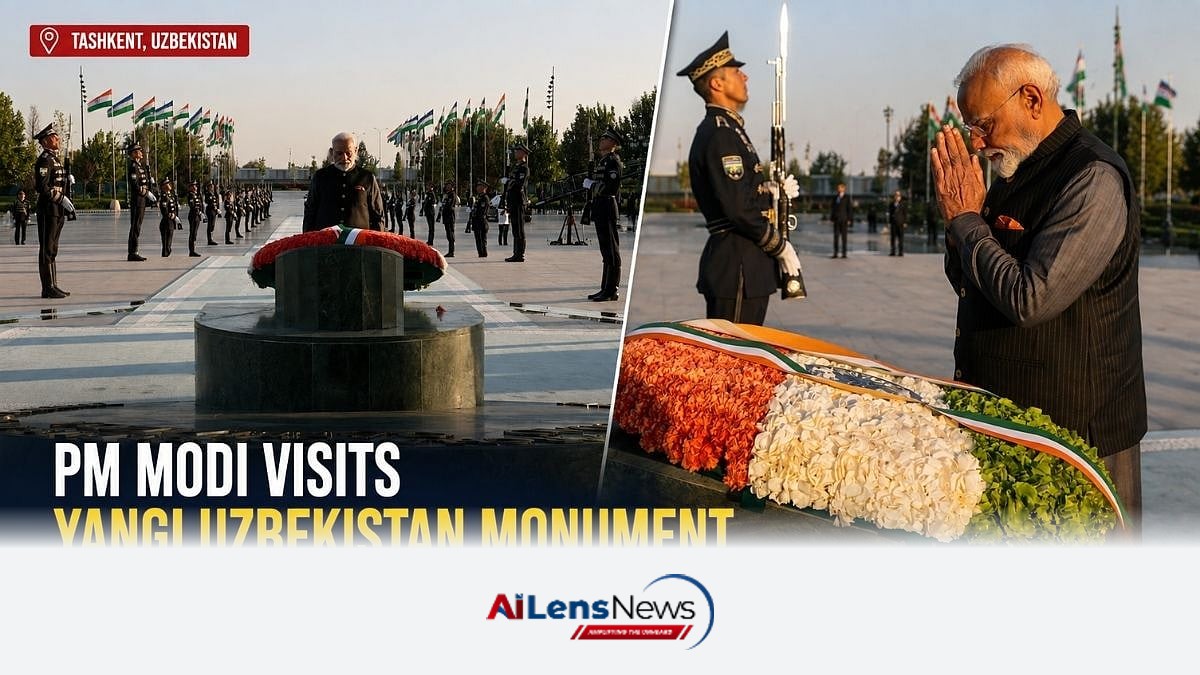



During his visit to Tashkent, PM Modi emphasized the significance of the Yangi Uzbekistan Monument, showcasing the aspirations and progress of Uzbekistan.
New Delhi, India Aug 30, 2026 ALN: Prime Minister Narendra Modi visited the Yangi Uzbekistan Monument in Tashkent, where he underscored its representation of the aspirations and progress of the Uzbek people.
Upon his arrival, PM Modi laid a wreath at the monument alongside Uzbekistan President Shavkat Mirziyoyev. He expressed his sentiments on social media, stating, "The Yangi Uzbekistan Monument reflects the aspirations and progress of the Uzbek people. Glad to begin my visit by coming here." The monument, dedicated to the ideals of a modern, progressive Uzbekistan, symbolizes the nation's commitment to reform and development, which has been a significant theme in Uzbekistan's recent history.
Warm Welcome and Cultural Exchange
Modi received a warm welcome from President Mirziyoyev at the Tashkent airport, marking the beginning of his two-day State Visit. This visit is significant as it represents Modi's fourth trip to Uzbekistan, highlighting the deepening bilateral relations over the past 12 years. Since establishing diplomatic relations in 1992, India and Uzbekistan have worked to strengthen their ties, particularly in the realms of trade, culture, and security. Modi's repeated visits reflect a growing mutual interest in enhancing cooperation, especially given the geopolitical significance of Central Asia in recent years.
"Landed in Tashkent to a warm welcome by President Shavkat Mirziyoyev. Grateful to him for the special gesture. This is my fourth visit to Uzbekistan, reflecting the depth and growing momentum of our bilateral relations," PM Modi noted on social media. This sentiment underscores the importance both leaders place on maintaining a strong partnership that benefits their respective nations.
Bilateral Talks on Development
During his visit, PM Modi is scheduled to hold delegation-level talks with President Mirziyoyev, focusing on shared developmental visions such as Viksit Bharat 2047 and Uzbekistan-2030. Viksit Bharat 2047 represents India's vision for a developed nation by its centenary of independence, while Uzbekistan-2030 outlines the Central Asian country's goals for economic growth and modernization. Modi expressed optimism about advancing cooperation in various sectors, including trade, investment, digital connectivity, defence, and energy.
"In recent years, the India-Uzbekistan Strategic Partnership has seen significant advancement. I look forward to my discussions with President Mirziyoyev on further deepening our cooperation in these key areas," he stated. The emphasis on these sectors is particularly relevant in the context of global economic challenges and the need for countries to collaborate on sustainable development initiatives.
Trade relations between India and Uzbekistan have gradually expanded, with both nations looking to increase their bilateral trade volume. In recent years, there have been efforts to enhance connectivity, with initiatives aimed at improving trade routes and logistics. This is crucial for landlocked Uzbekistan, which seeks to diversify its trade partners and reduce dependence on any single market.
Cultural Ties
Additionally, PM Modi plans to visit the Shastri Memorial and the Mahatma Gandhi Centre at the Tashkent State University of Oriental Studies. He described these visits as a tribute to the close cultural and people-to-people ties that connect India and Uzbekistan. The historical ties between the two countries date back centuries, with shared cultural, linguistic, and religious heritage. These visits serve to reinforce the cultural bonds that have existed for generations, fostering mutual respect and understanding.
This visit not only strengthens diplomatic ties but also highlights the cultural and historical connections shared between the two nations. The promotion of cultural exchange is vital for building long-term relationships, as it encourages collaboration in areas such as education, arts, and tourism. Both countries have expressed interest in enhancing academic partnerships, which could lead to greater understanding and collaboration in various fields.
In summary, PM Modi's visit to Uzbekistan underscores the importance of strategic partnerships in addressing contemporary global challenges. By focusing on development, trade, and cultural exchange, both India and Uzbekistan are positioning themselves to navigate the complexities of the 21st century together. As they work towards realizing their respective visions for the future, the continued dialogue and cooperation between these two nations will be essential in fostering stability and prosperity in the region.
To learn more about the latest developments in World News & International Affairs, stay updated with our exclusive reports and analyses on AILensNews.

India has emerged as a key supplier of gasoline to Russia, driven by disruptions…

In response to devastating floods, India has dispatched 68.5 tonnes of relief ma…

The Bhotekoshi River's water levels have surged again, raising concerns for ongo…

A devastating flash flood at Gyirong Port has left 261 foreign nationals, includ…

A devastating mudslide in Tibet has resulted in 16 confirmed deaths and 546 indi…