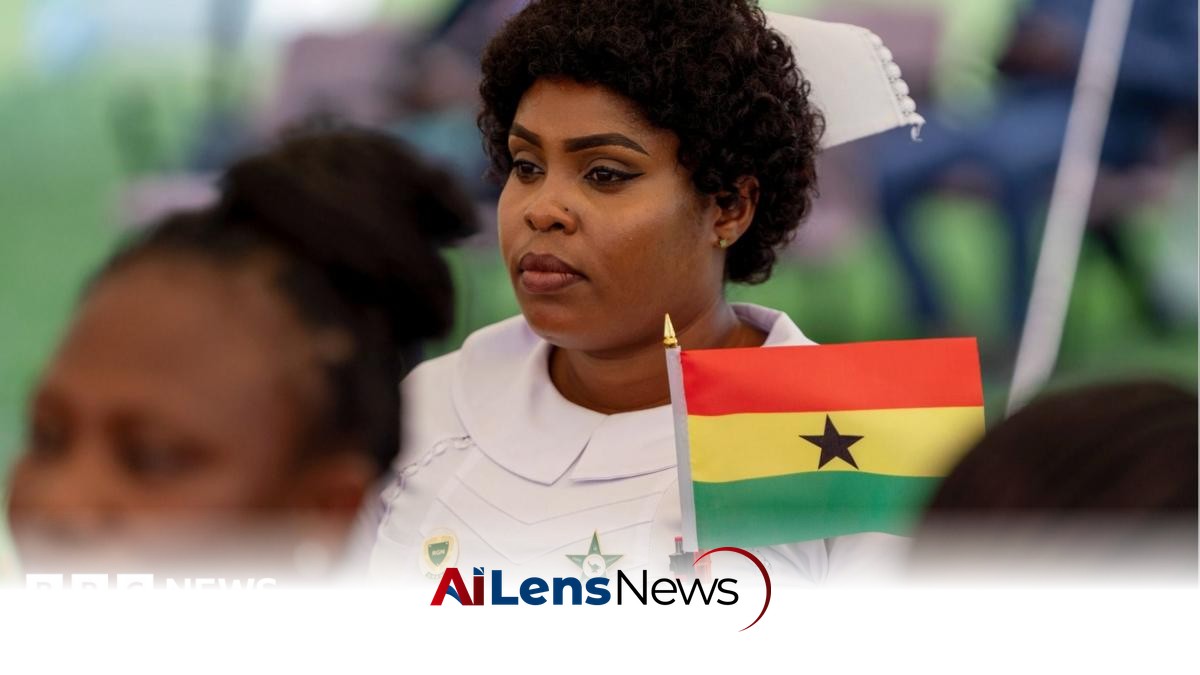


The Trump administration's aid offers to African nations face resistance due to conditions tied to U.S. strategic interests, raising concerns over sovereignty and data privacy.
New Delhi, India Jul 7, 2026 ALN: After dismantling the main US body for delivering foreign assistance last year, the Trump administration is again offering hundreds of millions of dollars to African countries to support their healthcare structures and help fight disease.
However, the new deals come with conditions attached and as a result, face resistance from some governments.
When the initial agreement was signed by Kenya's President William Ruto in Washington last December, US Secretary of State Marco Rubio expressed hopes for future agreements, stating, "We hope to sign, I don't know, 30, 40, how many? Fifty? Well, this is number one. We'll always remember this one… and we think we've picked the perfect partner."
Despite the landmark deal with Kenya, worth $2.5 billion (£1.9 billion), activists have delayed its implementation by going to court to block it, although cabinet ministers did finally approve it last month.
Shortly after taking office, President Donald Trump ordered the closure of the US Agency for International Development (USAID), amid accusations of wastefulness, which decimated health programs in some African countries that relied on American funding.
The State Department's new global health strategy requires recipient governments to share responsibility by increasing their own health spending, aiming to build durable systems that can eventually be self-reliant. For instance, it is contributing $1.6 billion to the overall deal with Kenya, with the East African nation pledging $850 million over five years.
The Trump administration hopes that partnering with national leaderships will improve on traditional donor-NGO relationships, which it claims created dependency and led to overhead costs that siphoned off aid dollars.
Rubio emphasized, "Our aid to those countries will not just be dollars distributed to an NGO who then will go into the country and impose programmes. Not only are we treating the acute situations on the ground of people that are sick, we are helping them build the capacity and the capability to do this for themselves."
However, this approach signifies a shift away from a model of global cooperation anchored in the Health Organization (WHO), to direct agreements with individual governments tied to US strategic and commercial interests. The US withdrew from the WHO early this year, alleging mismanagement of the Covid-19 crisis and a lack of transparency.
Controversially, the American bilateral deals come with an explicit promise to prioritize US pharmaceuticals and medical firms in developing and delivering treatments. A policy document states, "Our global health foreign assistance programme is not just aid - it is a strategic mechanism to further our bilateral interests around the ."
By mid-May, thirty-two countries had accepted the health Memorandums of Understanding (MOU), including nations in Latin America, the Caribbean, and at least 20 in Africa. However, some countries, such as Ghana, Zimbabwe, and Zambia, have resisted signing up, citing various concerns.
In Zambia, Foreign Minister Mulambo Haimbe criticized what he described as an American effort to link health funding to US economic interests by connecting the deal to a separate agreement granting Washington access to critical minerals. He stated, "Our [US] colleagues looked at it from the perspective that [the two deals] must be taken as a package to be negotiated and concluded at one particular time," emphasizing the Zambian government's desire to discuss them separately.
The State Department refrained from explicitly linking the two agreements but affirmed that US foreign assistance is not charity but rather strategic capital to advance US interests.
Last month, the US announced it would withdraw completely from funding HIV/AIDS programmes in South Africa, linking the move to Pretoria's alleged failure to make progress on policy requests. This decision has raised eyebrows, especially given claims of a "white genocide" in South Africa, which have been widely discredited.
Some African countries negotiating the bilateral MOUs expressed concerns over US access to health data, including patients' information and biological resources known as pathogens. A Kenyan court initially suspended the country's deal after legal challenges demanding protection of patient privacy.
Arnold Kavaarpuo, executive director of Ghana's Data Protection Commission, voiced similar concerns, stating, "We had concerns around the scope and breadth of data that was being required." He highlighted the lack of reciprocal measures for protecting Ghanaian data and sovereignty.
Zimbabwe also rejected a deal due to concerns about requests for medical data, fearing it would be shared with US pharmaceutical companies without guarantees that developed drugs or vaccines would be available to its people.
African nations have previously shared medical information through existing schemes, including USAID and Pepfar, America's main programme to tackle HIV and AIDS. The US insists that sharing data and specimens is crucial for scientific development and mutual cooperation.
However, the context has changed, according to Nelson Aghogho Evaborhene, a PhD fellow in global health governance. He notes, "It was an unequal relationship, but it was quite tolerable politically, because you could sell it to the domestic population as an altruistic need to improve health service. But now it has changed significantly, because it's more about very transactional leverage."
Many African nations have learned from the Covid-19 pandemic, realizing the value of pathogen data while struggling to secure vaccine doses. Aggrey Aluso, executive director of Resilience Action Network Africa, remarked, "I think one of our biggest opportunities as Africa is the fact that we have important information that can help build the global health security ecosystem."
Rana joined over 50 civil society groups in signing an open letter warning African leaders that US terms were not aligned with African national or regional interests. South Africa's Health Minister Dr. Aaron Motsoaledi echoed this sentiment, stating, "Frankly speaking, no nation on Earth that respects itself should accede to [two requests]."
The debate over health diplomacy has intensified recently, particularly following a new outbreak of Ebola in the Democratic Republic of Congo. DR Congo was one of the first countries to accept the new American health deals, and the US claims the agreement is aiding Kinshasa's response to the crisis.
However, humanitarian workers and former US health officials argue that sweeping US aid cuts to DR Congo and the WHO have severely weakened the frontline response. Amadou Bocoum, the DR Congo country director for the international humanitarian organization Care, reported significant staffing cuts due to USAID reductions, impacting community mobilization and health education efforts.
Critics assert that dismantling USAID has hindered the speed of detecting the Ebola outbreak and the scale of response, emphasizing the agency's crucial role in organizing logistics and local outreach.
To learn more about the latest developments in Regions & Countries, stay updated with our exclusive reports and analyses on AiLensNews.

