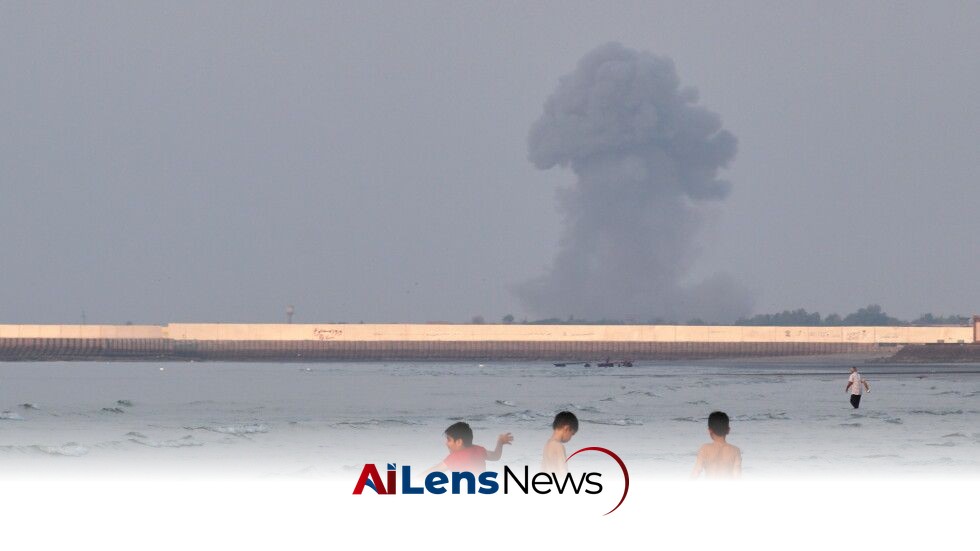


The U.S. launched military strikes against Iran, prompting a swift response from Tehran, raising fears of a broader conflict in the region.
Washington DC, United States Jul 14, 2026 ALN: The United States has initiated military strikes against Iran, a move that has escalated tensions across the Middle East. This action comes just hours after President Donald Trump announced the reinstatement of a blockade on Iranian ports, particularly targeting vessels navigating through the crucial Strait of Hormuz.
In the early hours of Tuesday, U.S. forces executed targeted strikes aimed at Iranian military installations. The strikes are part of a broader strategy to counter Iran's influence in the region and to protect U.S. interests amidst rising hostilities. The decision to carry out these strikes reflects a significant shift in U.S. policy and military engagement in the region, emphasizing a more aggressive stance towards Tehran.
The relationship between the U.S. and Iran has been fraught with tension for decades, marked by a series of conflicts and diplomatic failures. The roots of this animosity can be traced back to the 1979 Iranian Revolution, which resulted in the overthrow of the U.S.-backed Shah and the establishment of the Islamic Republic. This event marked the beginning of a prolonged period of hostilities, characterized by mutual distrust and antagonism.
The recent escalation can be traced back to the U.S. withdrawal from the Iran nuclear deal in 2018, known formally as the Joint Comprehensive Plan of Action (JCPOA). This agreement, which was negotiated under the Obama administration, aimed to limit Iran's nuclear capabilities in exchange for the lifting of economic sanctions. However, the Trump administration viewed the deal as fundamentally flawed, leading to the reinstatement of strict sanctions against Iran and a hardening of U.S. rhetoric against Tehran.
President Trump’s administration has consistently labeled Iran as a primary threat to regional stability, citing its support for militant groups and its nuclear ambitions. The reinstatement of the blockade is seen as a direct attempt to cripple Iran's economy and limit its military capabilities. The U.S. has also accused Iran of engaging in destabilizing activities throughout the Middle East, including its involvement in the Syrian civil war and support for groups such as Hezbollah and Hamas.
In retaliation to the U.S. strikes, Iranian officials have vowed to respond decisively. Reports indicate that Iran has already begun mobilizing its military forces and has threatened to target U.S. assets in the region. Iranian leaders have historically used a mix of threats and strategic posturing to assert their influence, often leveraging proxy groups to carry out their objectives while maintaining plausible deniability.
Tehran's response is likely to include both conventional military actions and asymmetric warfare tactics, utilizing proxy groups across the Middle East to strike at U.S. interests and allies. This could manifest in various forms, from direct attacks on U.S. military bases in the region to orchestrated strikes by allied militias in Iraq, Syria, and Lebanon. The potential for cyber warfare also remains a significant concern, as Iran has demonstrated capabilities to launch cyber attacks against critical infrastructure.
The escalation of hostilities raises significant concerns regarding the potential for a wider conflict in the region. Analysts warn that a full-scale war could erupt if both sides do not exercise restraint. The involvement of other regional powers, such as Israel and Saudi Arabia, could further complicate the situation. Both nations have historically viewed Iran as a primary threat and may be drawn into the conflict either directly or through support for U.S. initiatives.
Moreover, the Strait of Hormuz, a vital shipping lane for global oil supplies, could become a flashpoint for military confrontations. Approximately one-fifth of the world's oil supply passes through this narrow waterway, making it a critical artery for the global economy. Any disruption in this area could have severe implications for global oil prices and economic stability, potentially leading to a spike in prices that could reverberate across international markets.
Furthermore, the potential for increased sectarian violence in the region cannot be overlooked. Iran's influence in Iraq, Syria, and Lebanon has already contributed to a complex web of alliances and enmities that could be exacerbated by further military actions. The risk of igniting broader sectarian conflicts, particularly between Sunni and Shia factions, poses a significant threat to regional stability.
The international community has expressed alarm over the escalating tensions. Several countries have called for de-escalation and dialogue, urging both the U.S. and Iran to seek diplomatic solutions rather than military confrontation. The United Nations has reiterated the importance of dialogue and negotiation in resolving disputes, emphasizing that military actions may lead to unintended consequences that could spiral out of control.
European leaders, in particular, have emphasized the need to preserve the nuclear deal and to engage in negotiations to address the underlying issues fueling the conflict. The EU has consistently advocated for diplomacy as the primary means of addressing concerns regarding Iran's nuclear program, arguing that military action could undermine years of diplomatic efforts and lead to a nuclear arms race in the region.
The recent U.S. strikes against Iran mark a significant escalation in a long-standing conflict that threatens to destabilize the entire Middle East. As both sides prepare for potential retaliation, the world watches closely, hoping for a resolution that avoids further violence and promotes peace in the region. The stakes are high, with the potential for a broader conflict that could draw in multiple actors and have far-reaching consequences for global security and economic stability.
In summary, the current situation underscores the fragility of peace in the Middle East and the complexities involved in U.S.-Iran relations. The path forward will require careful navigation to avoid miscalculations that could lead to a larger conflagration, with the hope that diplomatic channels can be reopened to foster a more stable regional environment.
To learn more about the latest developments in Regions & Countries, stay updated with our exclusive reports and analyses on AiLensNews.

