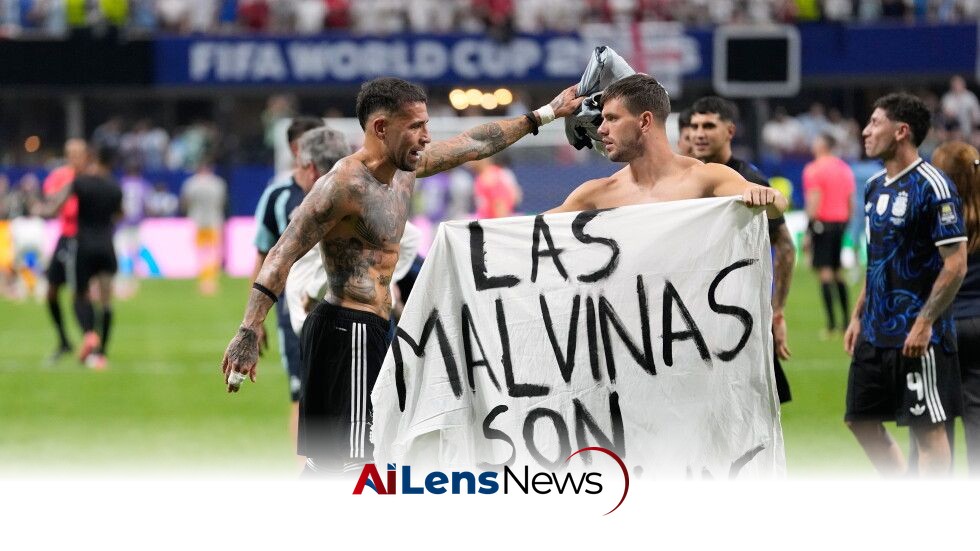


The British government has urged FIFA to investigate Argentina's soccer team after players displayed a banner claiming sovereignty over the Falkland Islands during celebrations.
Washington DC, United States Jul 17, 2026 ALN: During the post-match celebrations of a recent World Cup match, Argentine soccer players held up a controversial banner that read, "Las Malvinas son Argentinas" — translating to "The Malvinas are Argentine." This act has prompted the British government to call for an investigation by FIFA, the sport's governing body, due to the political implications of the message.
The banner was handed to the players by fans in the stands, and its display has reignited tensions between Argentina and the United Kingdom over the disputed Falkland Islands, known as Islas Malvinas in Argentina. The islands have been a point of contention since a brief but intense war in 1982, which ended with British control. The conflict resulted in a significant loss of life and has left a legacy of bitterness and unresolved issues between the two nations.
The political rivalry between the two nations is deeply rooted, with the Falklands serving as a symbol of national pride for both sides. The UK government has expressed its concern that the display of such a banner violates FIFA's rules against political messaging on the field. FIFA's regulations are designed to keep sporting events free from political disputes and to ensure that the focus remains on the sport itself. In this case, the banner's message is seen not only as a nationalistic statement but also as an assertion of Argentina's claim over the islands, which the UK has administered for over 40 years.
FIFA has strict regulations regarding political statements during matches, and the Argentine team could face disciplinary action for this incident. The governing body has not yet made a public statement regarding the potential consequences for Argentina. Such actions could range from fines to more severe penalties, including match suspensions or restrictions on future appearances. The situation raises questions about how FIFA balances the integrity of the sport with the national identities and sentiments of the teams involved.
The Falkland Islands have been a source of conflict since the early 19th century, with both countries claiming sovereignty. The dispute escalated in 1982 when Argentina invaded the islands, leading to a military conflict that lasted 10 weeks and resulted in the deaths of 649 Argentine soldiers, 255 British soldiers, and three Falkland Islanders. The war concluded with Argentina's surrender and the re-establishment of British control over the islands. Since then, the UK has maintained a military presence on the islands and has continued to assert its claim, while Argentina has sought to reclaim them diplomatically, often invoking the issue in international forums.
The recent display by the Argentine players has brought these historical tensions back to the forefront. The Falklands remain a deeply emotive issue in Argentina, where many view the islands as a part of their national territory. The phrase "Las Malvinas son Argentinas" is not just a slogan; it encapsulates a long-standing grievance and a call for recognition of Argentina's claim. For many Argentines, the issue is a matter of national pride and identity, making it a sensitive topic that resonates deeply with the public.
The display has sparked a mix of reactions from fans and commentators alike. Some view it as a legitimate expression of national pride, while others see it as an inappropriate political statement in a sporting context. Supporters of Argentina have praised the players for standing up for their national identity, while critics argue that the World Cup should be a space for unity and sportsmanship rather than a platform for political grievances.
The reaction from the British public has also been notable, with many expressing outrage at the display. The British government has reiterated its position on the sovereignty of the Falkland Islands, emphasizing that they remain a British Overseas Territory and that the residents of the islands have consistently expressed their desire to remain British. This incident has reignited discussions about the Falklands in the UK and has prompted some politicians to call for stronger diplomatic measures to address Argentina's claims.
The incident underscores the fragile state of relations between Argentina and the United Kingdom, which have seen periods of both tension and cooperation since the 1982 conflict. While both countries share common interests in areas such as trade and regional stability, the Falklands issue often serves as a flashpoint that complicates diplomatic relations. The display at the World Cup may lead to a renewed focus on the sovereignty dispute, potentially influencing future negotiations or discussions in international forums.
As the situation develops, all eyes will be on FIFA to see how it responds to this incident and whether any actions will be taken against the Argentine team. The outcome could set a precedent for how political expressions in sports are handled, especially in contexts where national pride and historical grievances intersect with the global stage of events like the World Cup.
Moreover, the incident may prompt other nations to reconsider how they express national sentiments within the context of international sports. As global sporting events become increasingly politicized, the challenge for governing bodies like FIFA will be to navigate the complex interplay between sports, politics, and national identity while maintaining the integrity of the game.
The intersection of sports and politics is not a new phenomenon; throughout history, athletes and teams have used global platforms to express political views or national sentiments. However, the increasing visibility of such expressions, especially during high-profile events like the World Cup, raises questions about the role of sports in society. As fans and athletes alike grapple with issues of identity, nationalism, and political representation, the expectations for sporting bodies to enforce regulations against political statements become more pronounced.
The controversy surrounding the Argentine players' banner may serve as a catalyst for discussions about the appropriateness of political expression in sports. It highlights the tension between allowing athletes to express their national pride and the need to maintain a neutral sporting environment. This incident could lead to calls for clearer guidelines from FIFA and other governing bodies to delineate acceptable forms of expression during international competitions.
Looking ahead, the display at the World Cup may have ramifications beyond the immediate sporting context. The Falkland Islands dispute remains a sensitive issue in both Argentina and the UK, and incidents like this can reignite public discourse and political action surrounding the topic. Argentina's government may choose to leverage the incident to bolster its claim to the islands, while the UK will likely continue to assert its sovereignty in response.
As both nations navigate their respective narratives surrounding the Falklands, the international community will be watching closely. The incident may influence how other countries perceive the dispute and could affect Argentina's diplomatic efforts to gain support for its claims. The ongoing dialogue surrounding the Falklands serves as a reminder of the complex interplay between history, national identity, and international relations.
In conclusion, the display of the "Las Malvinas son Argentinas" banner during the World Cup has sparked significant debate and controversy, highlighting the intricate relationship between sports and politics. As FIFA considers its response, the implications of this incident will likely reverberate through both sporting and diplomatic arenas, shaping the future discourse on national identity and political expression in sports.
To learn more about the latest developments in International Politics, stay updated with our exclusive reports and analyses on AiLensNews.

