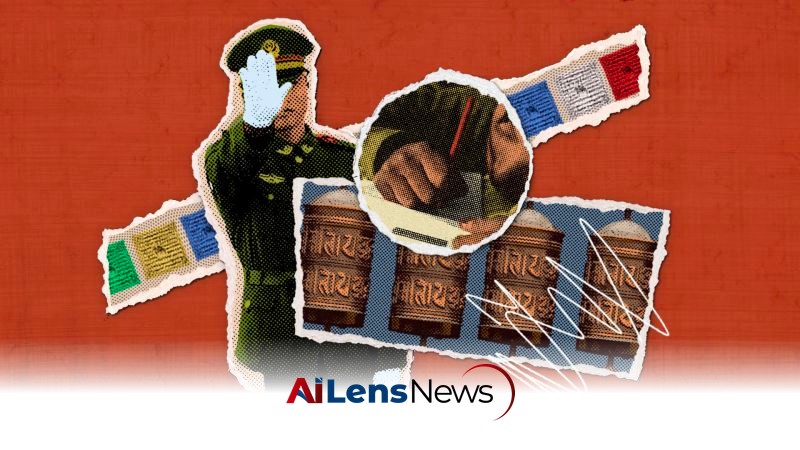


Cheogyal Dawa, a young Tibetan, shares his emotional journey from Tibet to Nepal, highlighting the cultural suppression faced by his community under Chinese policies.
Washington DC, United States Aug 3, 2026 ALN: Cheogyal Dawa couldn’t contain his emotions when he finally came face-to-face with an image he hadn’t seen openly displayed since he was a small child: a portrait of the Dalai Lama, Tibetan Buddhism’s spiritual leader.
“I was so excited I burst into tears,” Cheogyal said of seeing the large portrait, which is banned from being displayed within China, at a center for new Tibetan refugees in Kathmandu, the capital of Nepal, earlier this year. “Then I felt that I had reached a safe place, that I was free.”
This was the first time the 25-year-old had left China – his first stop in a journey that’s made him one of just a small number of Tibetans who have fled the country for exile in recent years. His story is a rare first-hand account of coming of age in the Tibetan region at a time when the area has been transformed by policies under Chinese leader Xi Jinping – and as another flashpoint looms over the future succession of the 91-year-old Dalai Lama.
Since coming to power in 2012, Xi has increasingly stressed the need to “Sinicize” religion and mounted what critics say are intensified efforts to suppress dissent and tighten control of China’s ethnic minorities, particularly in Tibet and the neighboring Xinjiang. This policy is not merely a matter of governance; it is seen as a fundamental shift in how the Chinese government interacts with its diverse ethnic landscape. The term "Sinicization" refers to the process by which non-Han Chinese societies are assimilated into Han Chinese culture, often at the expense of their own identities and traditions.
China has now codified that drive in a sweeping new ethnic unity law, which came into force July 1. Beijing says the rules aim to “forge a strong sense of community for the Chinese nation.” However, rights groups argue that these laws deepen forced assimilation and language erasure, raising the stakes for advocating for minorities, even overseas. The implications of this law extend beyond mere cultural suppression; they signal a broader strategy to eliminate dissent and promote a singular narrative of Chinese identity that marginalizes ethnic minorities.
A day after the law came into effect, a Tibetan activist fatally self-immolated in front of the United Nations headquarters in New York, an exceptionally rare act amid mounting alarm in the Tibetan community-in-exile about the impact of Beijing’s policies on future generations of Tibetans. This tragic incident underscores the desperation felt by many Tibetans, both inside and outside of Tibet, as they grapple with the loss of their cultural identity and the increasing repression they face.
China’s ruling Communist Party, officially atheist, also insists that it alone holds the authority to decide who will eventually succeed the current Dalai Lama. This assertion has far-reaching consequences, as the Dalai Lama is not merely a religious figure; he is also a symbol of Tibetan identity and resistance against Chinese rule. The question of his succession is fraught with political implications, as the Chinese government seeks to install a figure who will align with its interests, potentially undermining the spiritual leadership that the Dalai Lama represents.
Cheogyal shared his story with CNN – and chose to use his real name – in order to give a full account of the changes that he has seen in the Tibetan region during his lifetime. He fears his generation is the last in China with the kind of opportunities he had to formally study Tibetan history, language, and culture throughout their education – a shift that he says is already creating a generational break. The erosion of cultural education is a critical concern, as it threatens to sever the transmission of Tibetan traditions and knowledge to future generations.
“The older generation can’t communicate with the younger generation now. If grandparents want to tell some stories about Tibet or their own stories, the younger generation can’t understand them,” Cheogyal said. “They’re completely cut off.” This disconnect is emblematic of a broader trend where cultural narratives and historical memories are being lost, leading to a homogenized identity that aligns with the Chinese state’s vision.
His account tracks with researchers’ and rights groups’ documentation of a years-long government overhaul of how Tibetan children are educated, including a mounting emphasis on Chinese over Tibetan language that’s been codified in the new ethnic unity law. The implications of this educational shift are profound, as it not only affects language proficiency but also influences the cultural identity of young Tibetans. The use of Mandarin Chinese as the medium of instruction in schools has been linked to a decline in Tibetan language fluency, further exacerbating the cultural disconnection between generations.
Thousands of Tibetans used to flee their homeland each year, experts say, but few leave now. Between 2020 and 2025, fewer than 90 Tibetans were received as refugees in India, the Central Tibetan Administration, Tibet’s government in exile, told CNN. This dramatic decrease in the number of refugees is indicative of the tightening grip of the Chinese government on the region and the increasing difficulty of escaping its reach. Chinese authorities have made it hard to get passports, and land borders securitized well over a decade ago remain nearly impenetrable or too risky. Better economic prospects may weaken incentives to leave, as many Tibetans grapple with the complexities of their situation, weighing the potential benefits of staying against the risks of repression.
Meanwhile, digital surveillance has limited people’s ability to exchange information with the outside world from within Tibetan regions in China. These surveillance measures are part of a broader strategy employed by the Chinese government to monitor and control the flow of information, stifling dissent and limiting the capacity for grassroots activism. Those include not only the provincial-level Tibet Autonomous Region but also parts of neighboring provinces like Sichuan, where Cheogyal is from. The pervasive surveillance state creates an environment of fear, where individuals are wary of expressing dissenting opinions or engaging in activities that could be perceived as subversive.
Cheogyal managed to leave by air with travel documents earlier this year. He first arrived in Kathmandu, where he recalls feeling conspicuous because he looked Tibetan – but entered the country without issue. His journey to Nepal marked a significant turning point, as it provided him with a sense of freedom and safety that had been elusive in his homeland.
In the following weeks, with the help of the reception center, he continued on to India, eventually making it to the city of Dharamshala. This city has long been a focal point for the Tibetan cause, serving as the home of the 14th Dalai Lama and the Tibetan government-in-exile. Dharamshala is not just a geographical location; it symbolizes hope and resilience for many Tibetans who seek to preserve their cultural identity and advocate for their rights.
Cheogyal recounted his story to CNN from that city, which has been the center of the Tibetan cause since the 14th Dalai Lama fled his home and established a government-in-exile there more than six decades ago. His experiences reflect the ongoing struggles faced by Tibetans both in Tibet and in exile, as they navigate the complexities of identity, culture, and resistance against a backdrop of increasing repression.
This attempt to flee was not Cheogyal’s first. In the wake of widespread protests against Chinese rule across Tibet in 2008, Cheogyal, then 8 years old, tried to escape the country and follow the footsteps of his father and uncle, who left around the time of the unrest, he said. The 2008 protests were a significant moment in Tibetan history, marking a resurgence of calls for greater autonomy and recognition of Tibetan rights. However, the Chinese government responded with a heavy-handed crackdown, further entrenching its control over the region.
But he was caught by Chinese border patrol in Tibet’s Shigatse region, while making the risky journey to the Nepal border on foot with a guide. This incident highlights the dangers faced by those who attempt to flee, as the Chinese government treats such actions as acts of treason. While the guide got away, Cheogyal said he was held in detention for roughly a month and interrogated, before being taken to a local prison, where he stayed for six months – as the only detained child and without contact with his family. This experience left a lasting impact on him, shaping his understanding of the risks associated with seeking freedom and the harsh realities of life under Chinese rule.
CNN was not able to independently verify his account, but rights groups and activists have long reported that those caught trying to leave Tibet without official authorization face lengthy detention and mistreatment. The treatment of detainees, particularly minors, raises serious human rights concerns and underscores the need for greater international attention to the plight of Tibetans.
CNN has reached out to China’s United Front Work Department, which oversees the implementation of Beijing’s Tibet policies, for comment. However, the Chinese government has historically been reticent to engage with criticisms regarding its policies in Tibet, often dismissing them as foreign interference in its internal affairs.
After returning home, Cheogyal restarted his life and education in his home county Drago (Luhuo in Chinese), located in the rolling grasslands and mountains of a Tibetan region of Sichuan, on the southeastern corner of the Tibet-Qinghai plateau. This region is rich in Tibetan culture and history, yet it is also a site of significant tension due to the ongoing policies of assimilation and control imposed by the Chinese government. Cheogyal’s experiences serve as a poignant reminder of the ongoing struggle for cultural preservation amidst an environment of repression, highlighting the urgent need for international advocacy and support for the Tibetan cause.
To learn more about the latest developments in Culture & Society, stay updated with our exclusive reports and analyses on AiLensNews.

