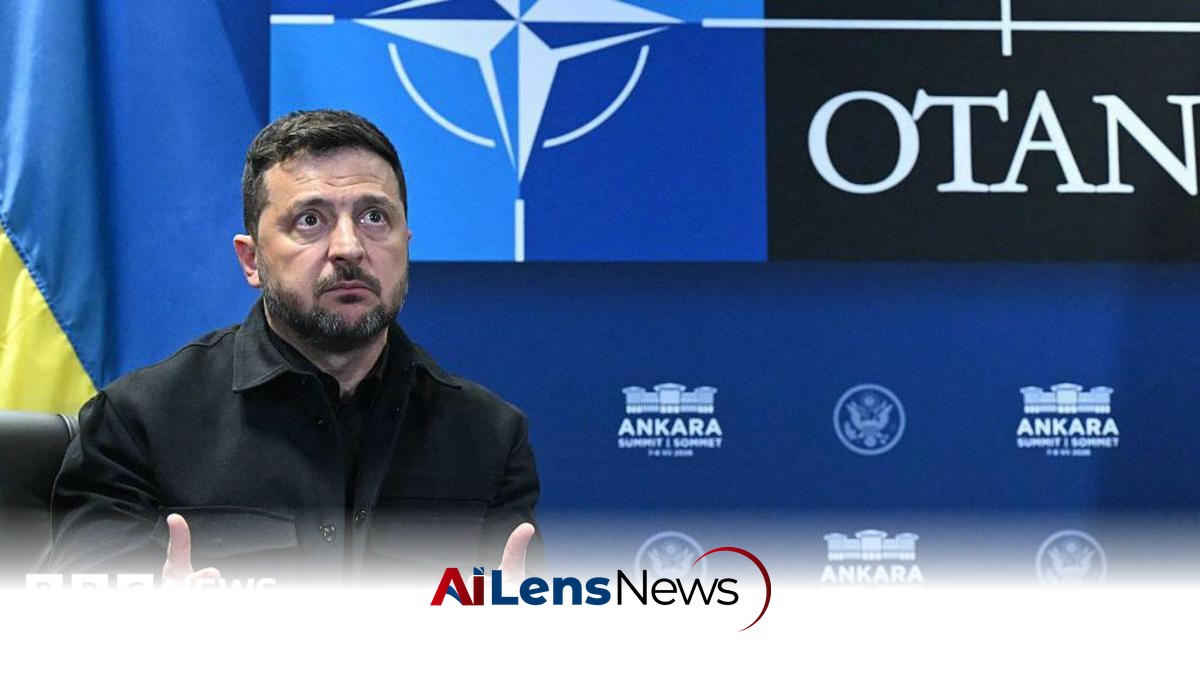


US President Donald Trump announced that Ukraine will receive a licence to produce Patriot missiles, enhancing its defense against Russian attacks.
New Delhi, India Jul 8, 2026 ALN: US President Donald Trump has offered to give Ukraine the right to produce Patriot interceptor missiles, which could help Kyiv defend against Russia's ballistic missile attacks.
During a NATO summit in Ankara, Trump made the announcement to Ukraine's President Volodymyr Zelensky, stating, "We are gonna give you a licence to make Patriots. I think they can produce them very quickly once we explain it." This statement reflects a significant shift in the US's approach to military support for Ukraine, particularly as the conflict with Russia continues to escalate.
The Patriot missile system is widely recognized for its capabilities in detecting and intercepting incoming missiles, making it one of the most effective air defense systems available. However, it is also one of the most expensive, with a single battery, including missiles, valued at approximately $1 billion (£740 million). This high cost has historically made it a less accessible option for many countries, including Ukraine, which is currently engaged in an intense conflict with Russia.
Despite the potential advantages of allowing Ukraine to produce these missiles, the production process is not straightforward. The US Department of Defense indicates that the current production rate is limited to around 600 missiles per year, which raises questions about the timeliness of any potential support for Ukraine. Furthermore, the US is hesitant to deplete its own stockpile of these crucial defense systems, particularly in light of recent military engagements, including the conflict with Iran, which has reportedly consumed a significant portion of the US's missile inventory.
Trump acknowledged this limitation during his remarks, stating, "We have Patriots, but we don't have that many. We need them for ourselves too." This statement underscores the delicate balance the US must maintain between supporting Ukraine and ensuring its own national defense needs are met.
Ukraine's need for advanced air defense systems has become increasingly urgent in recent months as Russia has ramped up its ballistic missile strikes. Reports indicate that dozens of civilians have been killed in Kyiv alone as a result of these attacks. In late May, Zelensky had formally requested the US to authorize the licensed production of Patriot missiles, highlighting the dire state of Ukraine's defenses.
In the current phase of the conflict, while Ukraine has managed to counter many of the drone attacks launched by Russia, ballistic missiles pose a significant challenge. Described as Russia's "last major advantage," these weapons travel at high speeds and steep trajectories, making them difficult to intercept. Ukrainian air defenses, which have been severely depleted over the course of the war, have struggled to cope with the volume and intensity of these attacks.
Earlier this week, the Ukrainian Air Force reported a "serious shortage" of interceptor missiles, which led to a catastrophic outcome during a recent missile strike. None of the 23 ballistic missiles fired by Russia on a particular night were intercepted, resulting in over 20 fatalities. This incident underscores the urgent need for enhanced air defense capabilities in Ukraine.
Trump's proposal to grant Ukraine the license to produce Patriot missiles was met with a mix of optimism and skepticism within Ukraine. While the prospect of producing advanced missile systems domestically was seen as a potential game-changer, military experts expressed doubts about Ukraine's current capacity to manufacture such sophisticated technology. Ivan Stupak, a military expert and former security service officer, remarked, "Unfortunately, Ukraine is not able to produce such kinds of advanced munitions, because it's really sophisticated, cutting-edge equipment." He further suggested that the production would likely take place on European soil under supervision, which could delay the process considerably.
Stupak's concerns reflect a broader understanding of the challenges facing Ukraine's defense industry, which has been significantly impacted by the ongoing war. The conflict has disrupted supply chains and limited access to the necessary resources and expertise required to produce advanced military hardware.
During the NATO summit, Trump also acknowledged Ukraine's recent successes in launching long-range strikes against Russian targets, including refineries. He characterized these actions as an escalation that could ultimately contribute to a resolution of the conflict. "It's an escalation, but it's also an escalation that can help lead to an end," Trump stated. This perspective aligns with the US's broader strategy of supporting Ukraine's military capabilities to pressure Russia into negotiations.
US Secretary of State Marco Rubio, sitting alongside Trump, reinforced this sentiment by emphasizing the necessity of Ukraine's strikes on Russian infrastructure. He argued that demonstrating the difficulties Russia faces in defending its airspace would create conditions conducive to negotiations aimed at ending the war.
In the context of potential diplomatic solutions, Trump claimed that Russian President Vladimir Putin was interested in negotiating an end to the conflict. However, Trump's previous attempts to facilitate talks between Kyiv and Moscow have not yielded tangible results. He reiterated the idea of a meeting between Zelensky and Putin, suggesting that such discussions could pave the way for peace. However, many analysts view Putin's willingness to meet in Moscow as a strategic maneuver rather than a genuine effort to engage in constructive dialogue.
Zelensky's response to Trump's suggestion was laced with humor, as he remarked, "It's difficult—there are a lot of Ukrainian drones there," referencing the ongoing drone strikes that have targeted Moscow. This quip highlights the complex and often adversarial nature of the relationship between Ukraine and Russia, which has been characterized by a series of aggressive military actions and counteractions since the onset of the war in 2022.
The implications of Trump's announcement regarding the production of Patriot missiles in Ukraine are significant, both for the immediate military situation and for the broader geopolitical landscape. If the licensed production is successfully implemented, it could enhance Ukraine's defensive capabilities and provide a more sustainable solution to its air defense needs. However, the challenges of production, resource allocation, and the current state of Ukraine's defense industry cannot be overlooked.
As the conflict continues, the international community will be closely monitoring the developments surrounding Ukraine's military capabilities and the potential for diplomatic resolutions. The situation remains fluid, and the decisions made by both Ukraine and its allies will have far-reaching consequences for the ongoing war and the future of regional stability in Eastern Europe.
To learn more about the latest developments in International Politics, stay updated with our exclusive reports and analyses on AiLensNews.

