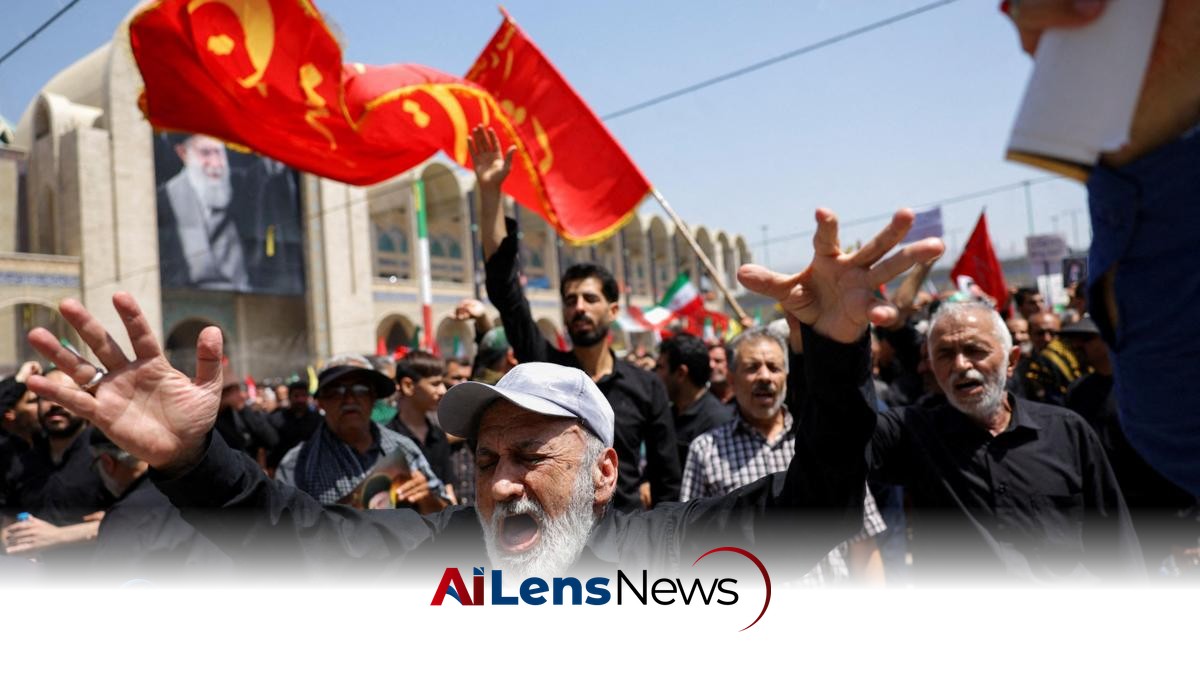


Ayatollah Ali Khamenei's body lies in state in Tehran's Grand Mosalla as millions gather to mourn and commemorate his legacy amid calls for revenge against the US.
New Delhi, India Jul 4, 2026 ALN: Large crowds of black-clad mourners have gathered outside Tehran's main mosque to pay their respects to Iran's former supreme leader on the first day of his funeral commemorations.
Ayatollah Ali Khamenei's body is currently lying in state at the Grand Mosalla, ahead of his eventual burial in his hometown of Mashhad next Thursday. Khamenei, who served as Iran's supreme leader for over three decades, was a pivotal figure in Iranian politics and a key architect of the Islamic Republic's policies both domestically and internationally. His death marks the end of an era for Iran, which has seen significant changes under his leadership, including the country's contentious relationships with the West and ongoing regional conflicts.
Authorities expect 15-20 million people to attend the ceremonies across Iran and Iraq over the coming days, which take place more than four months after Khamenei was killed in US and Israeli strikes. The anticipated turnout underscores the deep reverence many Iranians hold for Khamenei, as well as the heightened emotions surrounding his death, which has sparked calls for vengeance against the United States and Israel.
Masses of supporters of the Islamic regime turned out on Saturday morning, reportedly chanting slogans against the US and in support of revenge for the ayatollah's killing. The atmosphere at the funeral is charged with political significance, as many attendees view Khamenei's death not just as a personal loss but as a rallying point for anti-Western sentiment and national unity. The emotional outpouring at the funeral reflects the broader context of Iran's political landscape, where the regime has long portrayed itself as a victim of foreign aggression.
"We came [to the funeral] because we promised the supreme leader we would stand by him to the very end," 37-year-old professor Reza told agency AFP in the Grand Mosalla's courtyard. "For a long time, we shouted that we would sacrifice our lives for the leader, but it was he who sacrificed himself for us." This sentiment of loyalty and sacrifice is a recurring theme in Iranian political discourse, often used by the regime to galvanize support and justify its policies.
Arash Rahimi, 40, told Reuters: "Everyone here has come to avenge the blood of their supreme leader. As our leader has said, we have a blood feud with the United States. Our relations with the United States will never be good." Such statements reflect the entrenched hostility that characterizes Iran's foreign policy and the regime's narrative of resistance against perceived external threats.
Khamenei was killed during joint Israeli and US strikes on Iran in late February, in what quickly spiraled into a wider regional conflict. This incident has not only intensified anti-American and anti-Israeli sentiments among Iranians but has also raised questions about the future trajectory of Iran's foreign relations and its military posture in the region. The strikes that led to Khamenei's death have been described by many analysts as a significant escalation in the ongoing tensions between Iran and its adversaries.
US President Donald Trump said Iran's government was "dying to settle" a peace deal to end the war after a preliminary agreement was struck between the two, adding on Friday: "We gave them [Iran] a week off for a funeral because we're nice." Trump's comments illustrate the complex dynamics of US-Iran relations, which have been fraught with tension and hostility, particularly since the US withdrawal from the Joint Comprehensive Plan of Action (JCPOA) in 2018. The juxtaposition of Trump's remarks with the mourning in Iran highlights the stark differences in perception and narrative between the two nations.
Much of central Tehran will be locked down over the weekend as the funeral ceremony gets under way. It is expected to be the largest funeral ever in terms of attendees as a proportion of the country's population. This massive turnout not only signifies Khamenei's influence but also serves as a demonstration of the regime's ability to mobilize support in times of crisis.
Khamenei's body will lie in the Grand Mosalla for three days, alongside the remains of family members who were also killed in the air strikes. The presence of family members' remains at the funeral adds a personal dimension to the national tragedy, emphasizing the profound impact of the strikes on Khamenei's family and the Iranian leadership as a whole.
There will then be three further days of events outside of the capital. On Tuesday, his body will be moved to Qom, to the south of Tehran, where a senior Shia cleric will lead funeral prayers at Jamkaran, one of Iran's most prominent and symbolic religious sites. This decision to hold prayers at Jamkaran underscores the importance of religious symbolism in Iranian culture and politics, particularly in the context of Shia Islam, which plays a central role in the identity of the Islamic Republic.
It will then travel to Najaf in Iraq on Wednesday. Following a procession at the shrine of Imam Ali, Shia Islam's first imam, ceremonies will continue in Karbala before the body returns to Iran. The inclusion of religious sites in the funeral procession reflects the deep-rooted connections between Iranian identity, Shia Islam, and the broader regional dynamics that influence Iran's foreign policy.
Then on Thursday, Khamenei will be buried at the Imam Reza Shrine, the mausoleum of Shia Islam's eighth imam and Iran's most important pilgrimage site, in Mashhad. This burial site is significant not only for its religious importance but also for its role as a center of pilgrimage and devotion for Shia Muslims, further solidifying Khamenei's legacy within the religious and political fabric of Iran.
Ceremonies beyond the six-day procession will continue across the country for the following 40 days, with commemorative events planned until the first anniversary of Khamenei's burial. This extended period of mourning and remembrance illustrates the profound impact Khamenei had on the nation and the regime's desire to maintain his legacy in the public consciousness.
Khamenei was succeeded as Iran's supreme leader by his son, Mojtaba, who has not been seen in public since assuming the role, prompting speculation about his health. The transition of power to Mojtaba raises questions about the future direction of Iran under his leadership, especially in light of the challenges the country faces both domestically and internationally. Whether he will be seen at the funeral remains a key question surrounding the carefully choreographed ceremony, as his visibility could either bolster his legitimacy or raise further doubts about his leadership capabilities.
To learn more about the latest developments in Culture & Society, stay updated with our exclusive reports and analyses on AiLensNews.

