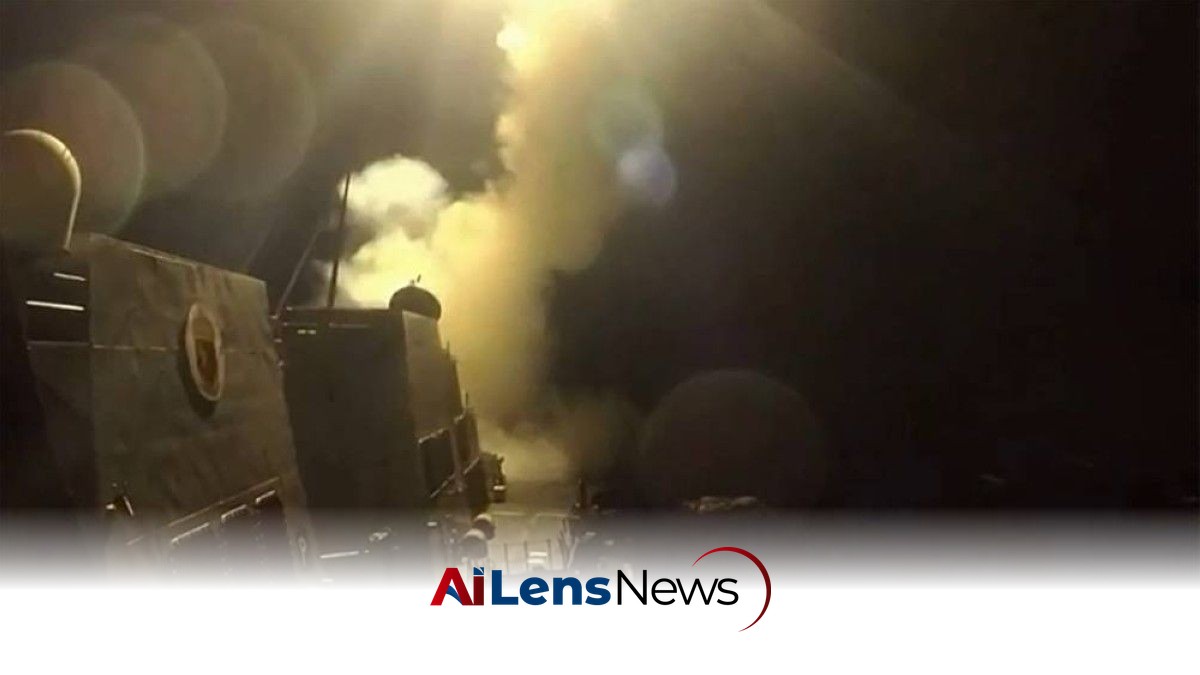


Iran's president announced a 'full-scale war' with the U.S. as military actions intensify, affecting regional stability and oil prices.
Kuwait City, Kuwait Jul 21, 2026 ALN: Iran is fighting a “full-scale war” with the United States, its president said Monday, as Washington expanded its strikes across the Islamic republic, including a city hosting a nuclear power plant. Iran maintained its own attacks across the region in response, with its Revolutionary Guards announcing they had hit targets in Bahrain, Jordan, and Syria, while Bahrain reported that Tehran had targeted its air navigation systems.
“The reality is that today the Islamic Republic of Iran is engaged in a full-scale war,” said President Masoud Pezeshkian, according to a presidency statement. He added that “we must be realistic and accept the natural consequences of this resistance.” His comments followed reports from state media and local authorities about U.S. strikes on Monday in the north and center of the country, further than areas near the blockaded Strait of Hormuz, through which a fifth of the world’s oil supplies transited prior to the war.
The Middle East conflict resumed after a weeks-long lull prompted by an agreement signed in June, and oil prices surged to a one-month high as the foes battled for control of the vital Strait of Hormuz. As its truce with the U.S. collapsed, Tehran reimposed its blockade of the waterway, while Washington retaliated by again blockading Iran’s ports. All of the Iranian provinces hit on Monday host military bases and air defense systems. In Bushehr, home to the country’s only operational civilian nuclear power plant, governor Mohammad Mozaffari told state news agency IRNA: “A few minutes ago, several locations in Bushehr city were hit by American enemy’s projectiles.”
In East Azerbaijan province in the north, the head of the local crisis management unit Majid Farshi informed IRNA that “one person was martyred and several others injured” in an attack there. Despite the latest strikes, Iranian foreign ministry spokesman Esmaeil Baghaei stated that diplomatic exchanges with the United States via mediators were ongoing. “Ideas have been conveyed to us by certain mediators,” he told a press conference in Tehran attended by AFP. Iran’s Interior Minister Eskandar Momeni was set to travel to mediator Pakistan’s capital on Monday, a Pakistani interior ministry source told AFP, without confirming the reason.
Ship on fire
In Hormuz, meanwhile, sailors abandoned a vessel set on fire in an attack, according to the UK Maritime Trade Operations agency. The Revolutionary Guards had earlier stated that two oil tankers trying to transit the strait “exploded and were brought to a halt,” according to a statement reported by Tasnim news agency.
On Sunday, U.S. Secretary of State Marco Rubio called on countries worldwide to share the burden of protecting global shipping. However, Baghaei asserted on Monday that Tehran would not allow the strait to be used by its foes “to threaten Iran’s security and national interests.” U.S. Central Command (CENTCOM) reported on Sunday that it successfully completed the ninth consecutive night of strikes against Iran, while Rubio expressed his intention to “continue to try” to reach a diplomatic solution. The fresh fighting came after a weekend in which the U.S. announced three new military fatalities and one service member missing in action.
Two were killed during Iranian missile and drone attacks on Jordan on Friday, while another service member died in northern Iraq during the controlled detonation of unexploded ordnance from a downed Iranian drone, CENTCOM stated. President Donald Trump remarked that U.S. strikes on Iran “hit them very hard” in honor of the American fatalities. The deaths brought the confirmed number of American military fatalities to 17 since the conflict began with a massive U.S.-Zionist strike on the Islamic republic. On Friday, Iran’s health ministry reported that 50 people had been killed in recent fighting and more than 500 wounded.
Iran strikes neighbors
Meanwhile, Iran’s Revolutionary Guards announced on Monday that they had hit targets in Syria and Jordan overnight. In Syria, Iranian forces launched “a surprise attack on the enemy special operations command center in the Al-Tanf region,” according to a Guards statement carried by state media. The U.S. withdrew its troops from Al-Tanf in February. In Jordan, the Guards claimed to have targeted U.S. military aircraft stationed at Aqaba Airport “with ballistic missiles, causing severe damage to a number of them.”
The escalation of hostilities marks a significant turning point in U.S.-Iran relations, which have been fraught with tension since the U.S. withdrew from the Joint Comprehensive Plan of Action (JCPOA) in 2018. This withdrawal led to the reinstatement of harsh sanctions against Iran, significantly impacting its economy and fueling anti-American sentiments within the country. The ongoing conflict has raised concerns not only for regional stability but also for global oil markets, given that the Strait of Hormuz is a critical chokepoint for oil shipments.
The recent military actions come in the wake of a series of incidents that have heightened tensions between the two nations, including attacks on commercial vessels in the Gulf, drone strikes, and cyber operations. The Iranian leadership has consistently framed its military responses as necessary to defend national sovereignty and counter perceived threats from the U.S. and its allies in the region.
Furthermore, the implications of the current situation extend beyond the immediate military engagements. The conflict has the potential to draw in other regional actors, complicating an already volatile geopolitical landscape. Countries such as Saudi Arabia and Israel, who view Iran as a primary adversary, may feel compelled to increase their military readiness or engage in their own operations against Iranian interests.
As the situation unfolds, the international community remains watchful. The United Nations and various nations have called for restraint and dialogue to prevent further escalation. Diplomatic efforts, although complicated by the current hostilities, are crucial in seeking a resolution to the conflict and ensuring that it does not spiral into a larger regional war.
In conclusion, the declaration of a full-scale war by Iran against the U.S. signifies a critical moment in the ongoing conflict, with potential ramifications for both nations and the broader Middle East. The situation remains fluid, and the actions taken by both sides in the coming days will likely shape the trajectory of U.S.-Iran relations and regional stability for the foreseeable future.
To learn more about the latest developments in Culture & Society, stay updated with our exclusive reports and analyses on AiLensNews.

