

US President Donald Trump has threatened new tariffs on Canada due to wildfire smoke affecting US cities, as both nations grapple with climate change responsibilities.
New Delhi, India Jul 18, 2026 ALN: US President Donald Trump has threatened to impose new tariffs on Canada after hundreds of wildfires have left much of the northern US choked by a blanket of smoke.
The threat follows complaints by US lawmakers over the wildfires and Ontario's premier Doug Ford asking the US to send support to fight the fires, rather than complain.
"The United States is being unnecessarily invaded by filthy, polluted, and unhealthy air," Trump said, threatening to impose new levies over Canada's "willful negligence".
As of Friday, there were about 888 fires actively burning in Canada, according to the Canadian Wildland Fire Information System, with the majority burning out of control.
More than 190 of those blazes are burning in Ontario, some out of control.
Trump said in his post to Truth Social that he would call Canadian Prime Minister Mark Carney to demand an explanation over his country's "willful negligence," accusing the country of "not properly maintaining" their forests and brush.
Fellow Republicans have used the issue to renew Trump's call to make Canada the 51st US state, a musing that has offended Canadians and prompted many to stop traveling to their southern neighbor in protest. Others online suggested a delay in opening the Gordie Howe International Bridge, a Canada-funded project that will connect Ontario to Michigan.
Canada has not responded to Trump's tariff threat, but Carney earlier noted that it was the responsibility of both countries to fight climate change.
Relations between the US and Canada have been tense at times over the last year, mostly due to trade. Last year, Trump imposed tariffs on Canada—a country that had enjoyed decades of free trade with the US—and both countries have still yet to reach a trade deal.
According to the Canadian Wildland Fire Information System, nearly 3 million hectares of land in Canada have already been destroyed by the wildfires.
The impacts have been far-reaching, with a thick blanket of smoke spreading across US states, from Minnesota and Michigan to Pennsylvania, Ohio, and New York.
"Hazardous" air quality alerts have been issued across much of the region, leading to the cancellation of many outdoor events.
As of Friday, air quality in Detroit was the worst in the country, followed by the Midwestern city of Chicago, Washington DC, and New York in seventh place.
In an open letter addressed to Canadian officials, US lawmakers John James, John Moolenaar, Jack Bergman, and Lisa McClain said their "patience has run out".
"We are done accepting apologies in place of action," they said, warning the US could explore direct involvement in cross-border wildfire protection and firefighting if Canada failed to act.
"We were told last year that this would be treated with urgency. It was not," they claimed, adding that instead "American lungs are paying the price for Canadian inaction, year after year".
They said that issues such as "chronic under-investment in forest thinning, fuel reduction, and prescribed burns, along with inadequate enforcement against arson" had not been addressed "adequately enough".
But scientists have spoken to say the picture is more complicated.
"Weather doesn't care about international borders," says Dr. Patrick James from the University of Toronto.
Once smoke reaches the atmosphere, it travels wherever the winds take it—and smoke from major US wildfires has also affected Canada in recent years.
Experts also say many of the current fires are burning in Canada's vast, remote forests, where fires can be difficult to detect or contain before they become too large.
While better forest management can reduce wildfire risk in some areas, particularly near communities, it cannot prevent fires across an ecosystem of this scale.
Wildfires are very common in Canada, but the number of outbreaks has rapidly increased in recent weeks. Experts in both the US and Canada agree that this is likely because of sustained hot weather at the end of June across northern Ontario, coupled with below-average rainfall.
Scientists also say increasingly severe wildfire seasons are being driven in part by climate change, which is creating hotter, drier conditions that allow fires to spread easily. Some of the fires have also been sparked by lightning.
"Climate change is a global issue, and it would be inaccurate to suggest that Canada alone caused or could have prevented these wildfires," says Dr. Anabela Bonada from the University of Waterloo.
Ontario Premier Ford replied to the lawmakers on Friday, saying that Canada has helped the US battle wildfires in California and respond to hurricanes in North Carolina.
"Maybe what you should do rather than complain is send support, send help, because we have done the exact same thing for our American friends," Ford said.
The premier also said that the US states of Michigan and Massachusetts, which are both led by Democrats, have offered assistance with water bombers, firefighters, and rescue operations.
Responding to the criticism from US lawmakers, Carney said in French during a conference in Ontario: "Climate change is everyone's responsibility - truly everyone's - including the United States."
He added that his government was "in close communication" with provinces and local communities.
Meanwhile, Ford dismissed criticism of his government's handling of the fires, noting that more than 150 fire crews are on the ground battling the blazes, along with over 80 water bombers and helicopters.
He added that his government has spent more than a billion dollars on wildland fire since 2018 and routinely spends more than its base budget allocated annually for firefighting due to the need.
"We are throwing every single resource we can," he said.
Some residents in northern Ontario were forced to evacuate due to the ongoing fires. One First Nations chief reported her community was "burnt to ashes".
Fires are also burning on the country's west coast, where more than 59 active fires in British Columbia were reported on Friday. The British Columbia Wildfire Service said that 39 of those fires started in the last 24 hours and more than half (31 fires) are out of control, prompting firefighters to use more aggressive means to control them.
A large cluster of fires affecting northwestern areas of Ontario are responsible for sending thick plumes of smoke and poor air quality across the region and into the US.
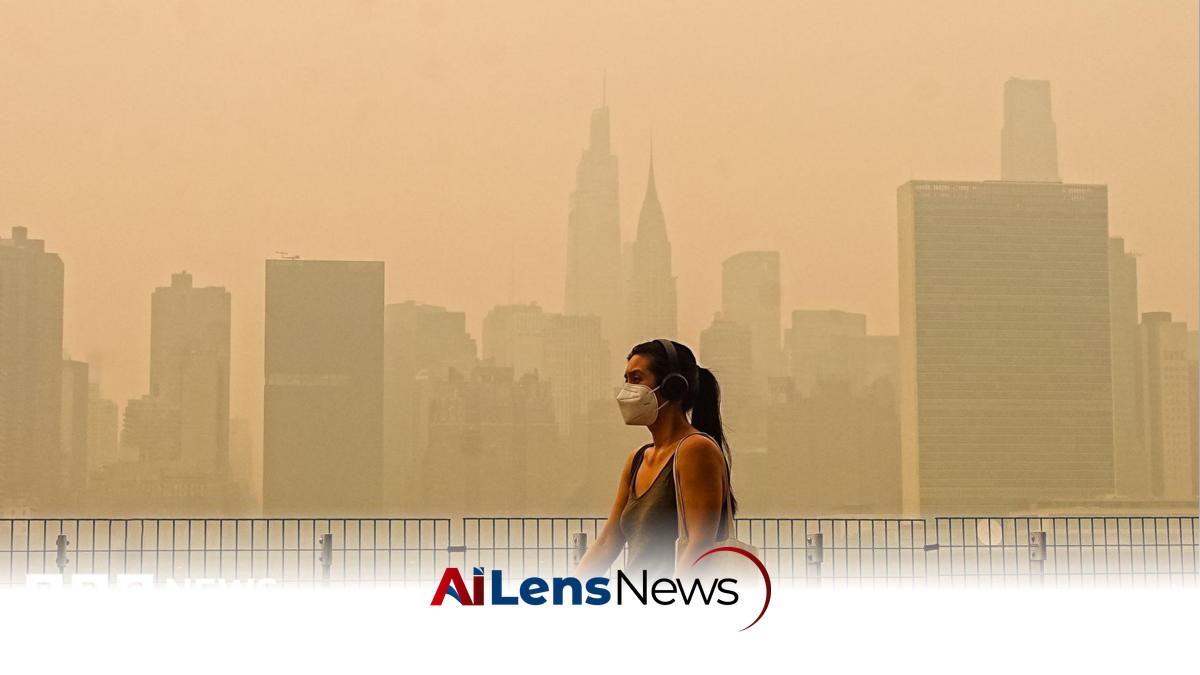
On Thursday, thick haze of smoke blocked views across New York City, including the Empire State Building and the Statue of Liberty. Likewise, national monuments across Washington DC were obstructed by the hazy conditions.
Officials have stressed for people to stay indoors, some areas even passing out free masks due to the poor health impacts of inhaling the fumes.
It's led to outdoor activities being canceled across the northern parts of the US, from Chicago and Detroit to parts of Pennsylvania and New England. Summertime camps were brought indoors, concerts were rescheduled—and at least one beach was shuttered along a popular lake.
Poor air quality also affected air travel in some areas where low-visibility conditions at airports caused flight delays.
The inclement weather has also sparked concerns around Sunday's Cup final between Argentina and Spain at MetLife Stadium—an open-air venue—in New Jersey, where Trump is due to attend.
White House officials— including Andrew Giuliani, the head of the White House's Cup task force—are holding informal meetings with FIFA officials and others monitoring the wildfires, but no larger, formal meeting has so far been planned.
Forecasters believe that rains in the area over the weekend will improve conditions before the two teams take the pitch.
In addition to the hazardous smoke extending across to the US, wildfires in northern Ontario have forced dozens from local First Nations communities to evacuate, with videos showing some fleeing the remote area by boat.
Members of the Namaygoosisagagun First Nation in the northern part of the province say they are "distraught" after fires tore through the community with very little warning.
To learn more about the latest developments in Regions & Countries, stay updated with our exclusive reports and analyses on AiLensNews.

