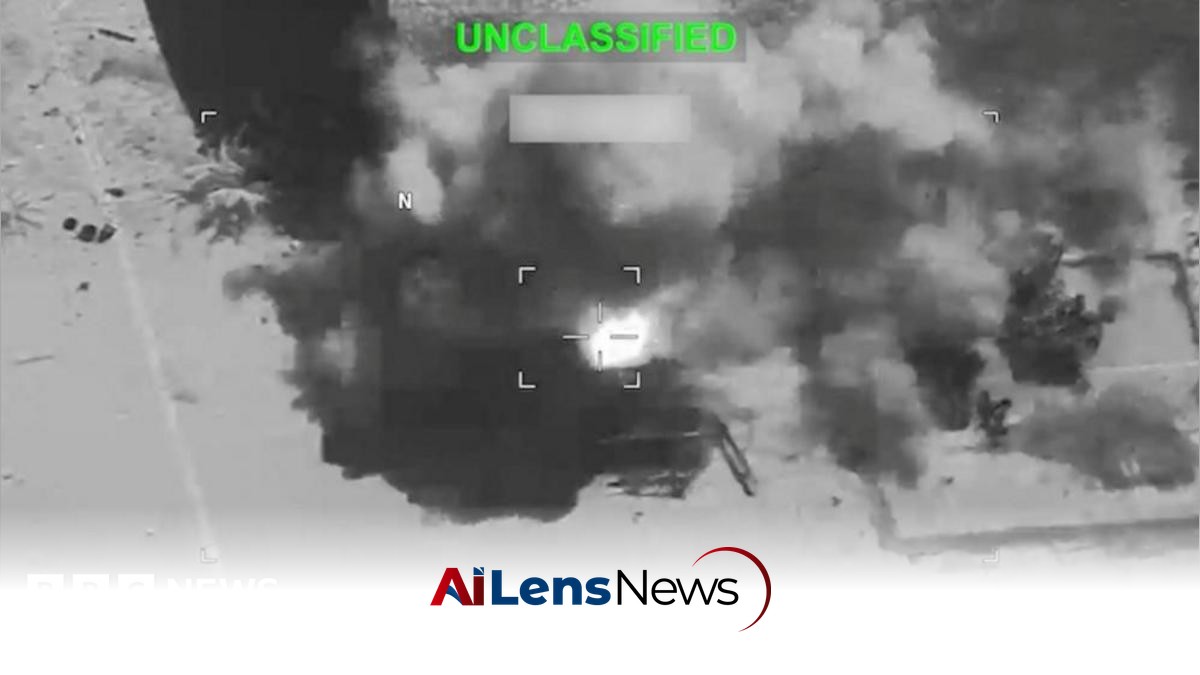


President Trump warns of targeting Iranian infrastructure if attacks on shipping in the Strait of Hormuz continue, escalating tensions in the region.
New Delhi, India Jul 23, 2026 ALN: President Donald Trump has threatened that the US would destroy an Iranian bridge or power plant any time its forces attack a ship in the Strait of Hormuz.
Potential targets would include ones "located next to, or in," the capital Tehran, he said in a post on Truth Social. This statement underscores the escalating tensions between the United States and Iran, particularly in the strategic Strait of Hormuz, a vital waterway through which a significant portion of the 's oil supply passes. The Strait of Hormuz is not only crucial for global energy markets but is also a flashpoint for regional military confrontations, making any threats to its security particularly alarming.
The military response would follow any form of attack on shipping in the vital waterway, "whether it be by missile, rocket, drone, or any other device or weapon." Trump's comments come amid a series of military actions, with the US launching strikes on Iran for the 11th consecutive night. This pattern of military engagement suggests a significant escalation in the ongoing conflict, which has seen both sides exchanging hostile actions and rhetoric.
Iranian state media reported that air defenses were activated in the capital Tehran, indicating a heightened state of alert within the country. Explosions were also reported in the north-western city of Tabriz, the south-eastern ports of Chabahar and Konarak, and in the southern city of Bushehr, which is home to Iran's only nuclear power plant. These incidents illustrate the widespread impact of the conflict across various Iranian cities and highlight the potential for civilian infrastructure to be affected in the ongoing military engagements.
Iran has retaliated against the US and its Middle East allies, warning of reprisals after Trump stated that the US would soon target an underground nuclear site near Natanz. This site has been a focal point of international concern regarding Iran's nuclear ambitions, as it is suspected of housing facilities for uranium enrichment. The threat of military action against such a sensitive location raises the stakes considerably, as it could provoke a broader military conflict in the region.
Kuwait's army reported on Wednesday that its air defenses had engaged with drone attacks originating from Iran, while Bahrain and Jordan also claimed to have intercepted drone and missile strikes. This regional involvement indicates a widening conflict that could draw in multiple nations, further complicating the geopolitical landscape and increasing the risk of miscalculation or accidental escalation.
Secretary of State Marco Rubio stated on Wednesday that the US would "defend" ships going through the straits that were getting "blown up." His remarks reflect the US commitment to ensuring the safety of maritime navigation in the region, which is critical for global trade. Rubio added that US officials were "open to diplomacy" but expressed skepticism about Iran's seriousness in pursuing negotiations. This dual approach of maintaining military readiness while advocating for dialogue illustrates the complexities of US-Iran relations, characterized by deep mistrust and conflicting interests.
The price of oil jumped in response to the latest escalation, reaching $94 on Wednesday. Such fluctuations in oil prices can have significant implications for the global economy, affecting not just energy markets but also consumer prices and inflation rates wide. The volatility in oil prices is often exacerbated by geopolitical tensions, and the situation in the Strait of Hormuz is a key contributor to these uncertainties.
Iran's top negotiator, Mohammad Bagher Ghalibaf, warned the US on Wednesday evening that "the equation of this war is clear: either all or none!" His statement reflects Iran's hardline stance and suggests that Tehran is prepared to escalate its military response if threatened. Ghalibaf's comments also highlight Iran's belief that its security is intertwined with the security of the Strait of Hormuz, asserting that if Iran's security is compromised, then the security of shipping lanes will also be jeopardized.
Rubio earlier mentioned that Washington was still willing to engage in diplomacy with Tehran but reiterated that he did not believe Iran was serious about talks. This skepticism underscores the challenges faced by US diplomats in navigating the complex relationship with Iran, where past agreements have often been undermined by subsequent actions and rhetoric from both sides.
Prior to that, the US president indicated that the next military target could be a complex known as Pickaxe Mountain, an underground nuclear site where Iran is suspected of building an undeclared enrichment facility. Targeting such a facility could have severe repercussions, potentially leading to an escalation of hostilities and a broader regional conflict, as Iran would likely respond forcefully to any perceived attack on its nuclear infrastructure.
Trump also threatened to "take care of" the Houthi rebels if the Iran-backed militant group in Yemen followed through on its threatened blockade of Saudi ports. The Houthis have been involved in a protracted conflict in Yemen, which has drawn in regional powers and exacerbated humanitarian crises. Their threat to close the Bab al-Mandab Strait, a critical maritime chokepoint, poses additional risks to international shipping and could further escalate tensions in the region.
The Red Sea has become crucial for oil shipments from Saudi Arabia during the US-Israeli war with Iran, which has led to the effective closure of the Strait of Hormuz. The strategic positioning of these waterways highlights the interconnected nature of regional conflicts and their implications for global trade. Following the Houthi announcement, two tankers which had just loaded Saudi crude bound for China and India at Saudi Arabia's Red Sea port of Yanbu made U-turns on Tuesday, heading instead towards the Suez Canal. This diversion illustrates the immediate impact of regional threats on global shipping routes and the potential for increased shipping costs and delays.
The threat from the Houthis risks further disruption to international shipping, with hostilities in the region having already led to global fuel prices fluctuating significantly. The ongoing conflict in Yemen, combined with the tensions in the Strait of Hormuz, creates a precarious situation for international trade and energy security.
Iran and the US signed a Memorandum of Understanding (MoU) in June to halt military operations and reopen the Strait of Hormuz, as well as to reach an agreement to end the war over the following 60 days. However, this agreement appears to have quickly unraveled, as three weeks after it was signed, Trump declared the ceasefire "over" following Iranian attacks on ships in Hormuz and US strikes in response. The failure of this MoU highlights the fragility of diplomatic efforts in the face of ongoing military actions and mutual distrust.
The war with Iran has cost the US some $37.5bn (£28bn) so far—a rise of nearly $8bn since the last estimate in May, US Defence Secretary Pete Hegseth said on Tuesday. This financial burden raises questions about the sustainability of prolonged military engagement and the potential impact on domestic priorities and military readiness.
Appearing before the Senate Appropriations Committee, Hegseth stated that military training would have to be curtailed unless lawmakers approved an urgent funding boost. The need for additional funding reflects the challenges faced by the US military in maintaining operational readiness while engaging in ongoing conflicts abroad.
House Republicans on Wednesday approved a $95bn budget package that mostly would go to funding the Iran war but also includes a Trump-backed bill changing voting regulations in the US. The measure was passed with only Republican support and faces an uphill battle in the narrowly divided Senate. This budgetary proposal underscores the political dimensions of military funding and the challenges of garnering bipartisan support for defense spending amidst broader domestic political debates.
Republican Senator John Thune on Tuesday defended the financial needs by the Trump administration, arguing Iran was "violating international law by blocking the shipping lanes and the Strait of Hormuz" and that Trump was "within his authority." His comments reflect the prevailing sentiment among many Republicans that assertive military action is necessary to counter perceived threats from Iran.
"In the meantime, I think most of us, at least, believe that we ought to support our men and women in uniform and hope and pray that they're successful," Thune said of the funding request. This emphasis on supporting military personnel highlights the broader societal commitment to those serving in the armed forces, even amidst contentious geopolitical conflicts.
Trump attended a dignified transfer ceremony on Wednesday in the city of Dover, Delaware, for the bodies of US service members recently killed in the Middle East. This ceremony serves as a poignant reminder of the human cost of military engagements and the sacrifices made by service members and their families. He earlier stated that Iran would pay for American fatalities "many times over," indicating a willingness to escalate military responses in retaliation for any losses incurred by US forces.
On Tuesday, the Pentagon identified a fourth soldier believed to have been killed in recent days. It said Sgt Angel S Rampersad, 28, who had previously been declared missing after an Iranian strike in Jordan, was thought to have died alongside two others in the same strike. This tragic loss of life underscores the ongoing risks faced by US military personnel in the region and the potential for further casualties as the conflict continues to unfold.
To learn more about the latest developments in International Politics, stay updated with our exclusive reports and analyses on AiLensNews.

