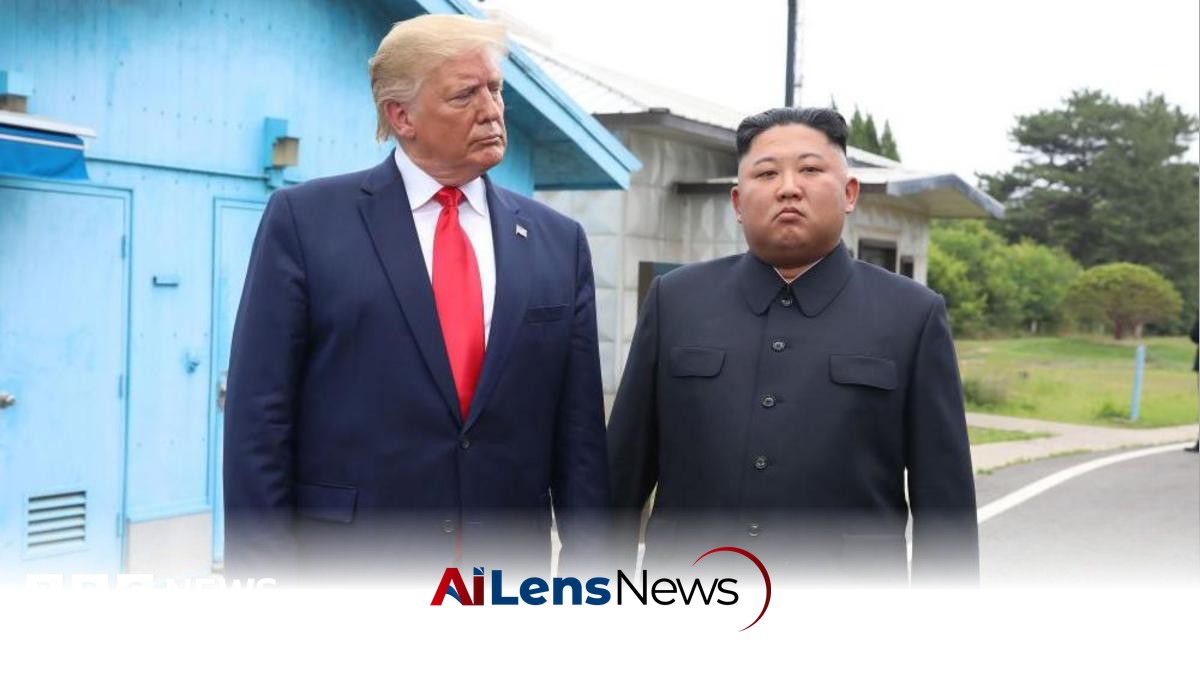


President Trump has declared a significant reduction in joint military exercises with South Korea, citing his relationship with North Korea's leader Kim Jong Un.
New Delhi, India Aug 17, 2026 ALN: President Donald Trump has said the US will "substantially reduce" joint military exercises with South Korea, citing his "very good relationship" with North Korea's leader Kim Jong Un.
This announcement comes at a time of heightened tensions on the Korean Peninsula, where North Korea has been increasingly assertive in its military ambitions, particularly with ballistic missile tests that have raised alarms internationally. Trump's decision to scale back military drills is significant, as these exercises have historically been a cornerstone of US-South Korea defense cooperation, aimed at deterring North Korean aggression.
In a post on Truth Social, Trump also noted that South Korea had recently declined to join the US in the "denuclearization" of Iran, which he highlighted as a point of contention. He remarked, "These exercises are not only costly, with much of these costs paid for by the United States of America (as usual!), but send a signal that is totally inappropriate and hostile." This statement reflects a broader sentiment that has characterized Trump's approach to foreign policy, particularly his emphasis on burden-sharing among allies.
In response to Trump's announcement, Seoul has reiterated that the joint drills with the US would proceed "as scheduled," indicating a commitment to maintaining military readiness despite the president's remarks. Pyongyang, on the other hand, has yet to comment on the situation, although it has been vocal in the past regarding joint military exercises, often condemning them as provocations.
The timing of Trump's announcement is particularly noteworthy, as it coincides with North Korea's recent ballistic missile tests, which are in violation of United Nations resolutions. These tests are part of North Korea's ongoing efforts to develop a credible nuclear deterrent, a pursuit that has intensified following the collapse of denuclearization talks in 2019. The failed negotiations during Trump's first term were marked by a series of high-profile summits and ultimately ended without a concrete agreement.
Trump's social media post suggested that it was "too late to cancel" the upcoming military exercises, which were set to commence shortly after his announcement. He added, "While somewhat unrelated (?), I recently asked the President of South Korea if they would like to join us in the Denuclearization of the Islamic Republic of Iran, and they said, 'No thanks!'" This comment underscores the complexities of international alliances and the differing priorities among partner nations.
Last week, US and South Korean military leaders held a joint press conference to announce the upcoming Ulchi Freedom Shield, an 11-day military exercise that is expected to mirror the scale of previous years, with approximately 18,000 South Korean soldiers participating. Such exercises are designed to enhance readiness and interoperability between US and South Korean forces in the face of potential threats from the North.
During the press conference, military leaders also addressed North Korea's involvement in supporting Russia's military efforts in Ukraine, highlighting the broader geopolitical implications of the North's actions. US military spokesperson Ryan Donald remarked, "our training accounts for that threat," referring to the potential for North Korean soldiers returning from the battlefield in Ukraine to pose a security risk in the region. Currently, about 28,500 American military personnel are stationed in South Korea, a presence that has been a focal point of US defense strategy in East Asia.
In a statement on Friday, North Korea's foreign ministry condemned the joint military drills as "a rehearsal for an aggressive war," a characterization that reflects Pyongyang's longstanding narrative regarding US military presence and activities in the region. The rhetoric surrounding these exercises often escalates tensions, as North Korea perceives them as direct threats to its sovereignty and security.
The joint exercises occur against the backdrop of North Korea's recent missile tests, which have drawn condemnation from the US, South Korea, and Japan. The trilateral cooperation among these nations is aimed at countering North Korea's provocations and ensuring regional stability. However, the growing military capabilities of North Korea pose significant challenges to this cooperation, prompting calls for a reassessment of strategies to address the North's nuclear ambitions.
Trump's comments regarding South Korea also suggest a level of frustration with the country's reluctance to engage in military or logistical contributions to US-led efforts in other regions, such as the situation in Iran. This sentiment is not new; Trump has previously expressed dissatisfaction with several allies, including Japan, France, and the UK, regarding their contributions to global security initiatives.
Importantly, Trump's move to downsize joint military exercises with South Korea is not without precedent. He suspended these exercises entirely in 2018 during the initial stages of denuclearization negotiations with Kim Jong Un. The exercises were further scaled back in 2020 due to the COVID-19 pandemic, which raised questions about the feasibility of large-scale military operations amid global health concerns.
In a related development, last week, South Korea's president proposed initiating talks with North Korea aimed at officially ending the Korean War, which has remained technically active since the armistice was signed in 1953. This proposal reflects ongoing efforts to seek diplomatic solutions to longstanding tensions on the peninsula, although the path forward remains fraught with challenges given North Korea's continued military developments and the complex geopolitical landscape in East Asia.
In conclusion, Trump's announcement to reduce military drills with South Korea amidst ongoing tensions with North Korea raises important questions about the future of US-South Korea defense cooperation, the implications for regional security, and the broader dynamics of international relations in the face of evolving threats. As both nations navigate these challenges, the balance between military readiness and diplomatic engagement will be critical in shaping the course of events on the Korean Peninsula and beyond.
To learn more about the latest developments in International Politics, stay updated with our exclusive reports and analyses on AILensNews.

