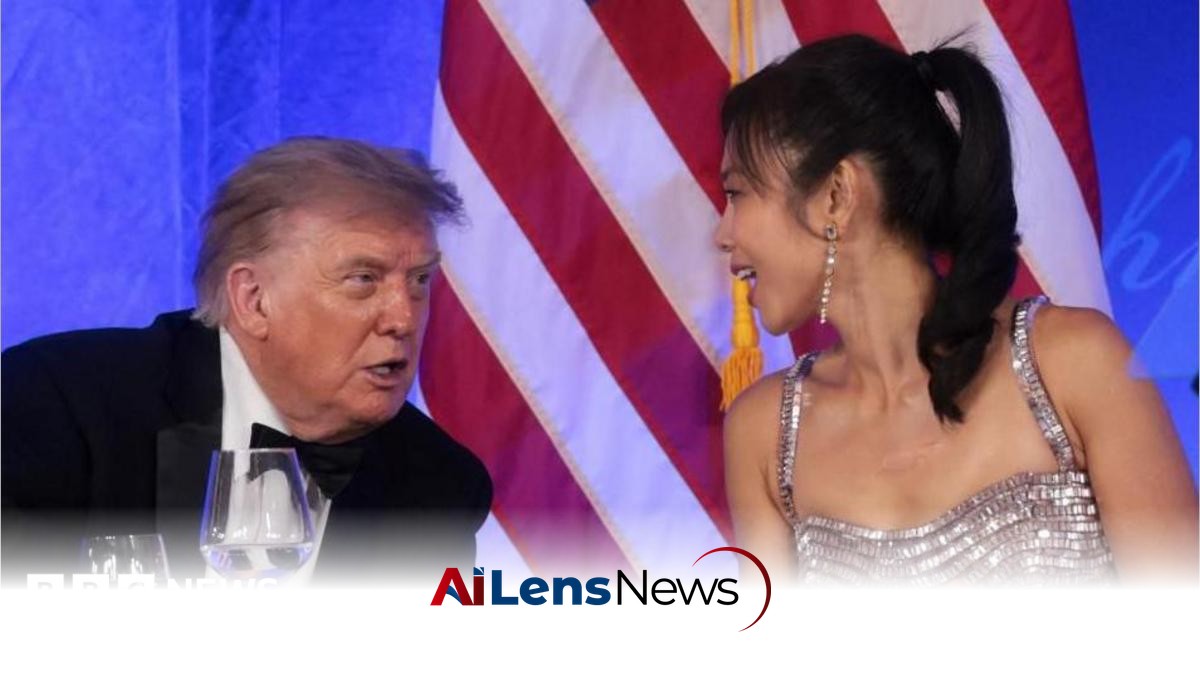


During the White House Correspondents' Dinner, President Trump criticized the media while celebrating press freedom, following a recent shooting incident.
New Delhi, India Jul 25, 2026 ALN: US President Donald Trump has taken swipes at the media at the White House Correspondents' Association (WHCA) dinner, a night that celebrated press freedom after the first event was cancelled by a shooting three months ago.
The WHCA dinner has historically been a significant event in Washington, D.C., where journalists, politicians, and celebrities gather to celebrate the role of a free press in American democracy. This year, however, the atmosphere was particularly charged due to the events of the previous dinner, which was abruptly halted when a gunman opened fire, leading to a heightened sense of security and tension among attendees. The president sat as reporters from outlets he has sparred with and even sued, including the New York Times, CNN, and the Wall Street Journal, came up to be honoured with awards.
The outgoing WHCA head, in her remarks, emphasized resilience in the face of adversity, stating she would "refuse to let an act of violence have the final word," referring to the gunman tackled at the first dinner in April. This sentiment reflected a broader commitment to upholding press freedoms, even amid threats to safety. The officer shot at the scene, Officer Victor Gonzalez of the US Secret Service, was given an award by Trump for his actions on the night of the shooting, highlighting the bravery of law enforcement in protecting public gatherings.
Trump's speech was a mix of humor and pointed critique, as he aimed barbs at the "fake " media and accused many journalists in the room of having "Trump Derangement Syndrome." This phrase has become a hallmark of Trump's rhetoric, used to dismiss criticism from the press and political opponents alike. In her remarks, WHCA President Weijia Jiang of CBS noted that the event would return to the scene of the April shooting, the Washington Hilton, next year, signaling a return to normalcy while acknowledging the need for vigilance.
During the dinner, Trump stood and shook hands with award winners, including a Wall Street Journal team recognized for their coverage of Trump's links to disgraced financier Jeffrey Epstein. This acknowledgment of the press's role in holding power accountable is a crucial aspect of the dinner, even as Trump often criticizes the very organizations that report on him. Ahead of the event, many in the White House press corps theorized that Trump would deliver a stern rebuke of the media, given his history of contentious interactions with journalists.
In his remarks, Trump was at times cordial and conciliatory, saying, "the second time is always better," joking and praising the media, stating he respects "most of them." This duality in his speech reflects the complex relationship between Trump and the media, where moments of levity coexist with sharp criticisms. "As I said three months ago, the show must go on," Trump stated, reinforcing the idea that despite the challenges, the tradition of the dinner and the celebration of press freedom would continue.
However, there were also some pointed insults directed at several journalists, some of whom were in the room. The harsher tone and personal attacks extended to Democratic politicians and celebrities as his hour-long speech took aim at some familiar targets. This approach, while entertaining to many of his supporters, underscores the ongoing polarization in American political discourse, where media figures are often seen as adversaries rather than allies in democracy.
Trump also called on Americans to respect freedom of speech, stating, "We settle our differences not with bullets, but with open and vigorous debate. And no deranged loser with a gun will ever change that. We can't let that ever happen." This statement reflects a broader theme in Trump's rhetoric, where he champions free speech while simultaneously attacking media outlets that he believes misrepresent him or his administration. His remarks at the dinner serve as a reminder of the importance of dialogue in a democratic society, even as he often undermines that very principle by labeling dissenting voices as "fake ."
Throughout the event, Trump appeared to be in a good mood, jokingly telling the media, "sometimes I really do think that some of you don't like me." This comment, while lighthearted, also reveals the underlying tension between Trump and the press, which has been a defining feature of his presidency. He further remarked, "This place [the dinner] is really the largest group of 'Trump derangement syndrome' people ever put together at one time," implying that many journalists' criticisms stem from a personal bias against him. He also joked that the industry would "be broke" after he is no longer in office because "there's not going to be anybody to report on," a tongue-in-cheek comment that reflects his understanding of the media's reliance on political figures for content.
The gala dinner came as relations between the White House and the media remain fraught. Just the week prior, Trump threatened to revoke the licenses of several US networks that did not carry his primetime speech about election security, showcasing his willingness to leverage governmental authority against media organizations he perceives as hostile. This tension is indicative of a broader trend in American politics, where the relationship between government and the press is increasingly adversarial, raising concerns about the implications for press freedom and accountability.
The event was considerably scaled down from the first correspondents' dinner, with about 700 people in attendance, compared with more than 2,000 in April. This reduction in attendance not only reflects the lingering impact of the April shooting but also highlights the challenges facing large public gatherings in an era where security concerns are paramount. Security was notably tighter, with several blocks around the hotel blocked off and a heavy presence of police and national guard. Guests were screened twice, with QR codes and IDs, and were given wristbands, indicating a heightened awareness of potential threats. At one point, visitors were prompted to walk in a single file line past two Secret Service officers holding rifles, a stark reminder of the dangers that can accompany public events, particularly those involving high-profile individuals.
The suspect of the shooting in April, identified as 31-year-old Cole Tomas Allen, has been charged with attempting to assassinate the president of the United States. This serious charge underscores the gravity of the situation and the potential risks associated with public appearances by the president. Allen was tackled by agents just short of a staircase that leads down to a ballroom where the dinner was getting underway, highlighting the quick response of law enforcement in preventing a potential tragedy.
Others in attendance on Saturday night included Defense Secretary Pete Hegseth, acting Attorney General Todd Blanche, FBI Director Kash Patel, Treasury Secretary Scott Bessent, and Commerce Secretary Howard Lutnick. Their presence at the dinner reflects the intersection of politics and media, where government officials often engage with journalists to foster relationships and promote transparency. Overall, the WHCA dinner remains a vital tradition in American democracy, serving as a platform for celebrating the press's role while also highlighting the challenges and tensions that exist between the media and those in power.
To learn more about the latest developments in International Politics, stay updated with our exclusive reports and analyses on AiLensNews.

