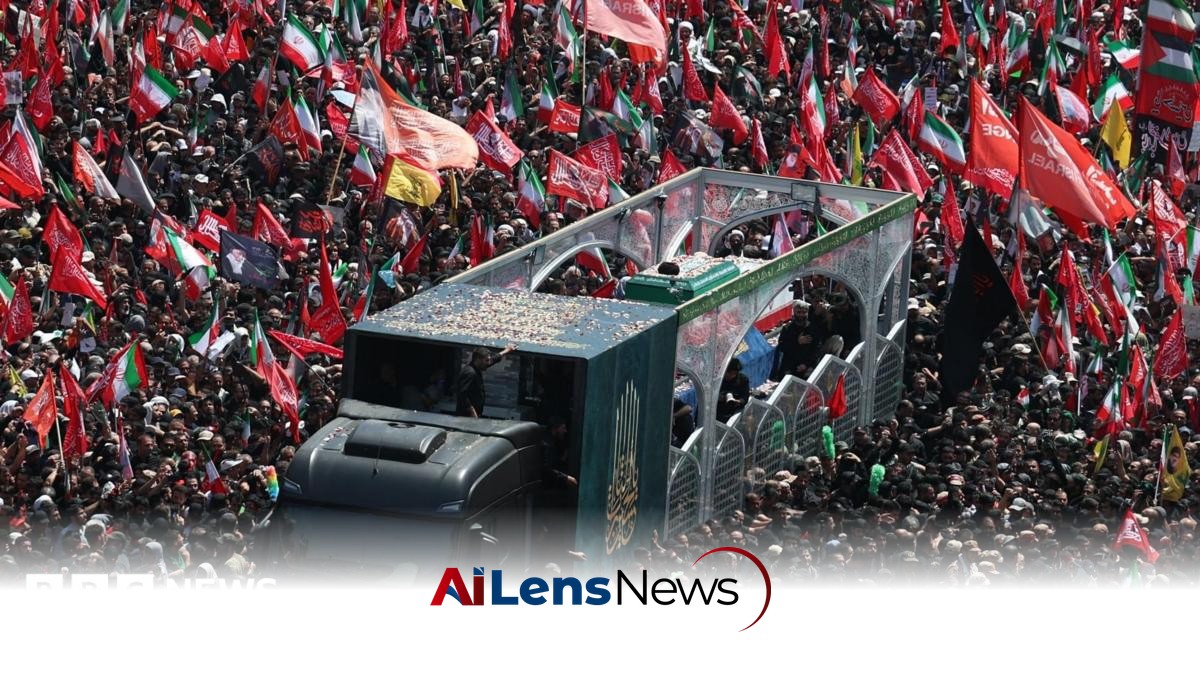


Tehran witnessed massive crowds mourning the late supreme leader, Ayatollah Ali Khamenei, who was killed in the recent war with the US and Israel.
New Delhi, India Jul 7, 2026 ALN: Huge crowds have lined the streets of Tehran for the funeral procession of Iran's late supreme leader, Ayatollah Ali Khamenei, who was killed on the first day of the war with the US and Israel.
The death of Khamenei marks a significant turning point in Iran's political landscape, as he had been a dominant figure in the country since becoming supreme leader in 1989, following the death of Ayatollah Ruhollah Khomeini, the founder of the Islamic Republic. Khamenei's leadership was characterized by a steadfast commitment to the principles of the Islamic Revolution, which included a strong opposition to Western influence, particularly from the United States and Israel. His policies and rhetoric often emphasized resistance to perceived threats from these nations, which he viewed as existential dangers to Iran.
Footage from Iranian state TV showed many tens of thousands of mourners gathered to watch Khamenei's flag-draped coffin being transported by a lorry along a 10km (6-mile) route that passed through the capital's landmark Enghelab Square. The procession was not just a farewell to a leader but also a manifestation of the deep-seated sentiments among many Iranians, who viewed Khamenei as a symbol of national pride and resilience against foreign aggression.
The procession took place after his body lay in state for two days at Tehran's Grand Mosalla mosque, a site that has historically held significant political and religious importance in Iran. This period allowed for the public to pay their respects, reflecting the reverence many had for Khamenei, despite the controversies surrounding his leadership. The presence of mourners from various walks of life underscored the complex relationship Iranians have with their leaders, marked by both loyalty and dissent.
Three of Khamenei's sons prayed beside his coffin there on Sunday. However, Mojtaba, the son who succeeded him as supreme leader, did not make an appearance. His absence raised questions and speculation regarding his health and the state of leadership transitions within the Iranian political hierarchy. Mojtaba has not been seen in public since he was reportedly seriously wounded in the same Israeli air strike in Tehran on 28 February that killed his father and his wife, further complicating the already delicate power dynamics in the country.
Khamenei's funeral procession wended its way slowly through central Tehran, from Imam Hossein Square in the east to Azadi Square in the west, on the last of three days of public mourning in the capital. The choice of these locations for the procession was significant, as they are not only central to Tehran but also symbolic of the Islamic Republic's revolutionary history. State media reported that millions of mourners filled the main boulevards connecting the squares and crowded around the black lorry that carried the coffin of the late supreme leader and four family members, emphasizing the collective grief and solidarity among the participants.
Many people were waving Iranian flags and red banners symbolizing vengeance, a reflection of the prevailing sentiment in Iran following the recent conflict. The display of national symbols during the funeral procession served as a reminder of the ongoing struggle for national identity and sovereignty in the face of external threats. There were also placards saying "We must rise" and others calling for the death of US President Donald Trump, who, along with Israel's Prime Minister Benjamin Netanyahu, ordered a joint attack on Iran four months ago that triggered a war in which thousands were killed. This atmosphere of anger and mourning illustrates the deep-seated hostilities that have characterized US-Iran relations for decades.
Mourners were also seen throwing stones at a billboard displaying Trump's face that was hung from a bridge. "The US killed our father. We won't let you go!" it read. Such expressions of outrage highlight the personal and collective grief felt by many Iranians, who view Khamenei not just as a political leader, but as a father figure and protector of the nation against foreign aggression.
"I came with honour and pride to show all the people of the how much we loved him and how committed we are to the system, the people, and the Islamic Republic," Melika Nourian, a 22-year-old university student, told the AFP agency. Her statement encapsulates a sentiment shared by many who participated in the procession, reflecting a complex mix of loyalty to the regime and a desire for national unity.
Former president Mahmoud Ahmadinejad was seen at the procession, local media reported. It appeared to be his first major public appearance since the start of the war, when three of his bodyguards were reportedly killed in a strike near his home. Ahmadinejad's presence at the funeral procession could signify his attempt to reassert his political relevance in a rapidly changing landscape, as the country grapples with both internal and external challenges.
Iran's current president, Masoud Pezeshkian, was also filmed walking among a group of mourners on a Tehran street. Earlier, he wrote on X that Khamenei had taught everyone in Iran that the country's "greatest asset" was "its people and their unity." He promised that Iranians would "continue the path of Iran's honour, progress, and glory." This statement reflects the government's messaging strategy aimed at reinforcing national unity in the wake of Khamenei's death and the ongoing conflict.
Other senior figures shown by state media included Foreign Minister Abbas Araghchi, judiciary chief Gholamhossein Mohseni Ejei, and Brig-Gen Esmail Qaani, commander of the Quds Force, the Revolutionary Guards' overseas operations arm. Their presence underscores the continuity of leadership and the commitment to maintaining the ideological tenets of the Islamic Republic, despite the significant challenges ahead.
But there was again no sign of Mojtaba Khamenei, who has not appeared on video or in public since before his appointment and communicates mainly through written statements. His absence raises concerns about the future of leadership in Iran and the potential for power struggles within the ruling elite.
Israeli Defence Minister Israel Katz said Ali Khamenei was "eliminated by Israel" because he had threatened its existence. "Any Iranian leader who will again try to pursue plans to destroy Israel will be killed as well," he added. This statement highlights the precarious nature of the geopolitical landscape in the region, as Israel and Iran continue to engage in a shadow conflict that has far-reaching implications for regional stability.
Ali Khamenei, who was 86, became supreme leader in 1989 after the death of the Islamic Republic's founding father, Ayatollah Ruhollah Khomeini. He maintained a firm grip on Iran's politics and its armed forces, and suppressed domestic challenges, sometimes violently. He also took consistently hard-line stances on external matters, including Iran's confrontation with the US and Israel. His death may lead to a power vacuum that could either consolidate or fragment the existing political order, depending on how the succession process unfolds.
Iran's ruling establishment wants the funeral ceremonies for him to send a message of strength following the war as well as the mass protests that swept across the country in January, when thousands of people were killed in a crackdown by security forces. The government's efforts to project unity and resilience during this period are critical, as they seek to quell dissent and reinforce the legitimacy of the regime in the eyes of the public.
Qom Friday prayer leader Ayatollah Mohammad Saidi declared last week that large turnouts "will, in effect, be another referendum for the Islamic Republic." This statement reflects the regime's reliance on public displays of loyalty to gauge its legitimacy, especially in light of recent protests and unrest that have challenged its authority.
The ceremonies are taking place less than three weeks after Iran and the US signed a preliminary agreement to end the war and reopen the crucial Strait of Hormuz waterway, through which 20% of global oil and gas shipments pass. This agreement is pivotal not only for Iran's economy but also for global energy markets, as instability in the region can have cascading effects wide.
The two countries also gave themselves two months to reach a final deal that covers Iran's nuclear programme, US sanctions, and a permanent truce. The potential for a diplomatic resolution to the ongoing conflict presents both opportunities and challenges for Iran, especially in light of the changing leadership dynamics following Khamenei's death.
Mediator Qatar said Iranian and US negotiators made "positive progress" at indirect talks in Doha last week following a four-day exchange of strikes, and that their next meeting would be scheduled after the conclusion of the ceremonies for Khamenei. This progress indicates a willingness on both sides to engage in dialogue, despite the historical animosities that have characterized their relationship.
On Tuesday, there will be another funeral procession and prayers in the central city of Qom, the centre of Iran's Shia Muslim clerical establishment, where Khamenei's body was flown by helicopter on Monday evening. This location is significant as it is a hub of religious authority and scholarship, and the ceremonies there are likely to attract a large turnout, further emphasizing the religious dimensions of Khamenei's legacy.
The ceremonies will then move to the Iraqi shrine cities of Karbala and Najaf on Wednesday. These cities hold immense religious significance for Shia Muslims and are symbolic of the broader Shia identity that Khamenei championed during his leadership. The choice of these locations for the final ceremonies highlights the transnational dimensions of Khamenei's influence and the aspirations of Iran's ruling elite to project their authority beyond national borders.
They will end on Thursday, when Khamenei will be buried at the Imam Reza shrine in his home city of Mashhad, in north-eastern Iran. This final resting place underscores Khamenei's deep ties to the religious and cultural heritage of Iran, and his burial there is likely to elevate the site's significance in the eyes of his supporters and the broader Shia community.
To learn more about the latest developments in Wars & Conflicts, stay updated with our exclusive reports and analyses on AiLensNews.

