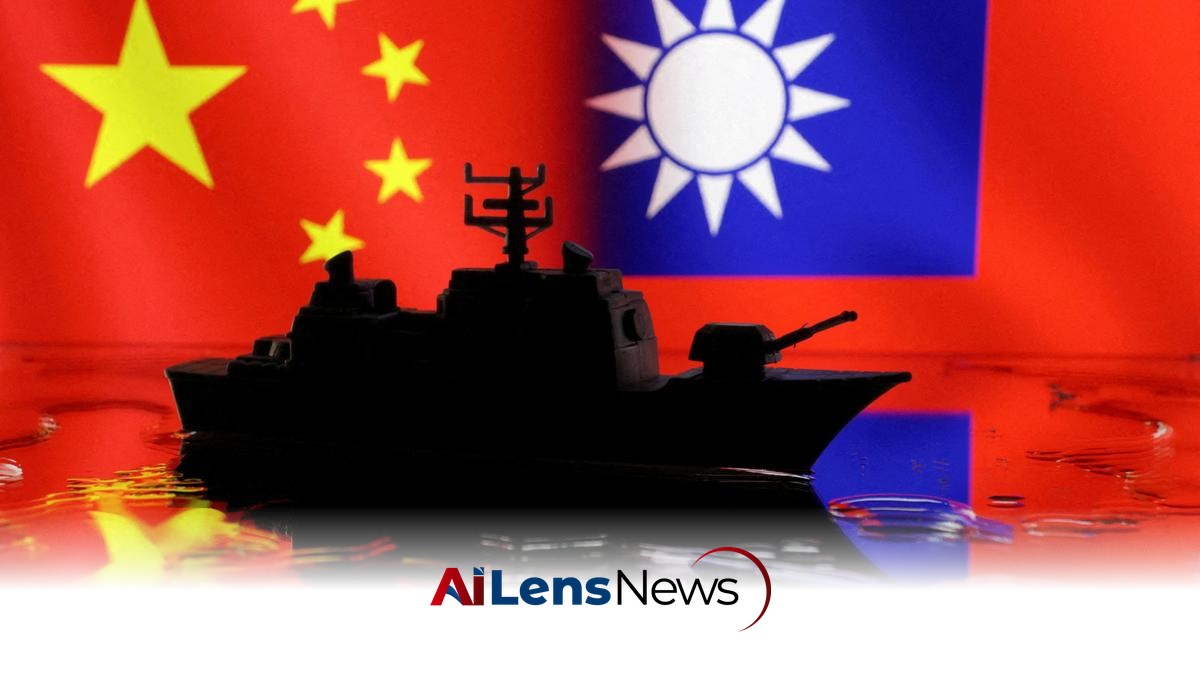


China initiates coast guard patrols east of Taiwan, escalating tensions amid international opposition and territorial disputes.
Taiwan, Taiwan Jul 4, 2026 ALN: China's recent announcement regarding the launch of a new coast guard patrol east of Taiwan has drawn significant attention and concern from various international observers. This development, reported on July 4, 2026, signifies a continuation of China's assertive posture in the Taiwan Strait, an area that has become increasingly contentious in recent years. The patrol replaces a previous task force that had already strained relations between Taipei and Beijing, as well as raising alarms among Western nations, particularly the United States and its allies.
The historical context of the Taiwan issue is critical to understanding the current tensions. The People's Republic of China (PRC) has long claimed Taiwan as part of its territory, a view that is rooted in the Chinese Civil War when the Kuomintang (KMT) retreated to Taiwan in 1949 after being defeated by the Communist Party of China. Since then, Taiwan has developed its own identity and governance, operating as a separate entity with its own democratic political system. However, Beijing has never renounced the use of force to achieve unification and has increasingly relied on military and paramilitary forces to assert its claims over the island.
In recent years, this has included a noticeable uptick in military exercises and maneuvers around Taiwan, which are often characterized by Taiwan as acts of intimidation. The use of the coast guard in these operations is a relatively new tactic, with China employing its maritime law enforcement vessels to assert control over contested waters. This strategy, referred to by Taiwan as "lawfare," aims to establish a legal basis for China's actions in the region, complicating Taiwan's ability to respond without escalating tensions further.
The stated objectives of the newly launched coast guard patrol are to conduct "law enforcement patrols" in what China claims are its jurisdictional waters. The Chinese Coast Guard has emphasized the importance of these patrols in safeguarding what it describes as China's territorial sovereignty and maritime rights. This assertion of jurisdiction is central to China's broader strategy in the South China Sea and surrounding regions, where it has ongoing disputes with several neighboring countries.
The implications of these patrols are significant. By framing its maritime activities as law enforcement, China seeks to legitimize its presence in contested waters, potentially undermining international maritime law as understood by other nations. This approach is particularly concerning for Taiwan, which views these actions as direct threats to its sovereignty and security.
In response to the new patrols, Taiwan's Coast Guard has taken proactive measures to monitor Chinese activities closely. Reports indicate that Taiwanese officials are tracking two Chinese vessels that were located approximately 54 nautical miles east of Taiwan’s Hualien, a region known for its strategic military installations, including an important air base. Taiwanese authorities have positioned their own vessels in the area to ensure they can respond swiftly to any potential incursions into their territorial waters.
Taiwan's commitment to defending its maritime domains is evident in its declaration that it will employ all necessary measures to expel Chinese vessels perceived as harassing its waters. This stance underscores Taiwan's determination to maintain its sovereignty, even as it faces increasing pressure from Beijing.
The launch of this patrol marks the second such operation in roughly a month, indicating a pattern of increased Chinese coast guard activity off Taiwan's east coast. These actions come amid broader geopolitical tensions, particularly following the announcement of formal discussions between Japan and the Philippines regarding their maritime boundaries. Beijing's interpretation of these discussions as encroachments on its waters has led to a heightened military presence in the region.
This escalation is not occurring in a vacuum; it is part of a larger trend of increasing assertiveness by China in its territorial claims across the Asia-Pacific region. The implications of these maneuvers extend beyond Taiwan, as they risk drawing in other regional powers and complicating existing alliances. The involvement of the United States, France, Germany, and Britain in the diplomatic disputes surrounding Taiwan illustrates the global stakes associated with these tensions.
In light of the increasing presence of Chinese vessels, Taiwan has taken a firm stance, urging its own vessels to ignore any demands for boarding or inspection from the Chinese Coast Guard. This directive reflects Taiwan's commitment to safeguarding its maritime rights and its willingness to confront Chinese assertions directly. Taiwanese authorities have made it clear that they are prepared to intervene if necessary to prevent any incursions into their waters.
The situation is further complicated by the fact that China does not recognize any claims of sovereignty by Taiwan. This lack of recognition creates a legal and diplomatic quagmire that makes resolution challenging. Taiwan, for its part, asserts that China has no legitimate claim to sovereignty or jurisdiction over the island or its surrounding waters, a stance that is supported by many in the international community.
The complexities of this situation were further highlighted on July 2, 2026, when China's Ministry of Natural Resources released a "legal opinion" regarding the Japan-Philippines maritime boundary discussions. This document urged both countries to engage in talks with China rather than Taiwan, asserting that any negotiations should exclude Taiwan's claims. The release of this opinion illustrates China's ongoing attempts to isolate Taiwan diplomatically and undermine its legitimacy on the international stage.
This ongoing situation underscores the intricate web of international relations in the region. As territorial disputes continue to escalate, they have the potential to draw in global powers and impact regional stability. The responses from Taiwan and its allies will play a crucial role in shaping the future dynamics of the Taiwan Strait and the broader Asia-Pacific region.
In conclusion, the launch of China's new coast guard patrol east of Taiwan represents a significant escalation in the ongoing tensions between Beijing and Taipei. The implications of this move are far-reaching, affecting not only Taiwan's security but also the strategic calculations of regional and global powers. As the situation develops, the international community will be closely monitoring the actions of both China and Taiwan, as well as the responses from other nations in the region.
To learn more about the latest developments in International Politics, stay updated with our exclusive reports and analyses on AiLensNews.

