

More
Checking your session
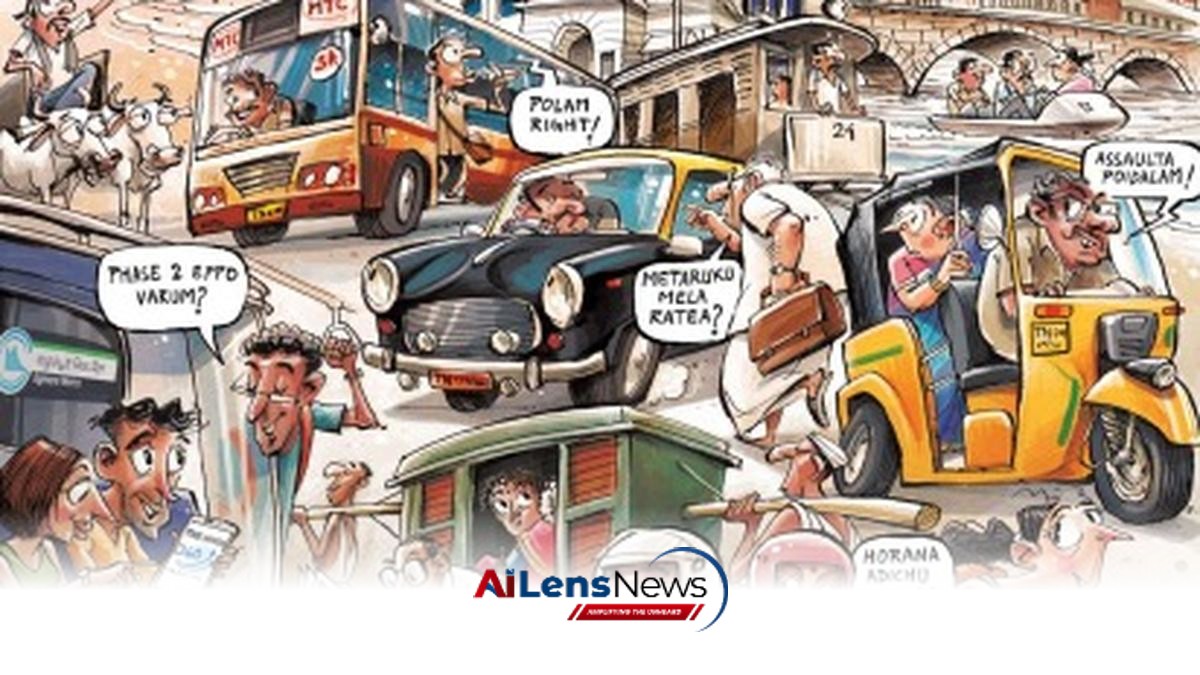



On Madras Day, we reflect on the rich history of public transport in Chennai, tracing its evolution from colonial times to the present.
Chennai, India Aug 22, 2026 ALN: Public transport is an abiding feature of city life. Madras, now known as Chennai, is no different. As we look back at the history of this city, and trace farther back in time to eras when colonial Madras did not exist but several villages, which were absorbed into it certainly did, we see that stories of movement are a constant. Walking is the oldest mode and still survives despite every impediment in its way. The well-to-do rode on horses, were driven about in carriages, or carried in palanquins. The colonials, when they arrived, adopted the same methods of conveyance as the locals but these eventually evolved. And from then on, it has been a continuous journey, by different modes.
A palimpsest is defined as a manuscript or parchment where the original has been partially or fully erased, to enable fresh writing. The topography of Madras is much the same, the change always brought about by the need for quick access to places. A metropolis, unlike a rural hamlet, needed to enable quick commutes — and so passageways and conveyances had to be available at the double. In the process, we never entirely got rid of what methods and routes existed in the past. And they survive, in bits and pieces here and there, to teach us history.
In the pre-colonial days, we had the concept of veethis, which almost certainly were the equivalent of high roads. They were meant for providing easy access from one self-contained village to another. Madras arose in their midst and demanded routes unto itself, which did not exist earlier. It was therefore transport that defined the primary topography of the colonial city. In the neighbouring Old Black Town, before the Esplanade and later the High Court and the law college obliterated all traces, the streets were defined on the basis of caste, and then easy access. New Black Town, which is today’s George Town, still carries vestiges of that layout.
As the city expanded and absorbed neighbouring villages into itself, roads came about to connect the Fort and George Town to the rest of the areas. These were not so much a priority as were those that needed to connect to weekend getaways and later garden bungalows of the East India Company servants. These, which today form the arterial thoroughfares of the city, carry in their (old) names that story of the purpose for which they were originally laid out - providing ease of access for the colonials to reach their homes. That these came to be the principal highways of the city on which public transport would eventually depend is a delicious twist of history. It is only with the emergence of planned localities, such as T. Nagar, Shenoy Nagar, and K.K. Nagar, that layouts were made with public accessibility as the principal criteria. Surprisingly, we seem to have lost the plot in later layouts.
On the palimpsest of Madras, we have rewritten the way we travel, by foot, boats, carts, carriages, and coaches, palanquins, tramways, trains, two-wheelers, cars and buses, aircraft, and, now, metro rail. The story of our transport systems is one of the many facets of the history of our city. And then, there are stories of transport systems that were planned but never became a reality, for a city is not just shaped by reality but also dreams.
The evolution of public transport in Chennai is not merely a reflection of changing technologies but also of the city's growth and transformation. The introduction of railways in the 19th century marked a significant shift in how people moved within and outside the city. The first train service began in 1856, connecting Chennai to other parts of the region, which facilitated trade, commerce, and the movement of people. Over the years, the railway network expanded, and today, it remains a vital part of the city's transport infrastructure, serving millions of passengers daily.
In the early 20th century, the introduction of trams added another layer to the public transport system. The tramways provided an efficient means of travel within the city, connecting key areas and enabling residents to commute with ease. However, as automobile usage increased and the city expanded, trams eventually became less viable. The last tram service was discontinued in 1953, marking the end of an era in Chennai's public transport history.
As the city continued to grow, the need for a more robust public transport system became evident. Buses emerged as the primary mode of public transport in the mid-20th century. The Metropolitan Transport Corporation (MTC) was established to manage bus services, and over the decades, it has expanded its fleet and routes to cater to the growing population. Buses remain a crucial part of Chennai's public transport landscape, providing affordable and accessible travel options for residents.
In recent years, Chennai has witnessed significant advancements in public transport, particularly with the introduction of the metro rail system. The Chennai Metro, inaugurated in 2015, aims to alleviate traffic congestion and provide a modern, efficient means of transportation. The metro rail project is expected to significantly reduce travel times and improve connectivity across the city. As the metro network expands, it is anticipated that it will play a pivotal role in shaping the future of public transport in Chennai.
Moreover, the rise of technology has led to the emergence of app-based transport services, such as ride-sharing and taxi services, which have further diversified the public transport options available to residents. These services have become increasingly popular, especially among younger generations who prefer the convenience and flexibility they offer.
Despite these advancements, challenges remain. Traffic congestion, pollution, and the need for sustainable transport solutions are pressing issues that Chennai faces today. The city continues to grapple with the implications of rapid urbanization, and there is a growing recognition of the need for integrated transport planning that prioritizes public transport, non-motorized transport, and pedestrian-friendly infrastructure.
In its 148-year history, The Hindu has walked hand-in-hand with Madras. With the help of The Hindu Archives and the writings and records from other sources, let us reconstruct the story of our city, forever on the move. Happy Madras Day!
To learn more about the latest developments in Destinations, stay updated with our exclusive reports and analyses on AILensNews.

Explore exciting last-minute staycation offers across the UAE for the upcoming l…
A TikTok user shares a preview of the upcoming RTS Link, promising a swift and c…

As crowds at Yr Wyddfa grow, climbers debate the ethics of skipping queues. Is i…

Enter for a chance to win a travel package worth QR 5,000 to Georgia, with the w…

Air Arabia has announced the introduction of four weekly flights to Katowice and…