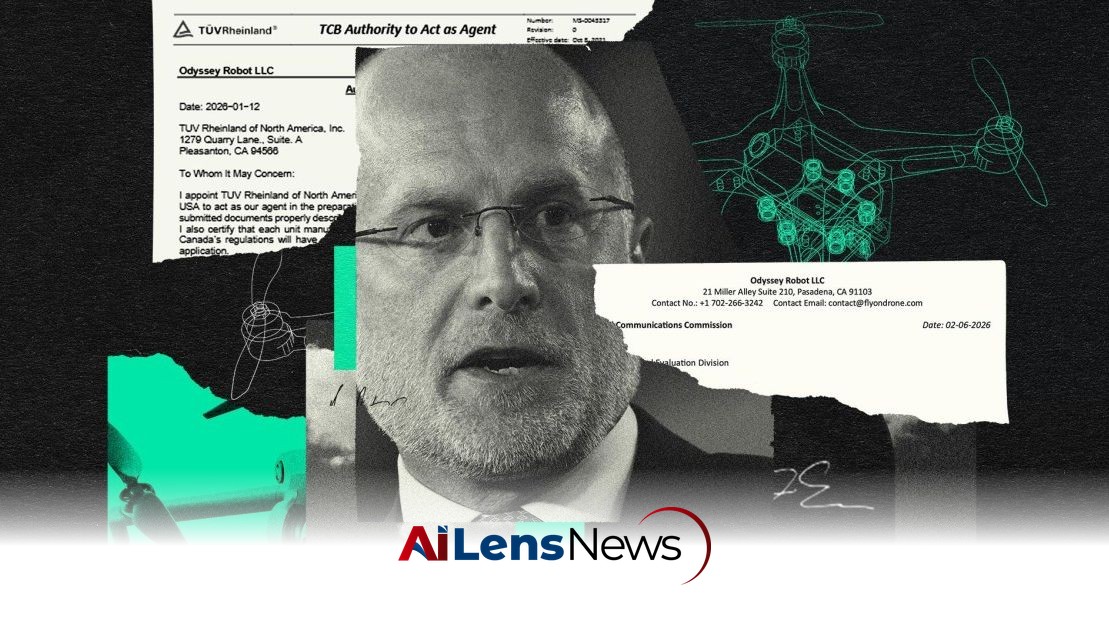


The FCC's ban on foreign drones has led to unexpected loopholes, allowing companies like Odyssey Robot to operate under questionable claims of US manufacturing.
Washington DC, United States Jul 24, 2026 ALN: In Pasadena, California, there’s a cute red brick courtyard where one storefront isn’t like the rest. The glass doors open onto a sparse industrial hallway, which leads to a sunlit foyer with a large spiral staircase. Go up, and you’ll see a typical coworking space: open tables, healthy snacks, a collection of meeting rooms with glass walls. Follow one hallway most of the way back, and you’ll find Office 18.
There are no signs of life in this tiny private office that’s supposed to be the headquarters of Odyssey Robot, an upstart US drone company. We saw three small desks and chairs, but no power strips, no monitors, no keyboards or chargers or decorations. Two of the desks were covered with sealed cardboard packages.
This room is the latest proof: The FCC’s ban on foreign-made drones is a bad joke.
On December 22nd, 2025, the US government claimed — without a shred of public evidence — that foreign consumer drones posed an unacceptable threat to national security. With the help of other agencies, FCC Chairman Brendan Carr banned all future foreign drones from entering the country without a special new waiver.
Like with Carr’s make-it-make-sense consumer internet router ban, that waiver has nothing to do with the security of these products. The application includes zero questions about restricting or improving the technology itself.
Instead, it gives Carr and President Donald Trump the power to decide losers and winners while beating the “America First” drum. Foreign companies have to submit a detailed plan to build their products in the US, including how much they intend to invest in US manufacturing — yet US-based Netgear got a waiver from the router ban even though it made no commitment to produce devices outside Asia.
Consumer drones are effectively all made in China, and as of April, it appeared that no one planned to change that as a result of the FCC’s foreign drone ban. Though some US dronemakers exist, they’re pursuing a different and more lucrative opportunity: drones that spy and kill.
But Office 18 shows another gaping hole in the FCC’s plan. Instead of creating new US consumer drone companies, it’s incentivizing fake ones instead.
How easy is it to fool the FCC? Just lie on the paperwork, it seems.
Just whip up a new company that pretends to build brand-new drones in the USA and count on no one noticing — even if your drones clearly use proprietary DJI wireless tech.
DJI, the world’s biggest drone company, didn’t dominate drones just because of first-mover advantage. It was technology. DJI’s OcuSync and older Lightbridge real-time video transmission systems were and are the most reliable long-range, low-latency ways to remotely control a consumer-grade drone. Almost every time The Verge has tested another brand, the signal hasn’t been as reliable. It’s a competitive advantage that DJI wouldn’t easily share.
But OcuSync has a telltale fingerprint. It uses specific pairs of radio frequencies, pairs that appear in the FCC’s databases.
When software developer and journalist Konrad Iturbe began watching FCC databases for those frequencies, he realized that DJI was preparing to play a grand game of Whac-A-Mole in the United States. Well ahead of the December 2025 drone ban, a host of new companies had suddenly appeared selling barely disguised versions of DJI technology. He dubbed them “DJI front companies.”
One of the most prominent DJI clones to enter the US was Skyrover, which released a budget drone that was a dead ringer for the DJI Mini 4 Pro. Last July, DJI would not confirm or deny to The Verge that “Skyrover” was a disguised version of its own drone, even though security researchers confirmed its app included DJI code.
Then, in October, Iturbe helped us introduce you to Xtra, the company that lets DJI sneak its popular cameras into the US. When we tested an Xtra camera versus a DJI camera, we found them so identical, it removed any doubt. Again, DJI would not confirm or deny.
As a result, US citizens were still able to purchase DJI tech — only now, they were dealing with fly-by-night businesses, with no real guarantee of support in the future.
This June, Iturbe discovered the most brazen attempt yet. The DJI fingerprint led him to the FCC filings for a company named Odyssey Robot, which does business as Galiview Tech. In March, it became the first DJI-equipped drone brand to get FCC approval since the drone ban began. DJI did not reply to requests for comment for this story.
If Galiview was trying to hide the DJI connection, it didn’t try very hard: The company’s website even listed DJI’s trademarked OcuSync tech as a Galiview feature.
Wasn’t stopping clandestine Chinese hardware the whole point of the ban? How could the FCC approve this drone?
Simple: On February 6th, a “Randolph Howard Eason” declared on an FCC form that Odyssey Robot’s drone and controller were made in the United States, and nobody ever questioned that before rubber-stamping its application.
The FCC could have spotted the OcuSync frequencies, or that this supposed drone was a clone, but they didn’t. Instead, they let a company that clearly has ties to DJI operate under the guise of American manufacturing.
This situation illustrates the flaws in the FCC's approach to drone regulation and raises questions about the effectiveness of their policies in truly protecting national security. The implications of such oversights are significant, as they not only undermine the intended objectives of the ban but also create a landscape where foreign technology can still infiltrate the market under the guise of domestic production.
To understand the broader context, it is essential to consider the motivations behind the FCC's ban. The decision was ostensibly made in the name of national security, reflecting growing concerns about foreign surveillance and the potential for espionage associated with foreign-made technology. However, the reality is that the enforcement of these regulations has been riddled with inconsistencies and loopholes, allowing companies like Odyssey Robot to exploit the system.
This issue is compounded by the rapid technological advancements in the drone industry, where innovation often outpaces regulatory frameworks. The challenge for the FCC and other regulatory bodies is to create policies that not only protect national security but also foster innovation and competition within the domestic market. The current approach, which seems to prioritize short-term political gains over long-term strategic planning, may ultimately stifle the very innovation it aims to promote.
Moreover, the rise of so-called "DJI front companies" raises ethical questions about the integrity of the market. Consumers may be misled into believing they are purchasing American-made products when, in reality, they are acquiring rebranded versions of foreign technology. This deception not only undermines consumer trust but also poses risks related to product safety and support. Without established companies backing these products, consumers may find themselves without recourse in the event of malfunctions or defects.
In addition to consumer implications, the situation also highlights the challenges faced by legitimate American drone manufacturers. Companies that are genuinely investing in domestic production and innovation may find themselves at a disadvantage in a market flooded with inferior, foreign-derived products masquerading as American-made. This could deter investment in the sector and hinder the growth of a robust domestic drone industry.
As the drone market continues to evolve, it will be crucial for regulatory bodies like the FCC to reassess their strategies to ensure they effectively address the complexities of global supply chains and technological advancements. Policymakers will need to engage with industry stakeholders to develop regulations that are not only effective but also adaptable to the rapidly changing landscape of technology.
Ultimately, the flaws in the FCC's drone ban serve as a cautionary tale about the importance of thoughtful and informed regulation in the tech sector. As the lines between domestic and foreign technology continue to blur, it is imperative that regulatory frameworks evolve to meet the challenges of the modern age while safeguarding national interests. The future of the drone industry, both in the United States and globally, hinges on the ability of regulators to strike a balance between security and innovation, ensuring that the market remains competitive and transparent for consumers and manufacturers alike.
To learn more about the latest developments in Artificial Intelligence, stay updated with our exclusive reports and analyses on AiLensNews.

