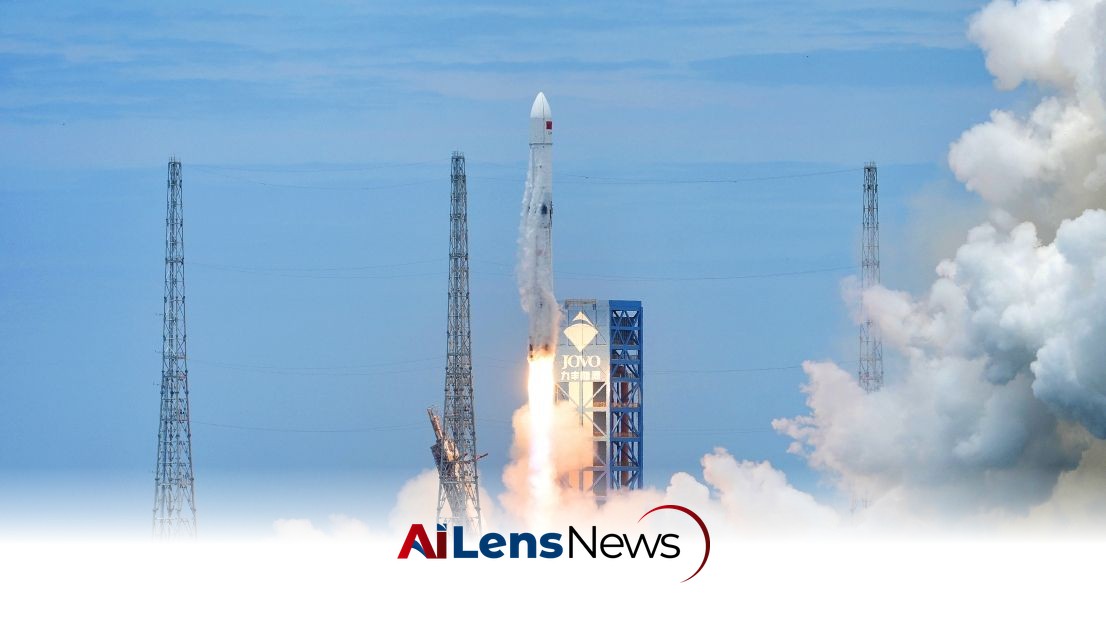


China’s state-owned space company successfully launched a Long March orbital rocket, marking a significant advancement in reusable rocket technology.
Washington DC, United States Jul 10, 2026 ALN: China’s state-owned space company successfully launched a Long March orbital rocket and landed the booster on a seagoing recovery vessel, making it the second country to achieve the feat.
The demonstration on Friday shows that China’s Aerospace Science and Technology Corporation (CASC) is poised to match the advance that catapulted SpaceX to the top of the heap: reusing the same booster again and again to drive down the cost of launching spacecraft. CASC said it would attempt to reuse the booster, which can carry about as much payload as SpaceX’s workhorse Falcon 9, by the end of the year.
Instead of unfolding landing legs to settle onto a floating platform, as the Falcon 9 does, China’s approach uses netting strung across a large frame onboard a recovery ship to capture the descending rocket. The ability to get the rocket back to the ship in a controlled flight, however, depends on sophisticated guidance software and sensors, along with engines that are reliable enough to restart and rugged enough to survive the descent back through the atmosphere.
SpaceX is currently breaking launch records on an annual basis with its fleet of reusable Falcon 9 rocket boosters. The vehicle underpins the company’s Starlink satellite network, which depends on cheap, regular space access, as well as its work for NASA and the U.S. Space Force. The success of SpaceX has not only revolutionized the economics of space travel but has also set a new standard in the industry, prompting other nations and companies to accelerate their own advancements in reusable rocket technology.
Victoria Samson, the chief director for Space Security and Stability at the Secure World Foundation called the demonstration a “huge game changer.” She emphasized that when China figures out how to reuse their rockets effectively, it could lead to a significant reduction in launch costs. This cost efficiency would enable China to leverage its space capabilities as a tool of soft power, potentially launching satellites for allied nations at competitive prices, thereby expanding its influence across various regions.
Despite the advancements, it is important to note that China would not directly compete with Musk’s company for launch customers due to national security regulations that effectively divide the global market for rockets. The market is largely segmented between the U.S. and Europe on one side, and Russia and China on the other. This division means that while China may develop its capabilities, it will not be vying for the same commercial contracts as SpaceX, which has established a strong foothold in the commercial launch sector.
However, a reusable rocket would empower China’s satellite communications networks and hypothetical orbital data centers to compete with SpaceX’s offerings. This competition could lead to a more diverse range of services and lower prices for consumers in various markets, particularly in regions where SpaceX is currently expanding its Starlink service, such as Africa, the Middle East, and Southeast Asia. The implications of this competition extend beyond commercial interests; for the U.S. military, it could signify a diminishing advantage in space capabilities, which has been a critical component of national security strategy.
The timing of China’s Long March booster recovery is particularly noteworthy, coming just days after a consortium of investigative journalists reported new documents indicating that China and Russia are collaborating on strategies to undermine Starlink due to its operational successes in Ukraine. This collaboration highlights the geopolitical stakes involved in space technology and the lengths to which nations may go to secure their interests in this new frontier.
In contrast, SpaceX is also under pressure to maintain its leadership in the space industry. The company is currently working on its larger Starship rocket, which aims to further enhance its capabilities. The last attempt to launch Starship yielded mixed results, but Musk’s company is expected to make another attempt this month. A recent static fire test of the massive booster reportedly went smoothly, indicating that SpaceX is making strides toward resolving previous issues.
In addition to SpaceX, the U.S. has other companies vying to develop reusable rockets. Notably, Jeff Bezos’ Blue Origin successfully recovered a booster in 2025 and reused it earlier this year. However, the company faced setbacks when one of its rockets exploded on the launch pad in May, which has delayed further attempts for now. Other players in the market, such as Rocket Lab, are also working on their own reusable systems. Rocket Lab has been developing the Neutron rocket, which is designed to fly with a reusable booster, while Stoke Space is focused on creating a fully reusable rocket, with hopes of testing it this year.
The advancements in reusable rocket technology are not merely technical achievements; they represent a shift in the landscape of space exploration and commercial spaceflight. As nations and private companies continue to innovate and push the boundaries of what is possible, the implications for global communications, national security, and international relations will be profound. The competition between SpaceX and China’s CASC is just one aspect of a broader race to dominate the future of space, where the stakes are high and the rewards could reshape economies and power dynamics on Earth.
The concept of reusable rockets is not new; however, it has only recently gained traction as a viable method for reducing costs in space travel. Historically, rockets were designed for single-use, which meant that each launch came with significant financial implications. The development of reusable technology has the potential to change this paradigm, making space more accessible to a wider range of entities, from governments to private companies and even universities.
As SpaceX has demonstrated, reusability can lead to a drastic reduction in launch costs, which in turn can make space exploration projects more feasible. For example, the Falcon 9 has successfully been reused multiple times, allowing SpaceX to offer competitive pricing for satellite launches and other missions. This has led to an increase in the number of satellites being launched, contributing to the rapid expansion of global internet services through satellite constellations, such as Starlink.
China’s entry into the reusable rocket market is significant for several reasons. First, it showcases the rapid advancements in Chinese technology and its growing capabilities in space exploration. The successful recovery of the Long March booster demonstrates that China is not only catching up with established players like SpaceX but is also innovating its own methods of rocket recovery. This could lead to new opportunities for collaboration or competition in international space endeavors.
Moreover, the implications of this technology extend beyond commercial interests. As nations invest in their space capabilities, they are also asserting their presence on the global stage. Space has become a new frontier for geopolitical competition, with nations vying for technological superiority and influence. The development of reusable rockets can be seen as a strategic move by China to enhance its soft power, allowing it to engage in space diplomacy while also potentially providing launch services to other countries.
The potential for collaboration between countries in space exploration is also worth noting. While competition is a driving force in the industry, there are opportunities for partnerships that could lead to advancements in technology and shared benefits. For instance, countries could collaborate on joint missions, share research and development resources, or even work together on international space stations or lunar bases. Such collaborations could help to foster peaceful relations and mutual understanding in an increasingly complex geopolitical landscape.
As the race for reusable rocket technology continues, it will be important for stakeholders to consider the broader implications of their advancements. The development of space technology is not merely about achieving technical milestones; it is about understanding how these advancements will shape the future of humanity’s presence in space. From the establishment of a sustainable presence on the Moon to the exploration of Mars and beyond, the next few decades will be critical in determining how humanity interacts with the cosmos.
In conclusion, China’s successful demonstration of a reusable rocket marks a pivotal moment in the landscape of space exploration. It highlights the competitive nature of the industry and the increasing capabilities of various nations. As SpaceX continues to innovate and push the boundaries of space travel, it is clear that the future of space exploration will be defined by the interplay of competition, collaboration, and the quest for knowledge and understanding beyond our planet.
To learn more about the latest developments in Future Tech Trends, stay updated with our exclusive reports and analyses on AiLensNews.

