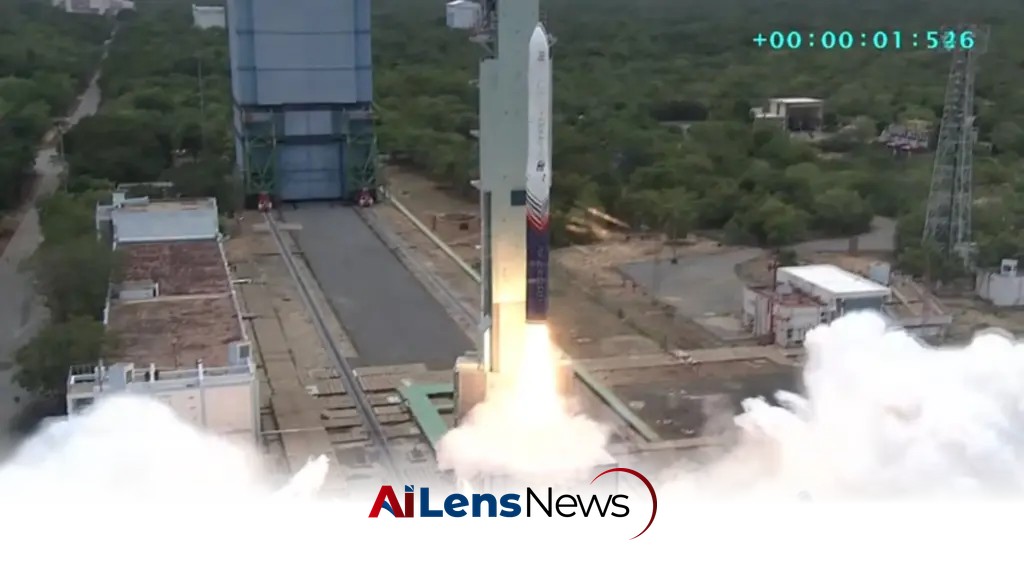


India's Vikram-1 rocket, developed by Skyroot Aerospace, successfully launched multiple payloads into low-Earth orbit, marking a significant milestone for the private space sector.
New Delhi, India Jul 19, 2026 ALN: India’s first privately developed orbital rocket, Vikram-1, successfully placed multiple technology demonstration payloads and postcards, including one from Prime Minister Narendra Modi, into a low-Earth orbit on Saturday. This launch marks a significant milestone in India's burgeoning private space sector and showcases the country's growing capabilities in advanced space technologies.
Dubbed ‘Mission Aagaman’ (meaning arrival), this mission signifies the entry of India’s private space sector into the orbital launch market, spearheaded by Skyroot Aerospace. The successful launch of Vikram-1 is not just a triumph for the company but is also seen as a pivotal moment for the Indian space industry as a whole, which has historically been dominated by the Indian Space Research Organisation (ISRO).
Skyroot Aerospace celebrated the launch as a “grand success.” Prime Minister Modi congratulated the team, stating that the successful launch demonstrates India’s capability to become “Atmanirbhar” (self-reliant) in advanced space technologies. This sentiment reflects the broader national agenda aimed at promoting self-reliance in various sectors, including defense and technology, as part of the government's push for a more robust domestic industry.
During a phone call with Skyroot Aerospace CEO Pawan Kumar Chandana and co-founder Naga Bharath Daka, Chandana informed the Prime Minister that his handwritten postcard bearing the message “Vande Mataram” had successfully reached its 450-km Low Earth Orbit. “Your card has successfully reached orbit. ‘Vande Mataram’ is now in orbit,” he said. This personal touch adds a unique narrative to the mission, connecting the leadership of the nation directly with the advancements in space technology.
The four-stage, seven-storey-tall Vikram-1 rocket lifted off majestically at 12:05 PM on Saturday from the first launch pad, leaving behind plumes of orange smoke and marking a new era for this spaceport. A “planned hold” due to navigation issues had delayed the launch time to 12:05 PM. Such challenges are inherent in space missions, where precision and timing are critical for success.
After its ascent, the primary payloads, which included technology demonstrators from Grahaa Space, Cosmoserve, DCubed, and Skyroot’s SCOPE, were sequentially deployed into a 450 km Low Earth Orbit (LEO). The deployment of these payloads is a testament to the rocket's capabilities and the reliability of its design and engineering.
The vehicle also successfully deployed a micro-art payload, an 18-karat gold rocket, and a handwritten postcard from Prime Minister Modi, along with postcards from engineers, scientists, and Indian astronauts. This inclusion of personal messages and artistic elements adds a cultural dimension to the scientific endeavor, highlighting the intersection of technology and human expression.
The miniature micro-art payload features micro-sculptures of Vikram Sarabhai, Sir CV Raman, and former President APJ Abdul Kalam, created as a tribute to these visionaries who shaped India’s scientific and space journey. By honoring these figures, Skyroot Aerospace not only pays homage to the past but also inspires future generations of scientists and engineers in India.
“Skyroot proudly named its rockets and engines after these icons,” the company stated. This branding strategy not only reinforces the company's commitment to Indian heritage but also aligns its mission with a larger narrative of national pride and technological advancement.
The engineering data collected during this test flight will be analyzed to validate guidance and navigation systems and to inform future refinements for commercial satellite missions, according to Skyroot Aerospace. The data gained from this mission will be invaluable as the company prepares for more ambitious projects, potentially opening the door for commercial partnerships and international collaborations.
With this mission, Skyroot Aerospace successfully demonstrated its orbital launch capability with the maiden flight of the Vikram-1 launch vehicle, moving beyond the suborbital flight achieved by its Vikram-S mission in 2022. This progression illustrates the rapid development of capabilities within the Indian private sector, which has been gaining momentum since the government opened the space sector to private players in 2020.
The successful flight validated the performance of the rocket’s all-carbon composite structure and 3D-printed engines in a real flight environment, features the company claims are “firsts.” The use of advanced materials and manufacturing techniques is a significant step forward, as these innovations can lead to reduced costs and increased efficiency in rocket design and production.
Both Chandana and co-founder Naga Bharath Daka, former ISRO scientists, were present at the space agency’s Mission Control Center (MCC) during the launch, along with its chief V Narayanan. Former ISRO chiefs, astronaut Shubhanshu Shukla, and Andhra Pradesh minister Nara Lokesh were also present to witness the launch. This gathering of prominent figures from the Indian space community underscores the collaborative spirit that is essential for the growth of the space industry.
This historic milestone is expected to strengthen India’s position in the rapidly growing global small satellite launch market, expanding the country’s presence in space alongside ISRO. The global small satellite launch market is projected to grow significantly in the coming years, driven by the increasing demand for satellite-based services in communications, Earth observation, and scientific research.
The payloads that accompanied Vikram-1 include Cosmoserve Space’s Embrace (mission name), an in-orbit demonstration of robotic arms capable of removing space debris, and Solaras by Grahaa Space, a compact satellite mission developed to demonstrate new capabilities in LEO. The focus on space debris removal is particularly timely, as the increasing number of satellites in orbit raises concerns about the sustainability of space activities.
According to the company, the Scope satellite by Skyroot Aerospace is an in-house experimental payload developed to test space technologies for future missions. This emphasis on research and development is crucial for maintaining competitive advantages in the rapidly evolving space sector.
Cosmic Bloom, an “artistic lab-grown diamond” by Cosmos Diamonds, and German test payloads uD3PP and mD3RN by Dcubed also successfully reached space on Saturday. The inclusion of diverse payloads highlights the collaborative nature of modern space missions, where multiple stakeholders can leverage shared resources to achieve their objectives.
In conclusion, the successful launch of Vikram-1 represents a significant achievement for Skyroot Aerospace and the Indian private space sector. It not only enhances India's capabilities in space launch technology but also sets the stage for future innovations and collaborations in the global space arena. As the private sector continues to evolve, it is likely to play an increasingly important role in shaping the future of space exploration and utilization, contributing to national pride and technological advancement in India.
To learn more about the latest developments in Software & Platforms, stay updated with our exclusive reports and analyses on AiLensNews.

