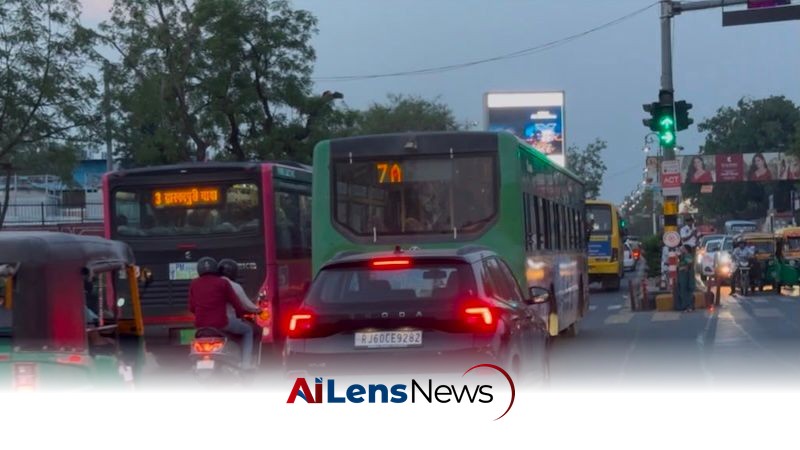


Jaipur is set to enhance traffic management with AI-driven signals at 253 intersections after a successful trial at Rambagh Circle, improving traffic flow and reducing emissions.
New Delhi, India Jul 13, 2026 ALN: Jaipur: Traffic signals in Jaipur are set to shift from fixed timers to a fully artificial-intelligence-driven system, following the success of a 39-day trial at Rambagh Circle, one of the city’s busiest intersections. The initiative, driven by Director General of Police Rajiv Kumar Sharma, was carried out by Jaipur Traffic Police in partnership with Data Core Infotech, and monitored by Traffic DCP Yogesh Goyal.
Unlike conventional signals that run on a fixed cycle of 60 to 90 seconds regardless of actual traffic, the new AI-based Intelligent Traffic Management System (ITMS) uses cameras to continuously read live vehicle counts and queue lengths on each arm of an intersection. The system automatically extends green time for the road carrying heavier traffic and shortens it for lighter lanes, operating fully automatically round the clock without requiring a traffic police officer to operate any remote or switch, according to Data Core Infotech directors Basant Goswami and Ojas Shukla.
The implementation of AI in traffic management is part of a broader trend seen in urban centers around the world, where cities are increasingly adopting smart technologies to improve traffic flow and reduce congestion. The use of AI in traffic signals represents a significant advancement over traditional systems, which are often inefficient and do not account for real-time traffic conditions. In many cities, fixed-timer signals can lead to unnecessary delays, increasing travel times and contributing to higher levels of vehicle emissions and air pollution.
During the trial, held from June 3 to July 11, 2026, the system cleared more than 4,88,140 vehicles at Rambagh Circle without human intervention. Motorists saved between 8 and 45 seconds per lane, with the average lane green time recorded at 33.63 seconds. The smoother flow of traffic also cut carbon dioxide emissions by 2,535 kg over the 39 days, a reduction of about 65 kg a day, according to trial data. This reduction in emissions aligns with global efforts to combat climate change and improve urban air quality, showcasing the potential environmental benefits of implementing smart traffic management systems.
Following the trial’s success, the Jaipur Police Commissionerate plans to connect 253 of the city’s 423 intersections to the AI-based smart camera and ITMS network. This widespread implementation is expected to significantly enhance the overall efficiency of traffic management across the city, potentially reducing congestion and improving travel times for residents. As urban populations continue to grow, cities face increasing challenges related to traffic management, and solutions like the AI-based ITMS could be crucial in addressing these issues.
Beyond signal timing, the system is designed to flag traffic violations automatically. Each camera reads about 4,200 vehicles daily, with details of roughly 450 vehicles’ pending challans recorded automatically. This feature is particularly significant in a country like India, where traffic violations are common, and enforcement can be challenging due to limited resources. Once rolled out, the cameras are expected to catch overspeeding, red-light jumping, wrong-side driving, and lane violations, and to alert the control room instantly if a scanned vehicle already has challans pending against it. This automated approach to traffic enforcement not only increases compliance but also allows law enforcement to allocate their resources more effectively.
Goswami and Shukla said the Rambagh trial marks only the first phase of the project. The next phase will involve multi-junction synchronization, allowing signals at different intersections to communicate with each other and manage traffic along an entire route rather than a single junction. This capability could lead to even greater efficiencies and reductions in congestion, as traffic signals would be able to adjust in real-time based on the flow of vehicles across multiple intersections.
Later phases envisage automatic priority green signals for VIP movement, fire brigade vehicles, and ambulances, so that patients are not held up in traffic. This is particularly important in emergency situations where every second counts. The ability to prioritize emergency vehicles could save lives and improve response times, addressing a critical need in urban traffic management.
Officials said the shift to AI-based traffic management is also expected to free up traffic police personnel from standing at intersections, allowing them to focus more on accident-prone spots, schools, and markets. This reallocation of resources could enhance road safety and improve the overall effectiveness of traffic management in Jaipur. With fewer officers required to manually control traffic signals, law enforcement can concentrate on areas where human intervention is necessary, such as accident hotspots or crowded pedestrian zones.
The implications of this shift extend beyond just traffic management; they also touch on broader themes of urban planning, public safety, and environmental sustainability. As cities like Jaipur invest in smart technologies, they can create more livable environments for residents, reduce pollution, and improve the efficiency of public services. The integration of AI into traffic systems is just one example of how technology can be leveraged to address urban challenges.
As Jaipur embarks on this ambitious project, it will be important to monitor the outcomes of the AI traffic signals closely. Continuous evaluation will help to identify any issues that arise and allow for adjustments to be made to optimize the system further. Additionally, public awareness campaigns may be necessary to educate drivers about the new system and its benefits, ensuring smooth adoption and compliance.
In conclusion, the implementation of AI traffic signals at 253 intersections in Jaipur represents a significant step forward in urban traffic management. By utilizing advanced technology to optimize traffic flow and enhance safety, Jaipur is positioning itself as a forward-thinking city ready to tackle the challenges of modern urbanization. The success of this initiative could serve as a model for other cities in India and around the world, demonstrating the potential of smart technologies to transform urban living.
To learn more about the latest developments in Software & Platforms, stay updated with our exclusive reports and analyses on AiLensNews.

