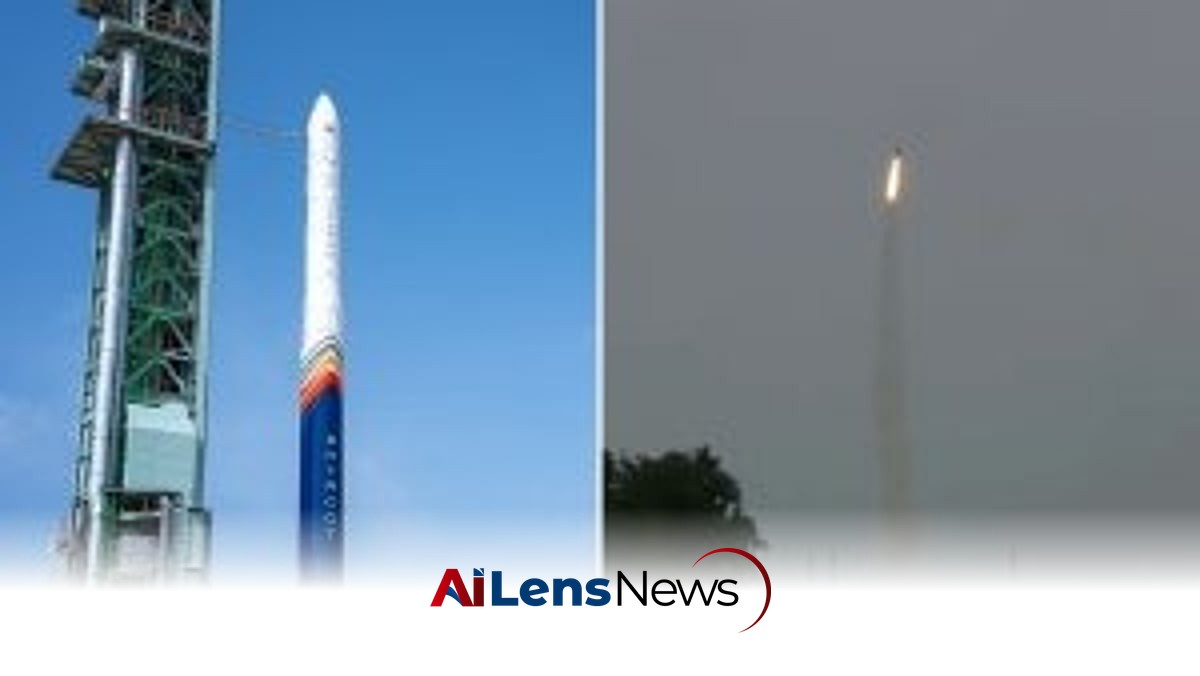


Skyroot Aerospace's Vikram-1 successfully reaches orbit, marking a significant milestone for India's private space sector and its first orbital-class rocket.
Itanagar, India Jul 18, 2026 ALN: Guwahati: Skyroot Aerospace has successfully launched Vikram-1 Test Flight-1, marking the maiden flight of India's first privately developed orbital-class rocket and a significant milestone for the country's private space sector. This achievement not only highlights the advancements made by private companies in India's space exploration efforts but also reflects a broader trend in the global space industry, where private enterprises are increasingly taking on roles traditionally reserved for government agencies.
The mission, named Mission Aagaman, was launched from the Satish Dhawan Space Centre, a facility that has been pivotal in India's space endeavors since its establishment. The successful placement of payloads into a nearly 450-kilometre Low Earth Orbit (LEO) is a testament to the meticulous planning and execution by the Skyroot team. With this achievement, India has become the third country in the world to demonstrate private orbital launch capability, joining the ranks of the United States and China. This milestone is particularly significant as it opens up avenues for more commercial satellite launches and collaborations with international space agencies.
Prime Minister Narendra Modi congratulated Skyroot Aerospace on the successful mission, describing it as a landmark achievement for India's growing space ecosystem. His acknowledgment underscores the government's support for the burgeoning private space sector, which has been encouraged through various policy initiatives aimed at fostering innovation and investment in space technology. The Indian government has recognized the potential of private players to contribute to its ambitious space goals, including plans for interplanetary missions and satellite deployment.
The 24-metre carbon-composite Vikram-1 rocket completed all planned stages of flight, including stage separations and the successful operation of its Orbital Adjustment Module (OAM). The OAM is a critical component of the rocket, designed to perform maneuvers in space that are essential for precise payload deployment. It fired its 3D-printed liquid engine to perform the final orbital insertion, showcasing the technological advancements in additive manufacturing and its application in aerospace engineering. The ability of the OAM to start, stop, and restart while in space is a significant feature that enhances the flexibility and efficiency of satellite operations.
During the mission, the Kalam-1200 solid-fuel first stage propelled the rocket through the densest part of the atmosphere before separating as planned. This stage is crucial as it provides the initial thrust needed to escape Earth's gravitational pull. Following this, the payload fairing was jettisoned, exposing the payloads to the vacuum of space. The successful burn and separation of the Kalam-250 second stage were next, which further propelled the rocket into its designated orbit. Finally, the Kalam-100 third stage completed the solid-propulsion phase of the mission, demonstrating the reliability of the multi-stage launch vehicle.
Designed to carry payloads of up to 350 kg into a 450-kilometre Low Earth Orbit, Vikram-1 carried several payloads on its maiden flight, including 'Diamond Lotus', a lab-grown diamond developed by Bengaluru-based Cosmos Diamonds. The inclusion of such innovative payloads reflects the diverse applications of space technology, from scientific research to commercial ventures. The successful launch of these payloads not only validates the capabilities of the Vikram-1 rocket but also encourages further investment in research and development within the private sector.
One of the mission's most symbolic payloads was a handwritten postcard by Prime Minister Narendra Modi bearing the words "Vande Mataram". This gesture represents a blend of national pride and the personal connection between the country's leadership and its space endeavors. The rocket also carried handwritten messages from the Skyroot team, investors, policymakers, and well-wishers from around the world, making Mission Aagaman a celebration of India's expanding space ambitions and the country's growing role in the global commercial space industry. Such symbolic gestures are important as they foster a sense of community and shared aspiration among those involved in the mission.
The success of Vikram-1 is expected to have several implications for the future of India's space industry. Firstly, it sets a precedent for other private companies to pursue orbital launches, potentially leading to increased competition and innovation in the sector. As more players enter the market, the costs of launching satellites may decrease, making space more accessible to a wider range of customers, including startups and small businesses. This democratization of space access could facilitate a new wave of technological advancements and business models centered around satellite technology.
Moreover, the successful launch of Vikram-1 could attract foreign investment and partnerships, as international companies look to collaborate with Indian firms that demonstrate a proven capability in space technology. Such collaborations can lead to knowledge transfer and the development of cutting-edge technologies that can benefit not only the private sector but also governmental space initiatives.
In addition to commercial implications, the launch also reinforces India's position in the global space community. As countries around the world ramp up their space exploration efforts, India's ability to conduct successful orbital launches through private enterprises enhances its reputation as a serious player in the international space arena. This could lead to increased participation in collaborative projects, such as satellite constellations for global internet coverage or joint missions to explore celestial bodies.
As the space industry continues to evolve, the successful launch of Vikram-1 serves as a reminder of the importance of fostering innovation and supporting the growth of private enterprises. With the right policies and support, India can position itself as a leader in the commercial space sector, contributing to advancements in technology, science, and international collaboration.
- South Korea Launches Investigation into Deadly Hanwha Aerospace Factory Explosion
To learn more about the latest developments in Artificial Intelligence, stay updated with our exclusive reports and analyses on AiLensNews.

