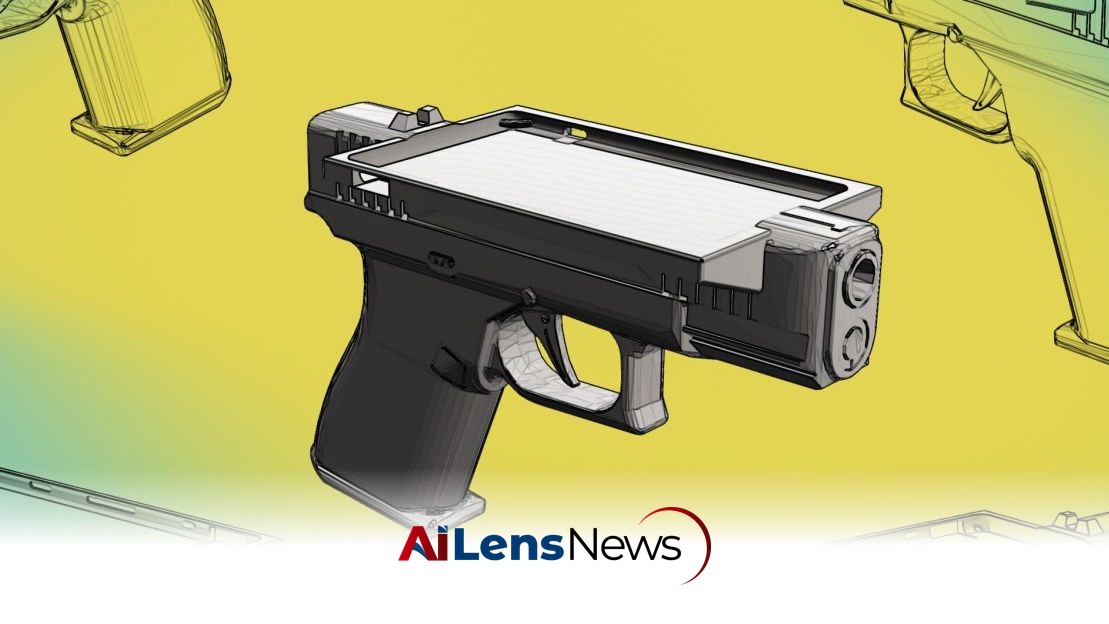


A bizarre 3D-printed e-reader case designed to resemble a gun sparks debate on the feasibility of mandating gun-blocking software for 3D printers.
New Delhi, India Jul 25, 2026 ALN: The intersection of nology and public safety is increasingly becoming a focal point of discussion, particularly in the realm of 3D printing. The recent unveiling of a 3D-printed e-reader case designed to resemble a firearm has sparked a debate that extends beyond mere novelty. This incident raises critical questions about the implications of 3D printing nology, the evolving landscape of gun regulation, and the balance between innovation and safety.
Luke The Maker, a creator based in Louisville, Kentucky, introduced a 3D-printed e-reader case that is modeled after a Glock 19, a widely recognized handgun. Dubbed the "Gundle," this accessory is designed to fit the minimalist Xteink X4 e-reader, allowing it to rest atop the case in a manner that mimics the appearance of a firearm. While the case is clearly non-functional—squeezing the trigger yields no results—it serves as a provocative commentary on the current state of both 3D printing and gun culture in America.
In a demonstration of the Gundle, Blackford, the creator, is seen engaging with classic literature, flipping through the pages of Cormac McCarthy’s Blood Meridian and J.D. Salinger’s The Catcher in the Rye, before casually tossing the firearm-shaped e-reader case into his car's center console. The accompanying text, which refers to the case as "the perfect e-reader for public reading," is intended to highlight the absurdity of the design while simultaneously critiquing societal perceptions of firearms.
Despite its humorous intent, the Gundle has ignited a serious conversation about the future of 3D printing nology and its potential implications for public safety. In various states across the U.S., lawmakers are advocating for legislation that would require gun-blocking software on all new 3D printers sold. This nology aims to analyze digital files before printing begins, scanning for designs that resemble firearms or firearm components. If a design is flagged as gun-like, the printer is programmed to halt the printing process.
As of now, New York has enacted such regulations, and similar legislation has passed the California state assembly. However, the effectiveness of these proposed regulations remains a point of contention. Critics voice concerns regarding the potential for false positives—instances where items that are not firearms but may bear a resemblance are blocked from being printed. Blackford's Gundle case exemplifies this gray area, as it is a non-threatening design that could easily be misidentified as a firearm under stringent detection criteria.
Blackford himself has expressed skepticism regarding the proposed regulations, emphasizing his commitment to open-source nology and the potential dangers of overreach in regulating 3D printing. "It’s just a wild frontier right now, so I definitely don’t trust [gun blueprint scanning] now," he stated. He believes that if individuals are determined to 3D print firearms, they will find ways to do so regardless of regulatory measures in place. This sentiment echoes a broader concern among creators and advocates for nological freedom, who fear that restrictions could stifle innovation and artistic expression.
The implications of these legislative efforts extend beyond the realm of individual creators like Blackford. As lawmakers push for regulations, it remains unclear how these laws would affect the creative community at large. For example, inquiries directed to New York Governor Kathy Hochul's office regarding the potential impact of false positives on creative expression have gone unanswered. Jess D’Amelia, the deputy communications director for Governor Hochul, has stated that the administration is focused on improving public safety and reducing gun violence, suggesting that the law is designed to address the threats posed by ghost guns and illegally manufactured weapons.
Experts in nology policy, such as Cliff Braun from the Electronic Frontier Foundation, have pointed out the challenges involved in implementing effective detection systems. The proposed software's ability to accurately flag designs like Blackford's remains uncertain. Critics argue that a cautious system relying on hash values to identify known firearm designs could easily be circumvented by making minor adjustments to a file's design. Conversely, a more expansive approach utilizing artificial intelligence to analyze a file's geometry may lead to a higher incidence of mistakes, potentially flagging benign items that merely resemble firearms.
"The intent of the law is not to block prints like this, but I think this print is a really good example of why that’s hard," Braun remarked, highlighting the complexities of distinguishing between functional firearms and harmless replicas or artistic expressions.
The challenges associated with detecting handgun designs are compounded by regulatory ambiguities. In 2022, the Bureau of Alcohol, Tobacco, Firearms and Explosives (ATF) clarified that only specific parts of a firearm—the housing or structure for the primary fire control component—are required to bear a serial number. This nuance complicates the detection of handgun frames, which can often resemble various non-gun items, further blurring the lines for software intended to block firearm designs.
Solomon Diamond, an associate professor of engineering at Dartmouth College, elaborated on the nical challenges faced by detection systems. Whether Blackford's e-reader case gets blocked ultimately depends on the nology employed by the printer. A conservative hashing approach might fail to detect the design, while a system using computer vision and AI could mistakenly identify it as a firearm. "Basing blocking on visual resemblance is where the false positive concerns arise because a prop and a real functional firearm resemble one another," Diamond explained. He noted that balancing the thresholds for decision-making in these systems is fraught with challenges, as achieving low false positive rates could result in unacceptably high false negative rates and vice versa.
Diamond proposed a geometric identification approach as a potential solution, suggesting that this method could theoretically allow for exact geometric matches that would minimize false positives. However, he acknowledged that this nique is still in its infancy concerning 3D print blocking and has yet to be widely adopted.
As the debate surrounding the implementation of gun-blocking software continues, it raises broader questions about the balance between public safety and the freedom of creative expression. The Gundle serves as a case study in the complexities of regulating emerging nologies and illustrates the potential pitfalls of relying on automated systems to enforce safety measures. As 3D printer manufacturers and policymakers grapple with these challenges, the outcome of this discussion will likely shape the future of both 3D printing nology and firearm regulation in the United States.
To learn more about the latest developments in Software & Platforms, stay updated with our exclusive reports and analyses on AiLensNews.

