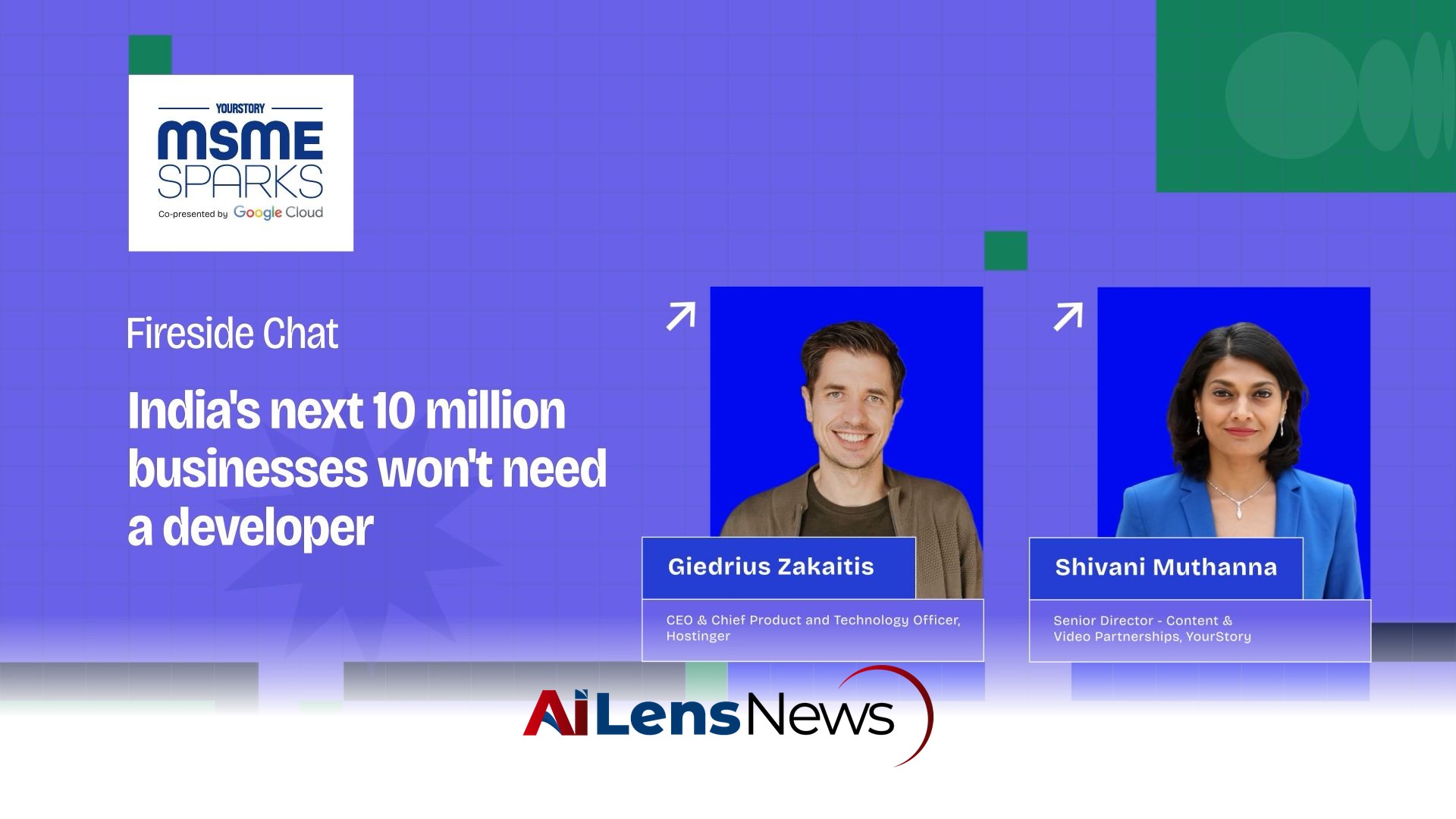


At MSME Sparks 2026, Hostinger's CEO shared insights on overcoming barriers for MSMEs, emphasizing confidence and ownership in the digital space.
New Delhi, India Jul 31, 2026 ALN: In the ever-evolving landscape of entrepreneurship, particularly within the realm of Micro, Small, and Medium Enterprises (MSMEs), many founders encounter a common dilemma. They often find themselves at a crossroads where their innovative ideas are ready for market introduction, yet the transition to an online platform appears daunting. This sentiment was palpable during the grand finale of MSME Sparks 2026, which took place on June 26 at ITC Gardenia in Bengaluru. At this significant event, Giedrius Zakaitis, the CEO and Chief Product and Technology Officer at Hostinger, addressed these challenges head-on, aiming to empower Indian MSMEs to embrace digital transformation.
In a fireside chat moderated by Shivani Muthanna, Senior Director and Head of Video Content Partnerships, Zakaitis identified three primary barriers that have historically impeded the progress of small business founders: capital, capability, and confidence. His insights are particularly relevant in the context of the Indian economy, where MSMEs contribute significantly to employment and GDP but often struggle with digital adoption.
Zakaitis asserted that two of these barriers—capability and capital—are no longer insurmountable. He emphasized that advancements in artificial intelligence (AI) have effectively dismantled the capability barrier. "The capability barrier got removed completely with AI, because now we can do the same. We can launch and store in a minute for a few hundred rupees," he noted. This is particularly significant in a country like India, where the cost of technology and skilled labor can be prohibitive for small businesses. Furthermore, he pointed out that while capital may still be necessary for scaling operations, it is no longer a prerequisite for initiating a business. Instead, he highlighted confidence as the most critical barrier that remains, stating, "AI unlocked so many possibilities that you just need confidence. You just need to start."
Once the decision to establish an online presence is made, Zakaitis offered crucial advice to MSME founders: avoid building businesses within closed ecosystems that they do not control. Social media platforms, while valuable for visibility, often dictate the rules of engagement and can limit a business's reach unless additional payments are made. This reality can stifle growth and innovation for small enterprises. By owning their domain and the relationship with their customers, businesses can maintain control over their operations and customer interactions.
To facilitate this ownership, Hostinger has developed Hostinger Reach, an AI-first marketing platform designed to empower businesses to conduct personalized marketing campaigns. This platform allows users to create tailored email and WhatsApp campaigns based on actual customer behavior, moving away from the one-size-fits-all approach that often characterizes traditional marketing strategies. Founders can articulate campaign ideas in simple language—whether for a seasonal sale or a promotional event—and receive a ready-to-send draft almost instantaneously, leveraging the platform's understanding of their business and customer base.
Zakaitis's second piece of advice revolved around a common pitfall he has observed among entrepreneurs: the tendency to delay launching their offerings in pursuit of perfection. He recounted instances where small business owners spent months, or even years, refining their websites and products, only to be overtaken by competitors who had the courage to launch sooner. He cautioned, "I've seen so many founders, small businesses who kept building, not publishing the website, like for half a year, for a year, that some other mediocre brand... just overtook them just because they were slow, just because they were hesitant to publish, to go live, and to get the first customer." This hesitation can be detrimental in a fast-paced market, where agility and responsiveness are crucial for success. Zakaitis offered a heuristic for founders: if they are not experiencing a degree of discomfort with what they are about to launch, they have likely waited too long.
The third and perhaps most vital step that Zakaitis emphasized is the importance of maintaining close relationships with customers post-launch. He shared that at Hostinger, this practice has been fundamental since the company's inception. "There is not a single day that I wouldn't get a message from our clients, and usually most of these messages are once again these little small improvements that we can make for the product, and then this one small tip really improves the experience for 1,000 other customers," he explained. This customer-centric approach not only fosters loyalty but also facilitates continuous improvement based on real user feedback.
Hostinger's commitment to customer engagement has yielded impressive results, as evidenced by the company's revenue tripling over the past four years while maintaining a stable workforce. This growth trajectory underscores the efficacy of their operational philosophy, which prioritizes customer input and iterative enhancement.
The Q&A session that followed Zakaitis's presentation delved into topics that resonated deeply with the founders in attendance. Questions arose regarding the management of a business's presence across multiple platforms and marketplaces, the competitive landscape for AI-native businesses, and the implications of agentic e-commerce for small enterprises entering the digital space. On the latter point, Zakaitis provided a noteworthy perspective, suggesting that founders who proactively design for agent-driven transactions today will gain a structural advantage over those relying on outdated infrastructure.
For entrepreneurs seeking actionable insights, Zakaitis distilled his guidance into three key takeaways. First, he reiterated the importance of owning one's platform, cautioning against building businesses within closed social ecosystems that can impose unpredictable changes. By securing their domain and nurturing customer relationships, founders can establish a foundation that is resilient to external fluctuations. Second, he urged entrepreneurs to launch their offerings before achieving perfection, emphasizing that a live, albeit imperfect, website is far more advantageous than one that remains in development. Finally, he stressed the necessity of maintaining close connections with customers after launching, advocating for a culture of continuous feedback that can lead to enhancements benefiting a broader user base. This practice should be ingrained as a habit rather than treated as a one-time task.
As the event drew to a close, Zakaitis's overarching message served as an empowering reminder for the founders present: the tools and technologies required for success in the digital age are increasingly accessible. What remains is the crucial decision to take the first step. In a rapidly changing world, where digital transformation is not just an opportunity but a necessity, the confidence to begin can be the defining factor that separates thriving businesses from those that falter.
To learn more about the latest developments in Founders' Stories, stay updated with our exclusive reports and analyses on AiLensNews.

