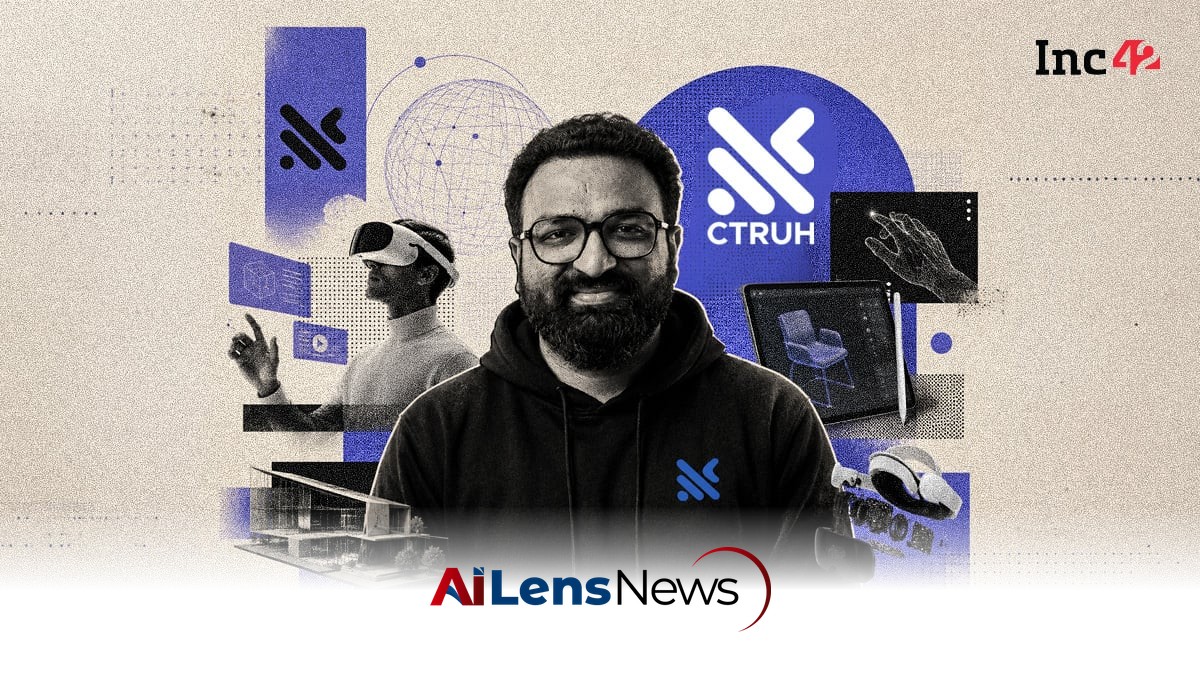


Founded in 2023, Ctruh has developed an AI-powered platform enabling enterprises to create immersive 3D experiences without coding or expensive hardware. The startup recently raised $2.5 million in seed funding to expand its offerings globally.
New Delhi, India Jul 10, 2026 ALN: Remember the early 2000s? There was always a queue in front of the AR/VR canopy at the local gaming zone. For most of us, it was a one-off experience, exciting enough to talk about but not something that would become a part of our daily lives.
Back then, no one imagined that we would one day use the same immersive tech to buy furniture, take home tours, and even give training for medical work. We have arrived, to say the least. And powering this shift is the spatial internet, an evolution of the internet that allows digital content to exist and interact with the physical world through technologies such as AR, VR, AI, and smart sensors.
The tech is now being used across ecommerce, real estate, automotive, travel, and healthcare, but the market remains fragmented, expensive, and difficult to scale. This is because the spatial internet still lacks a scalable, browser-native infrastructure layer, which is why most AR and 3D experiences remain expensive, hardware-heavy, time-consuming, and limited to a single industry.
Witnessing this, Vinay Agastya founded Ctruh in 2023 to patch up this fragmented market and make immersive content easier to build and use across devices. The startup has built an AI-powered, browser-native platform that helps enterprises build and deploy high-fidelity 3D experiences.
Unlike traditional game engines such as Unity or Unreal, Ctruh users don’t need apps, SDKs (software development kits), coding expertise, or powerful hardware to deploy 3D experiences on their platform.
It recently closed its $2.5 million seed funding round co-led by Inflection Point Ventures (IPV) and Avinya Ventures, with participation from India Accelerator, Founder’s Avenue, Anthill Ventures, IA, Finvolve, and LVX. Ctruh claims to serve clients across ecommerce and retail, healthcare, tourism, auto, and real estate. But before we dive deeper into what exactly the startup has to offer, let’s steal a glance at Ctruh’s beginnings.
Ctruh’s origin story traces back to Agastya’s years of working at the intersection of 3D design, enterprise software, and startup building. A mechanical engineer and former student at the MIT Media Lab, he returned to India in 2014 and started working with Swiggy.
But the eureka moment did not come until he joined no-code AR platform Scapic as a founding team member, where he was tasked with handling product and go-to-market (GTM).
“That’s the first time I ever got introduced to anything immersive. I was pretty intrigued with the possibilities of 3D and XR worlds,” Agastya said.
When Flipkart acquired Scapic, Agastya chose to move on. His next stop was Exotel, where he built and ran the technical customer success function from scratch. His quest to pursue something more meaningful also included a brief stint at Unacademy in 2021.
In 2022, Agastya left the edtech giant to travel for a while and build the “no-code” platform. He spent eighteen months building the Ctruh engine.
During this time, he built two core technologies and focused on raising funds. Ctruh raised its pre-seed capital of $2.5 million from a host of investors, with Agastya putting in $300K.
The funding helped him launch his first patented 3D engine, which runs on browsers across iOS, Android, Windows, and other operating systems (OS), without requiring a VR headset.
The second layer is Versa AI, a proprietary AI model designed to automate 3D content creation. Enterprises can feed in text prompts, product images, or 2D CAD files, and the system converts them into interactive 3D assets within two minutes.
This layer removes the need for brands to understand the coding behind 3D experiences. “In literally six steps and two to three hours, people can spin off a 3D asset and go live with an AR or mixed-reality use case directly on the browser,” he said.
By leveraging its two core technologies, Ctruh currently offers three products, with a fourth one on the anvil. Let’s steal a glance:
Currently, Ctruh operates on an enterprise licensing model. Under this model, users pay an initial implementation fee and an annual recurring subscription. The recurring component covers access to the company’s 3D engine, the Versa AI platform, and the infrastructure required to maintain and run immersive experiences.
With a clientele of 36 enterprises under its belt, the prices vary as per the size of the organisation. The company typically generates annual contract values (ACV) of around $10,000 from SMEs. Meanwhile, large enterprise customers generally pay between $50,000 and $100,000 annually, depending on the product usage.
For new clients, Ctruh initially handles onboarding to help enterprise customers become familiar with the product. It then offers them to use the tool as per their needs with the help of the customer support team.
“Mostly it’s enterprise onboarding first, where we hand-hold them to create and deploy a couple of experiences around their business requirement at a given point in time,” Agastya said.
On the financial front, he said the startup clocked a revenue of around $650K in FY26, with projections to cross $2 million in FY27 on the back of Iris launch and the studio upgrade in the pipeline.
To streamline deployment, the platform is also integrating its offerings with leading ecommerce systems. Shopify integration is already live, while support for WooCommerce and Magento is under development.
Alongside these product launches, the company is preparing to expand internationally, with plans to begin its go-to-market efforts in the US during the second half of the ongoing year.
As the startup eyes global markets and integrates deeper into ecommerce pipelines, the startup will be looking to showcase that high-fidelity spatial tech can be built out of India. But the real question is: can Ctruh turn expensive XR experiences into an invisible, frictionless, and foundational layer of the everyday web?
[Edited By Shishir Parasher]
To learn more about the latest developments in Funding & Investments, stay updated with our exclusive reports and analyses on AiLensNews.

