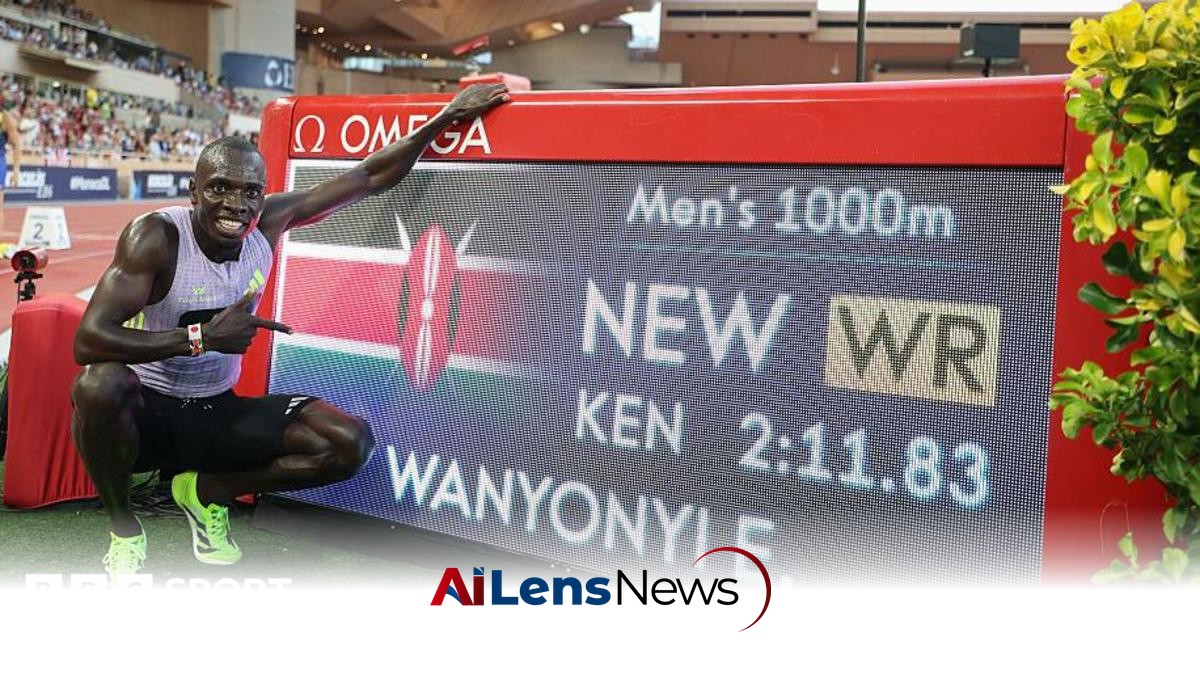


Kenya's Emmanuel Wanyonyi sets a new men's 1,000m world record at the Diamond League meeting in Monaco, finishing in 2:11.83.
New Delhi, India Jul 11, 2026 ALN: Emmanuel Wanyonyi broke the long-standing men's 1,000m world record on his debut at the rarely run distance in Friday's Diamond League meeting in Monaco, with Great Britain's Jake Wightman finishing second.
Wanyonyi's remarkable achievement has not only highlighted his potential as an emerging star in the world but also underscored the historical significance of the 1,000m event, a distance that is often overshadowed by more popular races such as the 800m and 1,500m. The 21-year-old Kenyan athlete crossed the finish line in a record time of two minutes 11.83 seconds, which is 0.13 seconds faster than the previous record set by compatriot Noah Ngeny in 1999. This event took place at the prestigious Stade Louis II, known for hosting a variety of elite track and field competitions.
Wanyonyi, who is also the reigning Olympic and world champion in the 800m, demonstrated his versatility and speed by dominating the race despite the pressure from seasoned competitors. Jake Wightman, the 2022 1500m world champion, put up a strong fight, finishing in second place with a personal best of two minutes 12.77 seconds. Wightman's performance not only earned him the runners-up spot but also moved him to fifth on the all-time world list for the 1,000m distance, further emphasizing the high caliber of competition present in Monaco.
The significance of Wanyonyi's victory extends beyond just breaking a record. It reflects the ongoing legacy of Kenyan athletes in middle-distance running, a tradition that has produced numerous world champions and Olympic medalists. The success of athletes like Wanyonyi and Ngeny illustrates the depth of talent in Kenya, which continues to dominate the , particularly in distances ranging from 800m to 5,000m.
In the aftermath of the race, Wanyonyi expressed his elation at breaking the record but remained humble about his future aspirations. He stated, "I don't want to talk about the world record in the 800m. I first want to run fast and improve my personal best." This statement reflects a maturity beyond his years, as he recognizes the importance of focusing on his development rather than the pressure of chasing records. Wanyonyi's approach is indicative of a new generation of athletes who are increasingly mindful of their physical and mental well-being as they navigate the demands of elite competition.
Wightman, reflecting on his performance, expressed a desire to have "surprised" Wanyonyi but acknowledged the challenge of competing against such a formidable talent. His strategy to push through quickly during the race highlights the tactical nature of middle-distance running, where pacing and positioning can significantly influence the outcome. Wightman's performance not only showcased his own abilities but also served as a reminder of the competitive spirit that defines the Diamond League events.
The Diamond League meeting in Monaco also featured other notable performances across various events. In the men's high jump, Britain's Kimani Jack made a strong impression by finishing second on his Diamond League debut with a clearance of 2.30m. Despite failing to clear 2.32m, Jack's performance indicates a promising future for the young athlete. Winner Oleh Doroshchuk from Ukraine, a world and European indoor champion, cleared the height at his first attempt, showcasing his consistency and skill in the event.
In the men's 400m, British sprinter Matthew Hudson-Smith finished fourth with a time of 44.22 seconds, while world champion Collen Kebinatshipi from Botswana set a new Diamond League record with an impressive time of 43.44 seconds. Kebinatshipi's victory, which included a celebratory display of push-ups inspired by his compatriot Isaac Makwala, highlights the camaraderie and smanship often seen among athletes in the Diamond League.
Meanwhile, British Olympic triathlon champion Alex Yee made a return to track competition, finishing 12th in the men's 5,000m. This marked his first Diamond League event in seven years, illustrating the diverse backgrounds and experiences of athletes participating in the series. His presence in the race serves as a reminder of the cross-disciplinary nature of , where athletes can excel in multiple s.
In the men's 100m, Jamaican world champion Oblique Seville showcased his speed by finishing first with a time of 9.88 seconds, narrowly defeating American Jordan Anthony. This race exemplified the fierce competition in sprinting, where milliseconds can determine the outcome. Emmanuel Eseme from Cameroon secured third place, further emphasizing the depth of talent present in the event.
The women's 200m race featured standout performances, particularly from Saint Lucian Julien Alfred, who crossed the finish line in 21.51 seconds, solidifying her status as the Olympic 100m champion. Alfred's time places her as the third-fastest woman of all time over the distance, trailing only behind legendary athletes Florence Griffith Joyner and Shericka Jackson. Her achievement not only highlights her individual talent but also contributes to the ongoing narrative of female empowerment in , as more women continue to break records and set new standards in the .
In the pole vault, world record holder Armand Duplantis continued to demonstrate his dominance, securing a meeting record with a clearance of 6.07m. The performances of Frenchman Baptiste Thiery and Australian Kurtis Marschall, who both cleared 5.85m, illustrate the high level of competition in the event as well. Duplantis's continued success reinforces his position as one of the premier athletes in the field, inspiring a new generation of pole vaulters.
As the Diamond League season progresses, the next meeting will take place in London on 18 July, where fans and athletes alike will be eager to see if new records can be set or if existing ones will be challenged. The Monaco meeting has set a high standard for the rest of the season, and the performances witnessed are sure to resonate within the community as benchmarks for future competitions. The implications of Wanyonyi's record-breaking run extend beyond the immediate accolades; they signal a potential shift in the landscape of middle-distance running, with new talents emerging to challenge the status quo and inspire future generations of athletes.
To learn more about the latest developments in Global Tournaments & Olympics, stay updated with our exclusive reports and analyses on AiLensNews.

