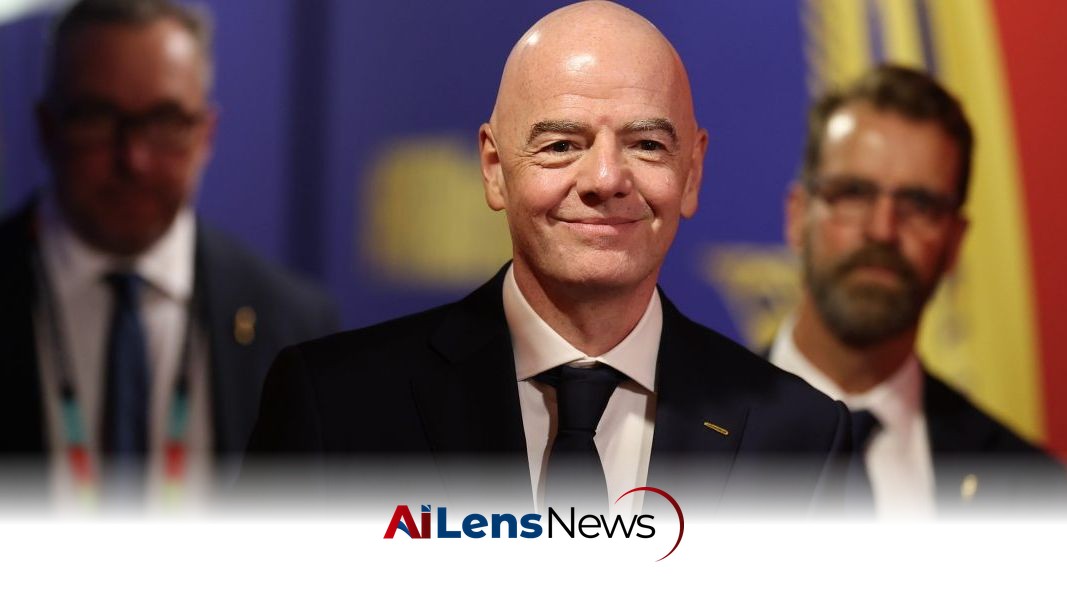


FIFA's proposal to secure billions from private investors has ignited anger among European soccer officials, fearing a shift in power dynamics within the sport.
Washington DC, United States Jul 29, 2026 ALN: The backlash against FIFA's proposed multi-billion dollar investment plan has been swift and intense, igniting a heated debate about the future of soccer and its governance. Critics of the plan, including various stakeholders from European soccer, argue that this move could fundamentally alter the dynamics of the sport, which has long been characterized by its European-centric power structure. The phrase ‘the beautiful game’ has been invoked by many who feel that the commercialization of soccer risks undermining its integrity and traditions.
At the heart of the controversy lies a significant shift in the financial landscape of soccer. FIFA, the governing body responsible for the World Cup, has reportedly been struggling with lackluster financial projections, prompting the need for external investment. According to insiders close to the negotiations, the proposed deal aims to bolster revenue-generating activities that are essential for sustaining the development of soccer on a global scale. This has raised concerns among European soccer interests, who feel threatened by the potential shift in power dynamics.
“UEFA is lashing out because this changes the balance of power in football from being European-centric to global-centric,” stated an anonymous source involved in the investment discussions. This sentiment reflects a broader anxiety among European soccer stakeholders, who have historically held significant influence over the sport's governance and financial distribution.
The plan to sell a stake in FIFA and establish the FIFA Forward Enterprise (FFE), a commercial subsidiary focused on ticketing, sponsorship, and broadcasting, came to light recently and has triggered a wave of criticism. The proposed valuation of FIFA’s commercial rights at $20 billion is ambitious, and the investment group led by Thrive Capital, along with other notable investors like Apollo Sports Capital, aims to inject up to $4.2 billion into FIFA.
Thrive Capital, founded by Joshua Kushner, is known for its investments in technology and media, and the firm’s involvement in this deal reflects a growing trend of private equity in sports. The inclusion of Greg Maffei, founder and CEO of BANN Ventures, further underscores the significance of this investment, as it brings additional financial expertise to the table. However, the backlash from UEFA and other European soccer bodies suggests that the deal is not just about finances, but also about control and influence in the sport.
FIFA's financial projections for the years 2027 to 2030 indicate a 7% annual increase in revenue, with expectations of 10% growth in marketing and a decline in ticketing revenue. The proposed deal promises to significantly increase annual funding to FIFA's member associations, which currently receive $8 million each year. Under the new terms, this amount is expected to rise to $20 million next year, with projections of $22 million by 2031 and $24 million by 2035. This increase in funding is being positioned as a key benefit of the investment, aimed at fostering the growth of soccer worldwide.
FIFA's member associations represent 211 countries, including major organizations like the U.S. Soccer Federation, the Fédération Française de Football, and England’s Football Association. The relationship between FIFA and UEFA has historically been fraught with tension, as both entities vie for political and economic dominance in the sport. The current situation has exacerbated these tensions, with UEFA expressing strong opposition to the investment plan.
“Europe would be leaving $1.1 billion on the table by not signing this deal,” the insider claimed, suggesting that the opposition from UEFA could ultimately be detrimental to European soccer's financial interests. This perspective highlights the complexity of the situation, as European stakeholders must weigh the risks of losing out on significant funding against the potential consequences of ceding control to outside investors.
The timing of this announcement is particularly noteworthy, coming just a week after the conclusion of the 2026 World Cup, which was jointly hosted by the U.S., Canada, and Mexico. The tournament saw record-breaking viewership, yet FIFA faced criticism for its increasing commercialization of the event. The introduction of mandatory “hydration breaks” during gameplay, which allowed broadcasters to run additional s, was one of the controversial changes that drew ire from traditionalists.
FIFA President Gianni Infantino has also been a polarizing figure, having faced scrutiny over various decisions, including a controversial phone call with U.S. President Donald Trump that resulted in a red card being revoked for a U.S. player. Such incidents have contributed to a growing perception of FIFA as an organization that prioritizes commercial interests over the sport's integrity.
As the investment plan unfolds, Infantino is expected to take on the role of commissioner of the new FIFA Forward Enterprise. FIFA has stated that outside investors will hold only a minority stake in the FFE and will not have any operational control over FIFA itself. This assurance is aimed at alleviating concerns about the potential for outside interests to influence the governance of the sport.
The investor mix is particularly notable. Thrive Capital, founded by Joshua Kushner in 2009, has a reputation for investing in companies that exhibit qualities that cannot be easily replicated by technology. The firm’s involvement in the FFE signals a strategic move towards leveraging technology and media to enhance the commercial viability of soccer. Meanwhile, Apollo Sports Capital, an offshoot of the private equity giant Apollo, has emerged as a significant player in the sports investment landscape, with plans to provide a $1.1 billion loan to the German Bundesliga.
The reactions from UEFA and FIFA regarding the investment plan have been muted, with both organizations not responding to requests for comment in time for publication. This silence may indicate a reluctance to engage in public discourse while negotiations are ongoing. However, the implications of this investment plan are far-reaching, and the outcome could reshape the future of soccer governance.
In conclusion, the proposed investment plan by FIFA has sparked a significant backlash from European soccer stakeholders, who view it as a threat to their long-held influence over the sport. As the negotiations progress, the tension between the desire for increased funding and the need to maintain control over the sport will be a critical factor in determining the future trajectory of soccer's governance. The outcome of this plan could have lasting implications not only for FIFA and UEFA but for the global landscape of soccer as a whole.
To learn more about the latest developments in Golf, stay updated with our exclusive reports and analyses on AiLensNews.

