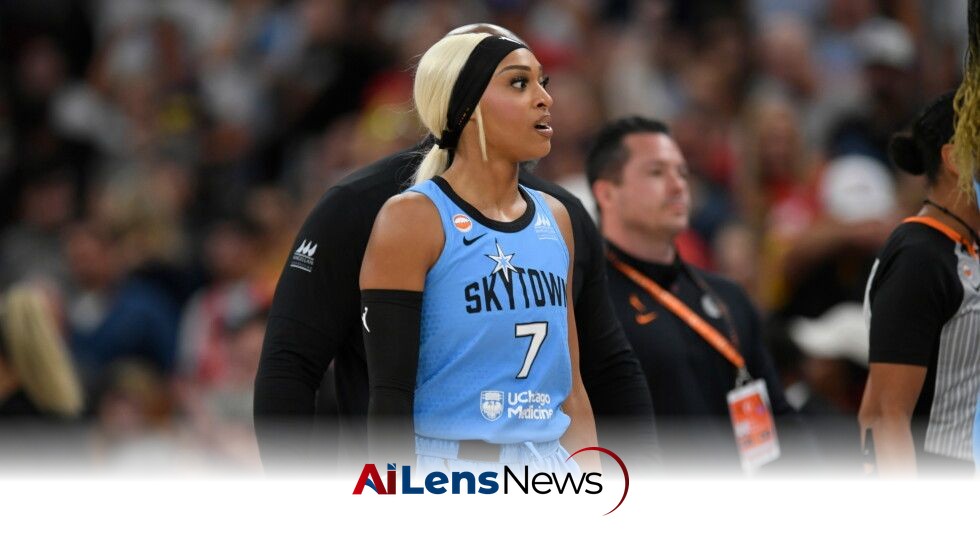


Chicago Sky's DiJonai Carrington clarifies her stance on the Flagrant 2 foul assessed during a game, denying claims of invoking white privilege.
Washington DC, United States Aug 12, 2026 ALN: DiJonai Carrington, a prominent player for the Chicago Sky in the Women’s National Basketball Association (WNBA), has recently found herself at the center of a controversy surrounding a Flagrant 2 foul assessed during a game against the Indiana Fever. The incident, which occurred on a fast-break layup, involved Carrington making contact with Fever player Sophie Cunningham, resulting in Cunningham hitting the court hard after being struck in the head and neck area. This foul was subsequently reviewed by the officiating crew and upgraded to a Flagrant 2, which is defined as a foul that is deemed excessive and unnecessary, warranting ejection from the game.
The context of the play is critical to understanding the implications and reactions that followed. Flagrant fouls are taken seriously in basketball, as they can lead to serious injury and compromise the integrity of the game. The referee's decision was based on three criteria: the windup, the impact, and the follow-through of the foul. The assessment of the foul was significant not only for the immediate game but also for the broader discussions regarding player conduct, safety, and the enforcement of rules within the league. In the high-stakes environment of professional basketball, where emotions run high and competition is fierce, the interpretation of such fouls can lead to contentious debates among players, coaches, and fans alike.
After being ejected from the game, Carrington took to social media to express her frustration. In a post that included the phrase “WHITE PRIVILEGE” and tagged the Fever, she sparked a dialogue that extended beyond the basketball court. The mention of white privilege in the context of a sports foul stirred a considerable amount of debate, particularly given the racial dynamics at play; Carrington is Black, while Cunningham is white. This intersection of race and sports has been a focal point of discussion, especially in recent years as social justice movements have gained momentum across various sectors, including athletics. The WNBA itself has been a platform for players to express their views on social issues, with many athletes using their visibility to advocate for change.
In the aftermath of her social media post, Carrington faced criticism from various commentators, including former NFL linebacker Emmanuel Acho. In response to his critique, she clarified her stance on X, stating that she never claimed the foul assessment was a product of white privilege. Instead, she urged her critics to engage in critical thinking and to understand the complexities of the issues at hand. Carrington emphasized her educational background, noting that she attended one of the top universities where she studied psychology as well as African and African American studies, suggesting that she possesses a nuanced understanding of the subject matter. This educational experience not only informs her perspective but also underscores the importance of context in discussions about race and privilege.
Her assertion that she would not invoke the term 'white privilege' lightly highlights the sensitivity surrounding discussions of race and privilege. The term carries significant historical and social weight, often associated with systemic inequalities that have persisted in various forms throughout society. By distancing herself from the notion that her foul was assessed through a racially biased lens, Carrington sought to refocus the conversation on the specific circumstances of the play and the rules of the game. This approach reflects a broader trend among athletes who are increasingly aware of the ramifications of their words and actions, particularly in a climate where social media amplifies every statement.
Carrington's background as an athlete adds another layer to this narrative. She played four years at Stanford University, where she was a key player on the basketball team, before transferring to Baylor University for her final season. Her academic focus on psychology and African and African American studies indicates a commitment to understanding social issues, which may inform her views on race and privilege. This educational experience could play a role in how she navigates the complexities of race in sports, particularly as a Black athlete in a league that has seen its share of racial discussions in recent years. The WNBA has historically been at the forefront of advocating for social justice, with many players actively participating in movements that address inequality, police brutality, and other pressing societal issues.
As of now, there has been no official word from the WNBA regarding any further disciplinary action against Carrington for the Flagrant 2 foul. The league has historically taken a firm stance on player conduct, especially concerning safety and sportsmanship. The lack of immediate repercussions could suggest that the league is still assessing the incident or that it may not view the foul as warranting additional punishment beyond the ejection during the game. This decision could reflect the league's desire to balance player safety with the need to maintain competitive integrity, a delicate line that officials must navigate in the fast-paced environment of professional sports.
The Chicago Sky, meanwhile, faced the Seattle Storm in their next game, where they lost 97-88. In this matchup, Carrington came off the bench, played for 27 minutes, and scored a career-high 26 points, demonstrating her skill and resilience despite the preceding controversy. Her performance could be seen as a testament to her ability to compartmentalize the events surrounding the ejection and focus on her contributions to the team. This ability to perform under pressure is a hallmark of elite athletes, who often face scrutiny not only for their on-court abilities but also for their off-court behavior.
The implications of this incident extend beyond Carrington and the immediate game. It raises important questions about race, privilege, and accountability in sports. The dialogue surrounding her comments and the foul assessment speaks to broader societal issues, where athletes are increasingly using their platforms to address social justice and equity. As discussions around race and privilege continue to evolve, Carrington’s experience may serve as a case study in how athletes navigate their identities and the ramifications of their actions both on and off the court. The intersection of sports and activism is becoming increasingly prominent, with athletes often finding themselves in the spotlight not just for their athletic prowess but for their roles as public figures and advocates for change.
Ultimately, the incident involving DiJonai Carrington serves as a reminder of the complexities that exist at the intersection of sports, race, and societal issues. As the WNBA continues to grow in popularity and visibility, players like Carrington will likely remain at the forefront of conversations that challenge traditional narratives and push for a deeper understanding of the dynamics at play in professional athletics. The ongoing discourse surrounding this incident may influence how players approach sensitive topics in the future and could lead to changes in how the league addresses issues of player conduct, safety, and social responsibility. As the landscape of professional sports continues to evolve, the voices of athletes will play a crucial role in shaping the future of the game and its impact on society.
To learn more about the latest developments in Basketball, stay updated with our exclusive reports and analyses on AiLensNews.

