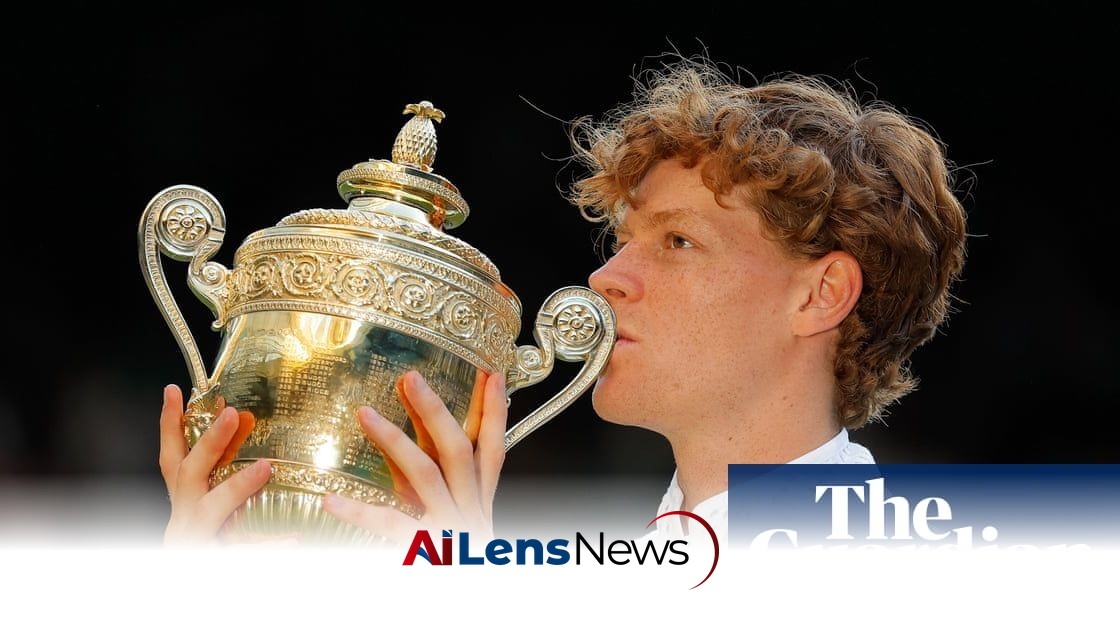


In a thrilling four-set match, Jannik Sinner overcame Alexander Zverev to secure his second Wimbledon title, showcasing exceptional serving and mental resilience.
London, United Kingdom Jul 13, 2026 ALN: In a gripping final at Wimbledon, Jannik Sinner, the world No. 1, successfully defended his title by defeating Alexander Zverev in four sets, with scores of 6-7 (7), 7-6 (2), 6-3, 6-4. The match, lasting 3 hours and 46 minutes, highlighted Sinner's remarkable serving and mental toughness, allowing him to recover from a challenging start. The match served as a testament to Sinner's development as a player and his ability to perform under the immense pressure that accompanies a Grand Slam final.
The match began with Sinner facing a crucial moment while trailing 15-30 in the fourth set. Despite the gusty winds, he responded with a series of powerful service winners, demonstrating his ability to perform under pressure. This pivotal moment set the tone for the remainder of the match, as Sinner maintained a high level of serving throughout. His ability to serve effectively, especially in critical moments, proved to be a decisive factor in his victory.
Both players showcased their serving prowess, but Sinner's transformation in this area has been a significant development in his game. Over the past few seasons, Sinner has worked diligently to improve his serve, which has become one of his key weapons. Zverev, despite landing 76% of his first serves and averaging impressive speeds, could not capitalize on his opportunities. Historically, Zverev had struggled against Sinner, losing nine consecutive matches prior to this final, which added an extra layer of psychological pressure for the German player.
However, Zverev entered the match with newfound confidence after winning his first Grand Slam title at Roland Garros. This victory at the French Open marked a turning point in his career, allowing him to shed the weight of expectations that had been placed upon him since he emerged as a promising young talent. For a set and a half, he played aggressively, showcasing his best tennis in a high-stakes environment. Unfortunately, he could not sustain this level of play throughout the match, as unforced errors began to creep in at critical moments, which ultimately cost him the match.
As the match progressed, Sinner's combination of excellent serving, defensive skills, and strategic shot selection allowed him to seize control. He displayed remarkable resilience, especially after a crushing defeat at the French Open just a month prior, where he led two sets and 5-1 before collapsing against Juan Manuel Cerúndolo. This recent setback seemed to fuel Sinner's determination in the Wimbledon final, as he demonstrated a renewed focus and commitment to his game.
This victory marks Sinner's fifth Grand Slam title, improving his record in major finals to five wins and two losses. His dominance in ATP Tour events, where he has won five consecutive tournaments, underscores his status as a formidable player on the circuit. Sinner's ability to perform consistently at such a high level is indicative of his hard work and dedication to the sport, and it positions him as a leading figure in men's tennis for years to come.
In the first set, Zverev's aggressive play paid off as he clinched the tie-break with a stunning down-the-line forehand winner. This early success seemed to energize Zverev, who was determined to prove that he could compete with the best players in the world. However, the momentum shifted in the second set, where Sinner capitalized on Zverev's early errors to take the tie-break decisively. This shift in momentum was critical, as it allowed Sinner to regain his confidence and assert his dominance on the court.
The first break of serve came in the third set, where Zverev's double fault and subsequent errors handed Sinner the initiative. Once Sinner secured the third set, he maintained his lead and refused to let Zverev back into the match. Sinner's ability to capitalize on Zverev's mistakes demonstrated his keen awareness and tactical acumen, traits that have become hallmarks of his game.
With this victory, Sinner further solidifies his place among the elite in men's tennis, showcasing not only his skill but also his ability to bounce back from setbacks. The implications of this win extend beyond the trophy itself, as it reinforces Sinner's status as a consistent performer at the highest level. As he looks to the future, Sinner's resilience and talent suggest he will remain a significant contender in upcoming tournaments.
Looking ahead, the landscape of men's tennis is increasingly competitive, with several young players emerging as potential stars. Sinner's victory at Wimbledon places him at the forefront of this new generation, alongside players like Carlos Alcaraz and Holger Rune. The rivalry among these young talents promises to create exciting matchups in the coming years, as they seek to establish their legacies in the sport.
Furthermore, Sinner's success also raises questions about the future of established players like Novak Djokovic and Rafael Nadal, who have long dominated the sport. As Sinner continues to develop and refine his game, he may soon become a central figure in the ongoing narrative of men's tennis, potentially shifting the balance of power in the sport. The emergence of younger players like Sinner, Alcaraz, and Rune could signal a transition period in men's tennis, as they challenge the long-standing reign of the older generation.
This generational shift is not just a matter of age but also reflects a change in playing style and approach to the game. The new wave of players often exhibits a blend of power and finesse, coupled with an aggressive baseline game that contrasts with the traditional serve-and-volley approach that characterized earlier eras. Sinner, in particular, has embraced a modern style of play that emphasizes physical fitness, mental toughness, and strategic shot placement, making him a formidable opponent on any surface.
In conclusion, Jannik Sinner's victory at Wimbledon is not just a personal triumph; it represents a significant moment in the evolution of men's tennis. His ability to defend his title against a formidable opponent like Alexander Zverev showcases his growth as a player and sets the stage for an exciting future in the sport. With his combination of skill, mental toughness, and determination, Sinner is poised to leave a lasting impact on tennis for years to come. As the tennis world watches closely, Sinner's journey will undoubtedly be a focal point of discussion and analysis as he continues to compete against both established legends and rising stars alike.
To learn more about the latest developments in Tennis, stay updated with our exclusive reports and analyses on AiLensNews.

