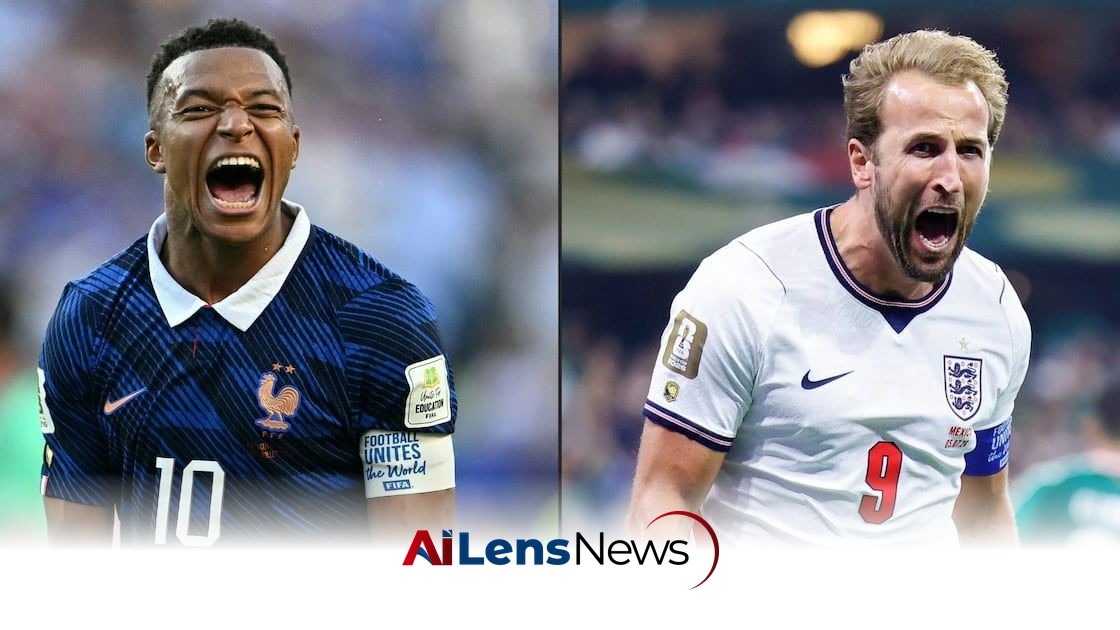


As France faces England in the World Cup 2026 third-place match, Kylian Mbappe and Harry Kane aim for the Golden Boot amidst low stakes.
Abu Dhabi, United Arab Emirates Jul 17, 2026 ALN: The World Cup 2026 has reached its final stages, and while the spotlight is primarily on the championship match, a lesser-known yet intriguing clash awaits. France and England will battle it out for third place, with both teams looking to salvage some pride. Among the players to watch are Kylian Mbappe and Harry Kane, who are both in contention for the coveted Golden Boot.
Kylian Mbappe, the Real Madrid striker, has been a standout performer throughout the tournament, netting eight goals in seven matches. His current tally places him in a strong position to become the leading goalscorer in World Cup history. However, to match Just Fontaine's record of 13 goals in a single tournament, he would need to score five times against England, a feat that seems highly improbable given the competitive nature of the match and the defensive capabilities of the squad.
Mbappe's scoring prowess has been evident not only in this tournament but also throughout his career. He has consistently demonstrated an ability to find the back of the net in crucial moments, often stepping up when his team needs him the most. His combination of speed, skill, and intelligence on the pitch has made him one of the most feared forwards in football today.
Fontaine's remarkable achievement dates back to 1958 when he scored four goals in the third-place match against West Germany, a record that has stood for 68 years. This record is a testament to the exceptional talent and scoring ability that Fontaine possessed, and it has become a benchmark for future generations of footballers. Mbappe's current World Cup career total stands at 20 goals, just one behind Lionel Messi, who leads with 21. This close race between two of the game’s greatest talents adds an extra layer of excitement to the tournament.
The historical significance of the Golden Boot is profound, as it not only highlights individual excellence but also reflects the evolution of the game itself. Over the years, the role of the striker has transformed, with modern forwards required to possess a diverse skill set that includes not only goal-scoring but also playmaking and defensive contributions. As such, Mbappe's pursuit of the Golden Boot is emblematic of a broader narrative in football history, where the best players continually redefine what it means to excel on the pitch.
With one match left for each player, Mbappe is tied with Lionel Messi on eight goals, although Messi currently leads due to having one additional assist. The stakes may be lower in a consolation match, but both players will be eager to enhance their goal tallies. The Golden Boot, awarded to the tournament's top scorer, is not just a personal accolade but also a significant achievement that can enhance a player’s legacy and marketability in the world of football.
In addition to personal pride, the Golden Boot can also have implications for a player's future contracts and endorsements. A player who finishes as the tournament's top scorer often sees their market value increase, leading to lucrative sponsorship deals and increased attention from major clubs. This competitive nature drives players like Mbappe and Kane to perform at their utmost, even in a match that may not hold the same weight as the final.
Mbappe's chances of increasing his goal count depend on whether he is selected for the match. Similarly, Harry Kane and Jude Bellingham, who each have six goals for England, will be looking to make their mark. Managers Didier Deschamps and Thomas Tuchel may opt to give fringe players a chance, but those in good form will likely want to play. The decision to field star players in a match that is often viewed as less significant could also be influenced by the players' own desires to compete and secure individual honors.
In the context of team strategy, the third-place match offers an opportunity for managers to evaluate their squads. It can serve as a platform for younger players to gain valuable international experience and showcase their talents on a global stage. However, the desire of established stars to leave a lasting impression can complicate these decisions, as they may push for playing time to chase individual accolades.
Despite the lack of high stakes, players like Mbappe and Kane, who are in excellent goal-scoring form, will not want to sit out. The desire to secure the Golden Boot could motivate them to perform at their best, even in a match that many regard as a consolation. The psychological aspect of such matches cannot be underestimated; players often use these opportunities to showcase their skills and end the tournament on a high note, potentially influencing their form for the upcoming club season.
Moreover, the third-place match can be a platform for redemption. Players who may have underperformed in earlier matches might view this as their last chance to shine on the world stage. For fans and players alike, the opportunity to end the tournament with a positive result can be immensely satisfying, providing a sense of closure after weeks of intense competition.
The third-place match also serves as a reflection of the teams' overall performances throughout the tournament. For France and England, both of whom entered the tournament with high expectations, the chance to finish third can provide a sense of redemption after being eliminated in the semifinals. Team morale can be significantly impacted by the outcome of this match, as players look to build momentum heading into their respective club seasons.
Winning the third-place match can also influence a team's confidence moving forward. For younger players, a strong performance can set the tone for future international competitions, while for veterans, it can serve as a reminder of their capabilities as they transition back to club football. The psychological boost from a positive result can be invaluable, especially in a sport where confidence plays a crucial role in performance.
For fans, the third-place play-off holds its own significance. It is an opportunity to see their national teams compete one last time in the tournament, and the presence of world-class players like Mbappe and Kane adds to the allure. The match can also be a celebration of football culture, showcasing the passion and dedication of fans who travel great distances to support their teams. The atmosphere in the stadium is likely to be electric, as supporters rally behind their players, hoping for one final display of skill and determination.
In many ways, the third-place match embodies the spirit of the World Cup—celebrating not only the competition but also the camaraderie and shared experiences of fans from around the globe. It serves as a reminder of the joy that football brings to millions, transcending borders and uniting people in their love for the game.
As the World Cup 2026 third-place play-off approaches, the focus will be on whether Kylian Mbappe and Harry Kane can add to their goal tallies. While the match may not hold the same significance as the final, the competition for the Golden Boot adds an intriguing layer to this encounter. The implications of this match extend beyond individual accolades; it represents the culmination of a tournament filled with highs and lows for both teams. As they take the pitch, players will have the chance to leave their mark on the tournament, not just for themselves, but for their nations and their fans as well.
To learn more about the latest developments in Basketball, stay updated with our exclusive reports and analyses on AiLensNews.

