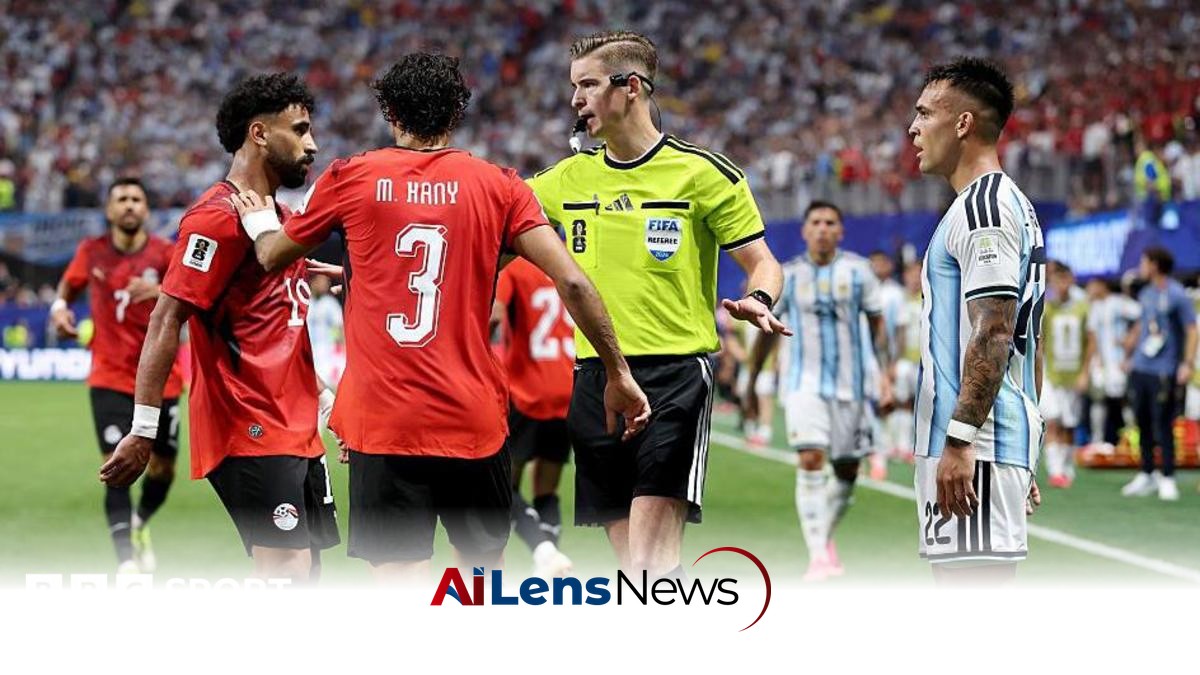


Fifa's Pierluigi Collina defends World Cup referees against allegations of bias following Egypt's controversial loss to Argentina.
New Delhi, India Jul 9, 2026 ALN: Fifa chief refereeing officer Pierluigi Collina asserts that "nobody can question the integrity" of World Cup match officials following "unfounded allegations" made after Egypt's 3-2 loss to Argentina.
On Tuesday, the Egyptian Association (EFA) requested Fifa to remove the officials responsible for their World Cup last-16 defeat from the tournament. This request came in the wake of a contentious match that saw Egypt initially leading 2-0 before a dramatic late comeback from Argentina, culminating in a 3-2 victory for the South American team. The EFA's call for action underscores the heightened emotions and tensions that surround international tournaments, where national pride is often at stake.
The EFA demanded an investigation into perceived "double standards" in officiating after two contentious second-half calls on fouls went against them, allowing Argentina to overturn a 2-0 deficit late in the match. Such instances are not uncommon in high-stakes tournaments, where the pressure on referees can lead to contentious decisions that are scrutinized heavily by fans, media, and governing bodies alike.
Collina stated, "Of course, constructive discussion about decisions will always be part of the game, but unfounded allegations have no place in our game." He emphasized, "Nobody can question the integrity of the Fifa World Cup match officials. When this happens, it may provoke reactions that lead to threats against them and their families. This is not right." His remarks highlight the broader issue of referee safety and the increasing scrutiny that officials face, particularly in high-profile matches where the stakes are extraordinarily high.
Following the match, Egypt's manager Hossam Hassan claimed that his team had been "treated unfairly" and had "suffered injustice." He speculated, "Perhaps they wanted to keep the world champion in the competition. Perhaps they wanted Messi to stay in the running." Such comments reflect a common sentiment among managers and players who often feel that officiating biases can influence the outcomes of critical matches. This perception can lead to a wave of criticism directed at referees and governing bodies, often resulting in calls for accountability and transparency in officiating practices.
Collina further asserted, "Equally, nobody can claim that Fifa refereeing can be influenced by anyone, not even by the Fifa president [Gianni Infantino]." He noted, "Infantino has always shown his full support for Fifa Team One while trusting us to work with complete independence. Match officials make honest decisions and, just like players and coaches, they always try to do their best." This statement serves to reinforce the autonomy of referees, emphasizing that their decisions are made based on the rules of the game, rather than external pressures or influences.
Fifa has faced widespread criticism for its decision not to uphold Folarin Balogun's automatic ban for a red card against Bosnia-Herzegovina, with UEFA labeling it "unprecedented, incomprehensible and unjustifiable." This incident underscores the complexities and controversies that can arise from disciplinary decisions in , where the interpretation of rules can vary significantly between different governing bodies.
US President Donald Trump also commented, stating he had asked Fifa to review the decision. This level of involvement from a national leader highlights the global nature of and how it intersects with politics and national pride. Such interventions can further complicate the already difficult task faced by referees and governing bodies as they navigate the expectations of fans, players, and political figures.
During the match, with Egypt leading 1-0 in the second half against Argentina, the video assistant referee (VAR) ruled out a goal by Mostafa Zico after midfielder Marwan Attia was penalized for stepping on Lisandro Martinez's foot at the start of the play. This decision was met with frustration from the Egyptian camp, who felt that the goal should have stood, reflecting the contentious nature of VAR interventions in high-stakes matches.
A potential foul on Mohamed Salah in the Argentina penalty area was also dismissed just before the reigning champions scored a stoppage-time winner. The failure to award a penalty in this instance added fuel to the fire of allegations regarding biased officiating, as Salah is one of the most prominent players in the tournament and a key figure for Egypt.
Despite typically refraining from commenting on "specific incidents" during major tournaments, Collina supported both decisions. He explained, "After every goal is scored, the VAR checks the attacking possession phase (APP). If a foul is identified in the build-up and is deemed to have impacted the goal, the VAR will recommend an on-field review." This process is crucial for maintaining the integrity of the game, as it allows for a second layer of scrutiny on potentially game-changing decisions.
He added, "There is no defined limit regarding either the distance from goal or the amount of time between the incident and the goal. An example of this came in the Argentina v Egypt game where Egypt number 19 Marwan Attia clearly treads on the foot of Argentina number six Lisandro Martinez." This explanation sheds light on the complexities of VAR and the criteria used to assess fouls in the build-up to goals, which can often lead to heated debates among fans and analysts.
Collina emphasized, "We believe that a foul is a foul. Regardless of whether the foul appears 'obvious', if the referee did not see it on the field of play, the VAR can intervene." This principle is fundamental to the VAR system, which aims to provide clarity and fairness in officiating, even if it occasionally leads to contentious decisions that leave fans and teams divided.
He concluded, "Of course, there will always be an element of subjectivity in some decisions, but we are happy with how this principle has been applied throughout the tournament." This acknowledgment of the subjective nature of officiating speaks to the challenges faced by referees, who must make split-second decisions in high-pressure environments, often with little room for error. As the tournament progresses, the focus on officiating decisions will likely continue, as teams and fans alike seek clarity and fairness in the beautiful game.
To learn more about the latest developments in Football (Soccer), stay updated with our exclusive reports and analyses on AiLensNews.

