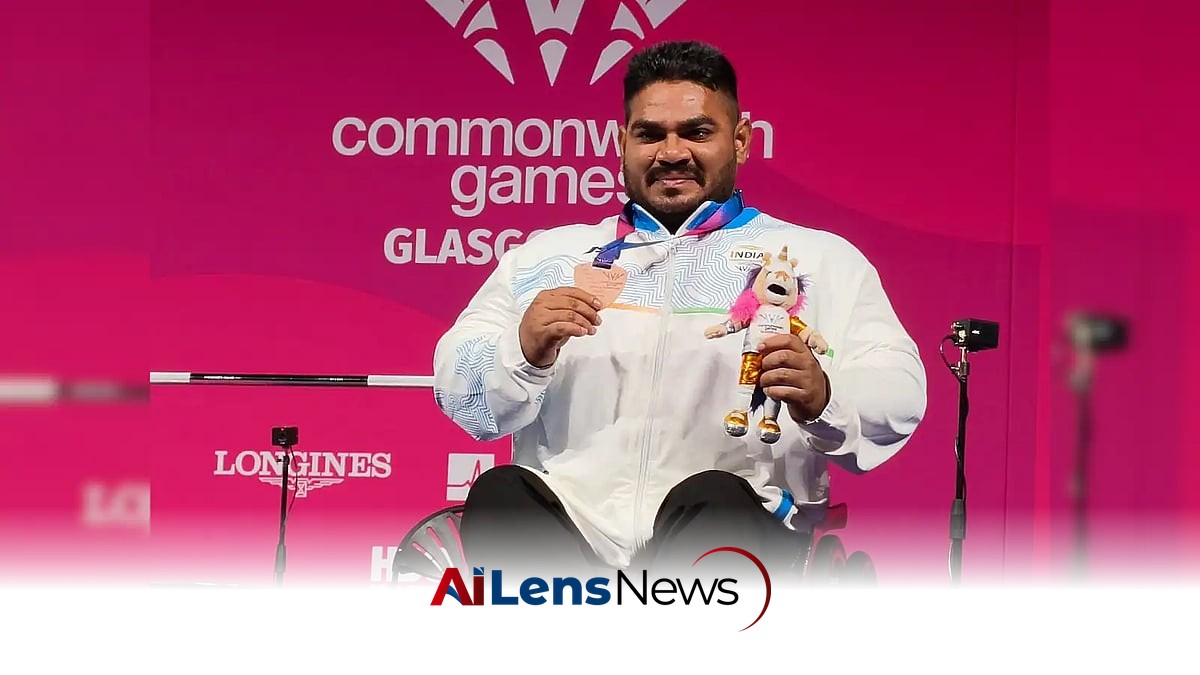


India's Jhandu Kumar secures bronze in men's heavyweight para powerlifting at Commonwealth Games 2026, earning praise from PM Modi.
Kohima, India Jul 25, 2026 ALN: Guwahati: Para powerlifter Jhandu Kumar opened India's medal account at the Commonwealth Games 2026 by winning a bronze medal in the men's heavyweight event, prompting Prime Minister Narendra Modi to congratulate him for his inspiring achievement.
The 28-year-old from Nalanda, Bihar, secured the bronze after successfully lifting 181 kg and 190 kg, finishing with 130.9 points. He narrowly missed a higher finish after failing to clear 196 kg in his final attempt. Nigeria's Idris Riluwan claimed the gold medal, while Matthew Harding won silver.
Jhandu's medal marks the first podium finish for India at the Glasgow Commonwealth Games and caps an extraordinary journey from adversity to international success.
A polio survivor, he grew up in a financially struggling family and helped his parents sell vegetables before taking up para powerlifting. To support his training, he worked various jobs, including operating an e-rickshaw, before making his mark on the global stage.
Congratulating the athlete, Prime Minister Narendra Modi wrote on X, "A spectacular performance by Jhandu Kumar, who has opened India's medal tally at the #CWG2026 by winning a Bronze in the Men's Heavyweight Para Powerlifting event! Congratulations to him. His achievement is a powerful reflection of immense strength, unwavering determination and years of disciplined effort. By overcoming every challenge and excelling on the international stage, he has made the entire nation proud and inspired countless Indians."
Jhandu's bronze has given India an encouraging start to its Commonwealth Games campaign, with several more medal events lined up in the coming days.
The Commonwealth Games, held every four years, is a multi-sport event involving athletes from the Commonwealth of Nations. The 2026 edition, taking place in Glasgow, marks a significant occasion for athletes across various disciplines, including para sports. The inclusion of para powerlifting in the Commonwealth Games has been instrumental in promoting inclusivity and providing a platform for athletes with disabilities to showcase their talents on a global stage.
Jhandu's journey to the Commonwealth Games is emblematic of the challenges faced by many athletes in India, particularly those from marginalized backgrounds. Born with polio, a condition that affects mobility, Jhandu faced significant hurdles from a young age. His family's financial situation meant that opportunities for sports training were limited, and he often had to juggle work and training to pursue his passion. The support from local communities and sports organizations played a crucial role in his development as an athlete, providing him with access to training facilities and coaching.
In recent years, India has made substantial investments in sports infrastructure and athlete development programs, particularly for para athletes. Initiatives aimed at identifying and nurturing talent have resulted in a growing number of athletes excelling in international competitions. The success of athletes like Jhandu Kumar highlights the importance of these programs, as they not only provide financial support but also foster a culture of sportsmanship and resilience.
The significance of Jhandu's achievement extends beyond just the medal. It serves as a source of inspiration for many young athletes in India, particularly those with disabilities. His story underscores the message that with determination and hard work, it is possible to overcome adversity and achieve greatness. This narrative is particularly important in a country like India, where societal perceptions of disability can often be limiting.
Moreover, Jhandu's success at the Commonwealth Games has the potential to influence policy and funding for para sports in India. As visibility increases for para athletes, it is likely that more resources will be allocated to support their training and development. This could lead to an increase in the number of athletes participating in para sports, ultimately enhancing India's performance on the international stage.
As Jhandu Kumar returns home with his bronze medal, he joins a growing list of Indian para athletes who have made their mark in international competitions. His achievement at the Commonwealth Games is not just a personal victory but a collective triumph for the para sports community in India. It reinforces the belief that sports can be a powerful tool for social change, breaking down barriers and challenging stereotypes.
Looking ahead, Jhandu's performance sets a positive tone for the rest of the Indian contingent at the Commonwealth Games. With numerous events scheduled over the coming days, the expectations are high for more medals. The Indian team, buoyed by Jhandu's success, will be keen to build on this momentum. The spotlight on para sports during the Commonwealth Games also serves as an opportunity to advocate for greater inclusivity and support for athletes with disabilities, both in India and around the world.
In conclusion, Jhandu Kumar's bronze medal in para powerlifting at the Commonwealth Games 2026 is a testament to his hard work, resilience, and determination. It marks a significant milestone in his sporting career and serves as an inspiration for aspiring athletes across the nation. As India continues to embrace and support its para athletes, the future looks promising for sports in the country, with the potential for even greater achievements on the global stage.
Jhandu's story is not just about personal triumph; it represents the broader narrative of inclusion and empowerment for individuals with disabilities. His success challenges existing perceptions and encourages a more inclusive society where everyone has the opportunity to pursue their passions, irrespective of their physical limitations. The Commonwealth Games, by including para sports, plays a pivotal role in this transformation, showcasing the talents of athletes who have overcome significant obstacles.
As the Commonwealth Games continue, the focus will also be on how countries support their para athletes. Jhandu's achievement may inspire other nations to invest more in their para sports programs, recognizing the value of inclusivity in sports. This could lead to a ripple effect, encouraging a global movement toward better support and recognition for athletes with disabilities.
In addition to the immediate impact of Jhandu's success, there is also a long-term vision for para sports in India. The hope is that as more athletes gain recognition, there will be an increase in sponsorships, media coverage, and public interest in para sports. This could create a sustainable ecosystem where para athletes can thrive, receive adequate training, and compete at the highest levels.
Furthermore, the role of grassroots organizations and community support cannot be overstated. Local clubs and organizations that identify and nurture talent from an early age are essential for the growth of para sports. They provide not only training facilities but also mentorship and encouragement, helping athletes like Jhandu realize their potential.
In summary, Jhandu Kumar's bronze medal at the Commonwealth Games 2026 is a landmark achievement that resonates beyond the world of sports. It is a celebration of resilience, determination, and the spirit of inclusivity. As India continues to support its para athletes, the potential for future successes remains bright, paving the way for a more inclusive sporting landscape both nationally and internationally.
To learn more about the latest developments in Cricket, stay updated with our exclusive reports and analyses on AiLensNews.

