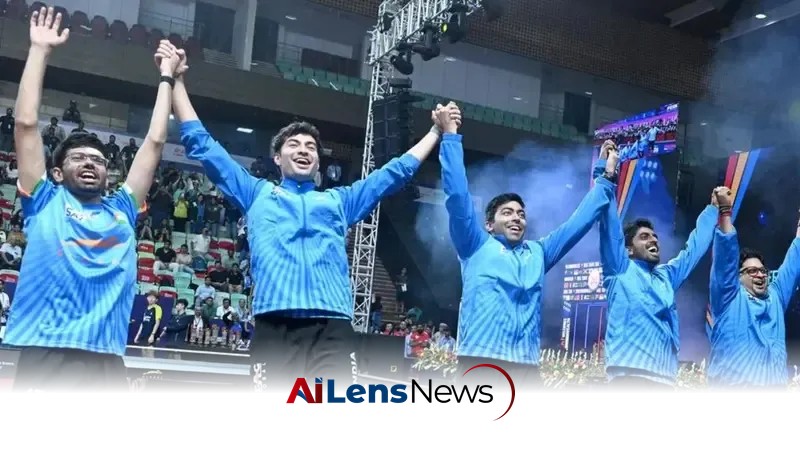


India's table tennis teams excelled at the Commonwealth Games, with the men's team edging past Malaysia and the women's team securing a decisive victory.
Kohima, India Jul 31, 2026 ALN: NEW DELHI, JUL 30: In a remarkable display of skill and determination, India’s table tennis teams achieved significant success at the Commonwealth Games, clinching dual titles in both the men’s and women’s categories. The men’s team, led by the standout performance of Manush Shah, triumphed over Malaysia with a nail-biting 3-2 victory in the final held at the Thyagaraj Stadium. The women’s squad, on the other hand, showcased their dominance by sweeping aside the Malaysian team with a convincing 3-0 win, highlighting the depth of talent in Indian women’s table tennis.
The men’s final was particularly dramatic, especially considering that India had previously suffered a defeat to Malaysia during the league phase of the tournament. This context added an extra layer of pressure for the Indian players, who were determined to avenge that earlier loss. Notably, the Indian team made a strategic decision to leave out Harmeet Desai from the lineup, a move that was met with scrutiny given the high stakes of the final. Malaysia, in a tactical response, opted to field their second player for the third rubber, which proved to be a pivotal moment in the match.
The match unfolded with high tension as Manav Thakkar, the world No. 41, initially raced to a 2-0 lead against Malaysia's Qi Shen Wong. However, Wong, ranked No. 204, displayed remarkable resilience by clawing back to win the match 3-2, leveling the contest at 2-2 and setting the stage for a dramatic conclusion. This unexpected turn of events put the pressure squarely on Manush Shah, who had already demonstrated his own fighting spirit earlier in the tournament. In his earlier match against Wong, Shah had recovered from a 4-7 deficit in the decider to win, showcasing his mental fortitude and ability to perform under pressure.
In the decisive fifth rubber, Shah faced Javen Choong, and he approached the match with confidence built from his previous encounters. From the outset, Shah dominated the game, employing a combination of aggressive forehands and strategic placements to secure a straight-game victory. His performance not only clinched the gold medal for India but also underscored the growing prowess of Indian table tennis on the international stage.
Meanwhile, in the women’s final, the Indian team demonstrated their strength and cohesion by blanking Malaysia 3-0. The matches were characterized by quick exchanges and tactical brilliance, as the Indian players showcased their skills and teamwork. This victory marked a significant achievement for Indian women’s table tennis, further establishing their reputation as a formidable force in the sport.
The success of the Indian table tennis teams at the Commonwealth Games is reflective of the broader growth of the sport in India over the past few decades. The country has invested significantly in sports infrastructure, coaching, and talent identification programs, which have contributed to the emergence of a new generation of players capable of competing at the highest levels. The Indian table tennis scene has been bolstered by the establishment of various academies and training centers that focus on nurturing young talent, and this strategy appears to be paying off.
In addition to table tennis, the Commonwealth Games have also seen notable achievements from Indian athletes in other disciplines. Murali Sreeshankar made headlines by winning a silver medal in the long jump, becoming the first Indian athlete to secure back-to-back medals in this event at the Commonwealth Games. Sreeshankar's journey to this podium finish is particularly inspiring, as he made a remarkable comeback from a career-threatening knee injury that had sidelined him for an extended period.
Before Sreeshankar's recent achievements, India had only seen a few athletes medal in long jump at the Commonwealth Games, including Suresh Babu, Anju Bobby George, and M Prajusha. Sreeshankar’s silver medal, achieved with a leap of 8.09 meters, not only adds to his accolades but also serves as a testament to his resilience and dedication to the sport. His performance was even more impressive considering the challenges he faced, including a ruptured patellar tendon that required surgery and rehabilitation, preventing him from participating in what was anticipated to be his first Olympic Games in Paris.
During the competition, Sreeshankar opened with a solid leap of 8.03 meters before improving to 8.09 meters in his second attempt. However, he faced stiff competition from Jamaica’s Tajay Gayle, the former world champion, who ultimately took the gold with a jump of 8.15 meters. Sreeshankar's consistent performances throughout the year, including a season-best of 8.38 meters at the National Inter-State Senior Athletics Championships, have solidified his status as one of India's top long jumpers.
In the realm of para-athletics, Indian sprinters Dilip Mahadu Gavit and Mohammed Basil achieved a historic 1-2 finish in the men’s 100m T47 final, further showcasing the depth of talent in Indian athletics. Gavit's gold medal performance, clocking a Games record time of 10.71 seconds, and Basil's silver with a personal best of 10.83 seconds, underscore the strides made by para-athletes in India. The men’s 100m T47 event is designed for athletes with arm impairments, and the success of Gavit and Basil not only highlights their individual talents but also reflects the growing support and recognition for para-sports in the country.
The Commonwealth Games have traditionally served as a platform for athletes from Commonwealth nations to showcase their talents, and this year’s edition has been no different. The achievements of Indian athletes across various sports, including table tennis, athletics, and para-athletics, signal a promising future for Indian sports on the international stage. As India continues to invest in sports infrastructure and training programs, the hope is that these successes will inspire a new generation of athletes to pursue excellence in their respective disciplines.
The dual titles won by India in table tennis, along with the impressive performances in athletics, particularly by Sreeshankar, Gavit, and Basil, reflect a growing culture of sports excellence in the country. As these athletes continue to break barriers and set new records, they not only elevate their own careers but also contribute to a collective national pride in India's sporting achievements on the global stage.
Furthermore, the recognition and support for athletes, especially in non-cricketing sports, have seen a notable rise in recent years. Government initiatives, sponsorship deals, and media coverage have played a crucial role in promoting sports other than cricket, which has historically dominated the Indian sports landscape. This shift in focus is expected to create a more level playing field for athletes across various disciplines, encouraging diversity and fostering talent that may have otherwise gone unnoticed.
Moreover, the success of Indian athletes at the Commonwealth Games has the potential to inspire young sports enthusiasts across the nation. Schools and colleges are increasingly recognizing the importance of sports in education, and many are integrating sports programs into their curricula. This growing emphasis on sports can lead to a healthier lifestyle for students and may also help in identifying and nurturing future sporting talents early on.
In conclusion, the recent achievements of Indian athletes, particularly in table tennis and athletics, not only highlight the individual excellence of the competitors but also reflect a broader trend of improvement and investment in sports within the country. The dual titles in table tennis represent a significant milestone for Indian sports, while the successes in athletics underscore the potential of Indian athletes to compete on the world stage. As India continues to support and develop its sporting infrastructure, the future looks bright for the next generation of athletes who aspire to bring glory to the nation.
To learn more about the latest developments in Cricket, stay updated with our exclusive reports and analyses on AiLensNews.

