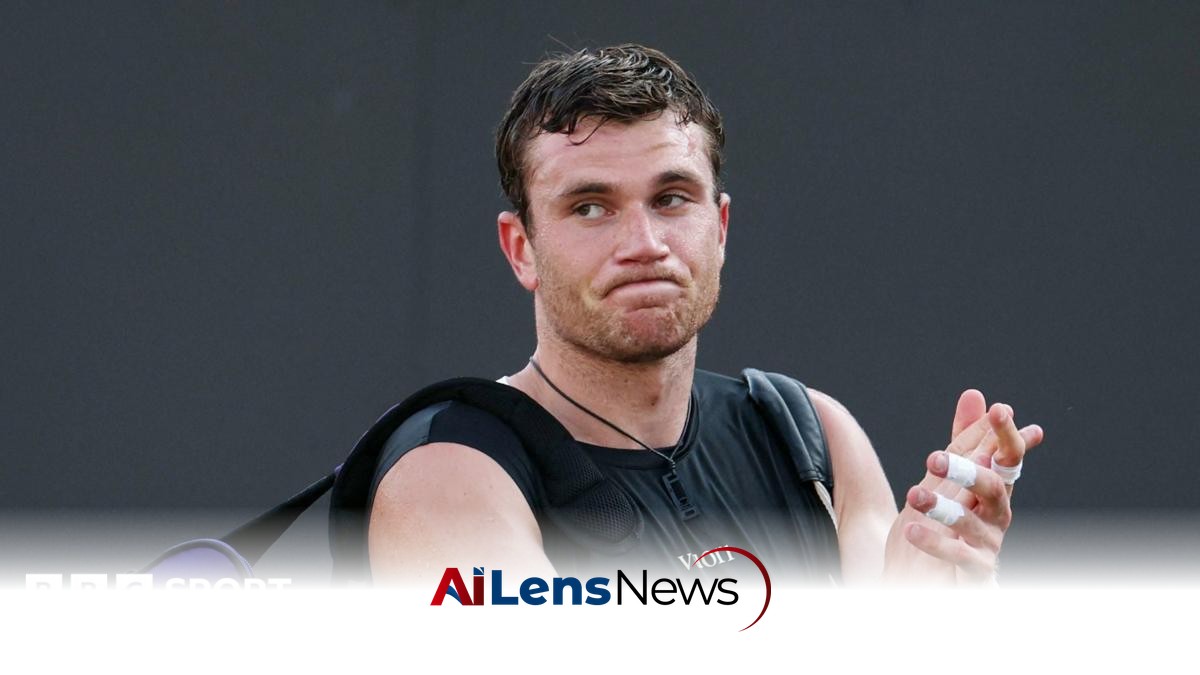


Jack Draper faces ongoing challenges due to a complicated arm injury, impacting his career and participation in major tournaments.
New Delhi, India Jul 28, 2026 ALN: By his own admission, the arm injury which has derailed Jack Draper's career is "complicated".
Former British number one Draper withdrew from a planned comeback in Washington on Monday after feeling more discomfort from bone bruising in his serving arm. This decision has left many fans and analysts concerned about the trajectory of his career, especially given the promising potential he displayed early on.
It is a similar situation to what happened at Wimbledon last month, where the 24-year-old Englishman also spoke positively about his fitness - and seemingly practiced well - before pulling out on the eve of the tournament. This pattern of optimism followed by withdrawal has raised questions about the reliability of his recovery process and the psychological toll that such injuries can take on an athlete.
Draper continues to insist "finding acceptance and being patient" remains the key - but his fans can be forgiven for fearing the worst. The uncertainty surrounding his condition underscores the challenges athletes face when dealing with injuries that do not have clear timelines for recovery.
Draper has been hampered by the bone bruising in his left arm for more than a year, playing just 14 matches in the past 12 months and missing all three Grand Slam tournaments so far this year. This lack of match play not only affects his ranking—he has dropped to the cusp of the world's top 150—but also his confidence and ability to compete at the highest levels.
Bone bruising is essentially internal bleeding in the centre of the humerus bone, according to Prof Amar Rangan, vice-president of the British Orthopaedic Association. The humerus is the long, tube-like bone between the shoulder and elbow joints, with the stronger outer layer - known as the cortical bone - protecting a spongier tissue called trabecular bone. When the trabeculae break, the bleeding increases pressure inside the bone - causing bruising.
Players are particularly liable to this injury because of the stresses imposed on the humerus by the rapid acceleration and deceleration of their shots - particularly the serve. The serve is a critical aspect of that requires explosive power, and any injury affecting this motion can significantly alter a player's performance.
Generally, it tends to cause a dull, deep-seated pain, as well as limited mobility and inflammation for some people. The pain associated with bone bruising can hinder a player's ability to serve effectively, which is crucial in a where service games often dictate the outcome of matches.
"How do you recover from this injury? A lot of patience - basically that is it," Prof Rangan told BBC. "It is almost a race between the bone healing and further stresses." This highlights the delicate balance athletes must maintain between training and recovery, as pushing too hard can exacerbate the injury.
However, the notion of a player potentially needing surgery to fix the issue is emphatically rejected by Prof Rangan. "The only thing that can heal it is rest. The body has to heal and strengthen the bone," he said. "Surgery would be further injury to the area and would not help. As long as there is sufficient relative rest to allow the bone to heal and strengthen and consolidate, it should settle down." This perspective is crucial in understanding the long-term management of such injuries in professional s.
Draper has leaned on other players who have dealt with the same injury, including British pair Arthur Fery and Toby Samuel. Both players endured frustrating long spells on the sidelines, but have each come out of the other side to enjoy the best results of their careers. This serves as a reminder that recovery from such injuries is possible, albeit often a lengthy process.
Fery, 24, was a shock Wimbledon semi-finalist last month after suffering with bone bruising for most of 2024 and 2025. His success illustrates how perseverance can lead to breakthroughs, even after significant setbacks. Samuel, 23, is close to breaking into the world's top 100 having come back from almost a year out in 2024. Their experiences provide a glimmer of hope for Draper as he navigates his own path to recovery.
Eventually, the pair felt they were able to play through the pain, but Draper remains at the stage of his recovery where he is happy to continue taking extra caution. This cautious approach may be wise, as rushing back into competition can lead to further injuries, potentially derailing a player's career even more severely.
"It is a tough injury because there's no set time or magic cure for it," Samuel told BBC. "At first it was tough to play again. I was still feeling pain and not playing amazing. But I came through it and I haven't looked back." This sentiment resonates deeply with many athletes who have faced similar challenges, emphasizing the mental and emotional aspects of recovery.
Since first becoming aware of the problem in May 2025, Draper has taken a series of measures to alleviate the issue. Initially, he tried to play through the discomfort, before withdrawing from last year's US Open before his second-round match and swiftly deciding to curtail his 2025 season. This decision to prioritize his health over competition is a critical one that many athletes struggle with, particularly when they feel pressure to perform.
Draper opted not to play this year's Australian Open in January, then missing the French Open and Wimbledon as he continued to take precautionary moves. This pattern of withdrawals illustrates the ongoing nature of his injury and the careful management required to prevent further damage.
Another tactic saw Draper switch to a platform serve - standing with his feet slightly wider throughout the motion to allow a smoother transfer of weight - which put less load on his arm but "didn't necessarily help" his knee, which he injured at the Barcelona Open in April. This adjustment reflects the adaptability athletes must exhibit when faced with physical limitations, often requiring them to modify their techniques to mitigate pain.
Spending more time in ice baths, saunas, and red light therapy has also become an important part of his recovery. These methods are increasingly popular among athletes as they seek to enhance recovery through various modalities. "You start looking into all things when you have this type of injury," Draper said at Wimbledon last month. "I definitely looked more into my sleep and nutrition. I always did these things pretty well, but it's probably now at an elite level. I think that will help the longevity of my career hopefully - going through this experience now." This reflective approach highlights a growing awareness among athletes about the importance of holistic health in performance and recovery.
This article is the latest from BBC's Ask Me Anything team.
How are famous faces invited into Wimbledon's royal box?
Can Wimbledon umpires take toilet breaks?
What is the difference between quad and wheelchair?
What does 'Open era' mean in ?
To learn more about the latest developments in Tennis, stay updated with our exclusive reports and analyses on AiLensNews.

