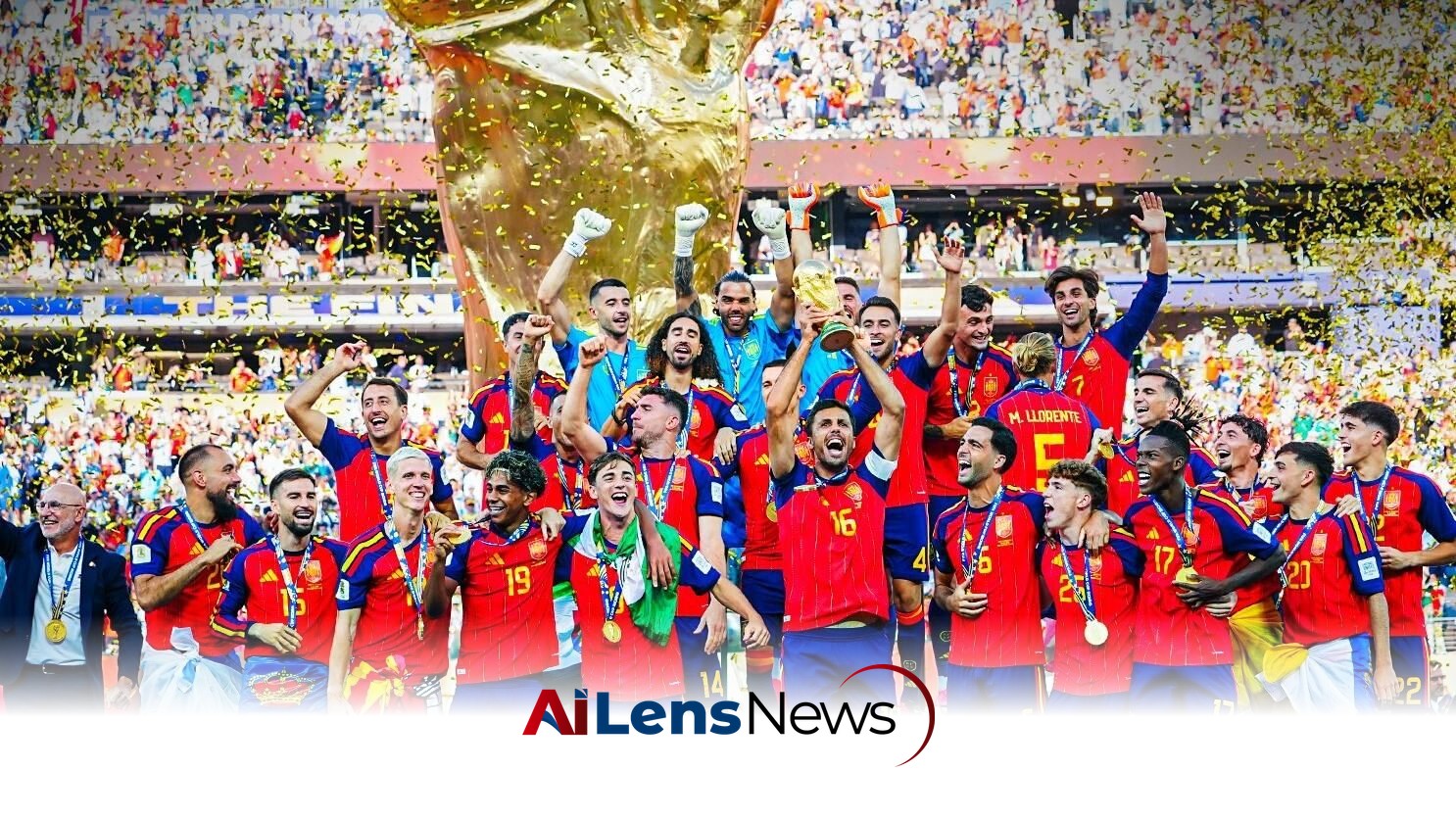


The FIFA World Cup showcases football's worldwide popularity, contrasting sharply with cricket's limited global presence and participation.
New Delhi, India Jul 25, 2026 ALN: Now, this was what can be truly called a 'genuine' World Cup!
I refer, of course, to the just concluded FIFA World Cup, jointly played out in the USA, Canada and Mexico. Readers of this column might perhaps recall that I had, in the past, railed against ersatz 'World Cups', especially the cricket competition between ten nations, which had hardly merited the designation of being a World Cup, and argued that, at best, it could have been called a 'ten percent ICC Cricket World Cup'!
In sharp, taunting contrast, in the 2018 FIFA World Football Championship in Russia, 210 teams from six confederations played 872 matches at the qualifying stage, from which 31 teams were selected for the finals, the figure being rounded up to 32 because host Russia automatically qualified.
In that World Cup, the 32 qualifying teams played 64 matches at 12 venues across 11 cities. Each and every continent was represented during the qualifying rounds. Now that's what we would call an authentic, true blue World Cup!
The 2022 FIFA World Cup took place in Qatar from 20 November to 18 December 2022, the first to be held in the Middle East, and the second in an Asian country after the 2002 tournament in South Korea and Japan. Because of the climatic conditions at the venue, it was held over a reduced time frame of 29 days, with 64 matches played by 31 teams determined by the qualification process, while Qatar entered automatically as the host team. All in all, 204 teams had participated in the global qualification rounds for that World Cup, with Argentina finally emerging as the champion.
The 2026 FIFA World Cup took things even further, with a total of 205 FIFA-affiliated national teams globally entering the initial qualification process, competing to fill the tournament's expanded 48-nation field.
But no one, least of all football fans, minded the enlargement, which was obviously made for commercial reasons. Nor did they mind the blatant attempt to Americanise the game—from mid-match hydration breaks used to show commercials, to championship rings and half-time shows—given that it tried to bring the world's most beautiful game to a country that had never fully embraced the sport.
As expected, this FIFA World Cup had its share of controversies. Controversial referee decisions, for example, led to the exit of Egypt in the thrilling Round of 16 match against Argentina. Moreover, the competition also exposed deep divisions and political vindictiveness, with the US using its visa regulations to hinder the participation of nations like Iran.
One of the biggest, most unprecedented bloopers in FIFA's history was made by Donald Trump, when he made a call to top FIFA officials to revoke the suspension of US striker Florian Balogun, and the organisation shamelessly conceded to his demand!
But, as with all FIFA World Championships, it was also a tournament filled with thrills and spills, with the heroic performance of Cape Verde and Norway's deep run into the quarterfinals topping the list. It was replete with magical moments, hair-raising excitement, near-misses, individual heroics, heart break and entertainment, the repeated come-backs of Argentina being the most memorable!
The biggest irony, of course, was the crowning of Spain as the ultimate champion, given that Trump had ordered a halt to US trade with Spain for what he said was insufficient military spending and its opposition to the US-Israel war on Iran.
Indeed, the 2026 FIFA World Cup, in which the four top-seeded teams - France, England, Spain and Argentina - made it to the semifinals, explicitly testified to the reality that the 'beautiful game' has the ability to unite and bring unadulterated joy to sports lovers across the globe!
Let us contrast it with the cricket World Cups, now bifurcated into three distinct divisions—T-20, One Day, and Test—in which only a handful of countries participate. The two continents of North America and South America are unrepresented, while Africa is represented by just two or three countries. With the UK being out of Europe, that continent too goes unrepresented!
This brings home the reality that cricket is a game played by just a few countries across the world, most of them belonging to the Commonwealth. This is because the game, originating in England, was carried by the imperialists to parts of the world they had colonised, with the natives picking it up through such contact.
This too explains why sporting giants such as Russia, China and Japan know nothing of cricket. Although the US had been a colony of Britain, cricket did not become its favourite game, for everyone knows that America does the opposite of what Britain does, including driving on the right side of the road instead of the left! Colonised places such as Hong Kong, Zimbabwe and Kenya do have cricket teams, but their performances of late have been dismal.
Fortunately for the 'gentleman's game,' the Indian subcontinent took to cricket like a fish takes to water; else it might have attained an 'endangered game' status by now. Passion for cricket is displayed in four neighbouring nations of South Asia - India, Pakistan, Sri Lanka and Bangladesh. Also, fortunately for the game, in heavily populated India, cricket has, to a great extent, become yet another of the many 'religions' this nation has produced.
But the obsession with cricket has taken the focus away from other games, which explains why we have not been able to attain a level of excellence, for instance, in football, so as to be able to participate in the final stage of a FIFA World Cup, having always been eliminated in the preliminary rounds.
Moreover, the passion for cricket has ensured that our sportspersons whose achievements surpass those of our cricket 'idols' are not 'worshipped' in the same way.
Viswanathan Anand, for example, was at one time the chess champion of the world, a feat far surpassing those of most of our cricketers. India's Neeraj Chopra made history as the first Asian to win an Olympic gold medal in the javelin throw at the Tokyo Olympics. Mary Kom is an internationally famous boxer and is relatively well known within her own country too, but the amount she earns is a pittance compared to what is earned by even mediocre wielders of the willow.
Michael Ferreira, Geet Sethi, Ramanathan Krishnan, Prakash Padukone, Saina Nehwal, Pankaj Advani, Abhinav Bindra - one can reel off a host of names of sports personalities who have done India proud on the world stage, some of whom will not even be recognised by the current generation! It is sad indeed that our obsession with cricket has ensured that we lag behind the rest of the world in other sports.
To learn more about the latest developments in Golf, stay updated with our exclusive reports and analyses on AiLensNews.

