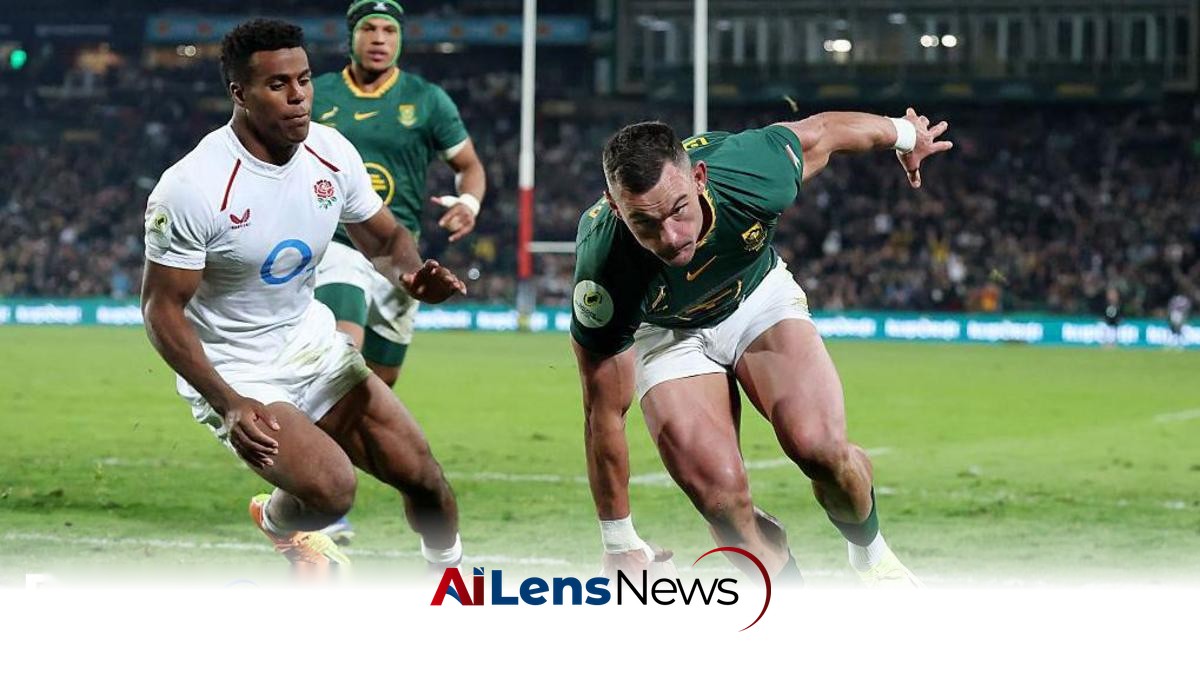


South Africa reassert their dominance over England with a commanding victory at Ellis Park in the opening round of games in the new Nations Championship.
New Delhi, India Jul 4, 2026 ALN: Nations Championship
South Africa (17) 45
Tries: T du Toit, Kolbe, Arendse, Williams, Kriel, Marx, Dixon Cons: Kolbe 5
England (14) 21
Tries: George, Martin, Coles Cons: F Smith 3
South Africa once again asserted their dominance over England with a commanding victory at Ellis Park, with the outcome rarely in doubt across 80 bruising minutes.
The Springboks blitzed into a 17-point lead inside 11 minutes, leaving England bewildered by the pace, muscle, and cohesion of the hosts. The match, part of the Nations Championship, showcased South Africa's strength and tactical prowess, reinforcing their status as a powerhouse.
Powerful scores from Ellis Genge and George Martin, just before half-time, ignited a glimmer of hope for England. However, South Africa turned the screw after the break, scoring another three tries to canter to a fourth successive victory over England. The visitors came up well short of the gold standard set by the double reigning world champions.
Looking ahead, England's Nations Championship campaign continues against Fiji at Hill Dickinson Stadium in Liverpool on July 11 before heading back to the southern hemisphere to take on Argentina on July 18. These upcoming matches will be critical for England as they seek to regain momentum and confidence after this heavy defeat.
England arrived at altitude in Johannesburg 10 days before kick-off with the aim of acclimatising early and catching the Springboks, whose last serious outing was seven months ago, cold. This strategic decision was part of their preparation, as playing at high altitude can significantly affect player performance due to lower oxygen levels.
While England lost full-back George Furbank to appendicitis in the hours before kick-off, South Africa also had to rejig their starting line-up. Key players Eben Etzebeth and Siya Kolisi, both integral to the Bok pack, withdrew late with injuries sustained earlier in the week. This reshuffling highlighted the unpredictable nature of , where last-minute changes can impact team dynamics and performance.
Despite the disruption, the hosts opened with a blizzard of attacking brilliance that left Steve Borthwick's side reeling. With less than three minutes on the clock, prop Thomas du Toit, heading back to his homeland from Bath this summer, muscled through Ellis Genge and Ollie Chessum to score from close range. This early score set the tone for the match, showcasing South Africa's physicality and determination.
Just two minutes later, with England crumbling in collisions and their defence leaking line breaks, Cheslin Kolbe had acres of space out wide and duly left opposite number Cadan Murley groping at shadows with a jagging side-step. Kolbe's try exemplified South Africa's attacking flair and ability to exploit defensive weaknesses.
On the opposite wing, Kurt-Lee Arendse held off Marcus Smith to dive over for a third try, making it 17-0 after just 12 minutes. The early onslaught left the English side in disarray, struggling to cope with the intensity of the Springbok attack. Ellis Park, filled to close to its 62,000 capacity after a late lowering of ticket prices, was electric with excitement, while England's performance was far from inspiring.
Even when the visitors belatedly began to play, with Fin Smith and Ben Earl making yards and Jack van Poortvliet landing a daring offload, they couldn't make it stick on the scoreboard. England’s captain Jamie George had a try chalked off; his opportunistic dot-down from close range was ruled out for an accidental offside. This moment was emblematic of England's struggles throughout the match—moments of potential thwarted by errors and missed opportunities.
However, England managed to stem the haemorrhaging of points at the other end, possibly aided by some understandable Springbok complacency. A yellow card for Arendse due to a deliberate knock-on gave England a man advantage for 10 minutes. Taking advantage of this opportunity, Genge barged through opposite number Thomas du Toit from a quick tap penalty, scoring England's first try.
Then, in the final play of the half, a neat three-phase strike play, with a long line-out followed by two blind-side thrusts, culminated in 20-stone second row George Martin rampaging over Jasper Wiese and into the corner. With Fin Smith landing the conversion, England was only three points adrift at the break—an impressive comeback considering their dire start, but one that still left them vulnerable.
However, the Springboks restored their sense soon after the restart. Grant Williams, the hosts' electric running scrum-half, sniped through a sliver of a hole to break 20 phases of England's goalline defence on 45 minutes, before Jesse Kriel strolled in after a smart offload from the excellent Damian Willemse to stretch South Africa's lead to 31-14. This sequence of play demonstrated South Africa's relentless pressure and ability to exploit defensive lapses.
England's discipline and accuracy proved too shoddy a base to launch a second comeback, as the penalty count against the visitors ramped up. Referee James Doleman pinged England nine times after the interval, a clear indication of their struggles in maintaining composure and discipline under pressure. Too often, attacking kicks went uncontested, and England's front row came under pressure at the scrum, leading to further frustrations.
Henry Pollock, who had been a focal point of discussion in South Africa in the build-up to the match, was introduced to a chorus of jeers with a little over 20 minutes to go. Despite the hostile reception, it was another replacement who had the greatest influence for England late on. Henry Slade hit a superb line to set up a try for Alex Coles, briefly bringing England back within 10 points.
However, two yellow cards in the space of two minutes—Tommy Freeman for a high hit on Willemse and Guy Pepper for an early tackle—put paid to England's hopes of mounting a comeback. This continued an ugly theme from England's Six Nations campaign earlier this year, where their efforts were undermined by eight cards in five matches. This lack of discipline has raised concerns about the team's mental fortitude and ability to compete at the highest level.
As the match progressed, it became increasingly clear that South Africa's dominance was inevitable. Malcolm Marx rumbled over at the back of a driven line-out against an understaffed England defence shortly after, and the home crowd serenaded their heroes with Neil Diamond and Coldplay hits. Ben-Jason Dixon capped the victory with a seventh score, further emphasizing South Africa's comprehensive performance.
South Africa: Willemse; Kolbe, Kriel, De Allende, Arendse; Libbok, Williams; Nche, Marx, T du Toit, P-S du Toit (capt), Nortje, De Villiers, Hanekom, Wiese
Replacements: Wessels, Steenekamp, Porthen, Van Staden, Dixon, Reinach, Esterhuizen, Moodie
Yellow cards: Arendse (27)
England: M Smith; Feyi-Waboso, Freeman, Atkinson, Murley: F Smith, Van Poortvliet; Genge, George (capt), Heyes, Coles, Martin, Chessum, Curry, Earl
Replacements: Cowan-Dickie, Obano, Opoku-Fordjour, Ewels, Pepper, Pollock, Mitchell, Slade
Yellow cards: Freeman (69), Pepper (72)
Attendance: 52,790
Referee: James Doleman (New Zealand)
Assistant Referees: Andrew Brace (Ireland), Pierre Brousset (France)
TMO: Richard Kelly (New Zealand)
Related topics: England
To learn more about the latest developments in Basketball, stay updated with our exclusive reports and analyses on AiLensNews.

