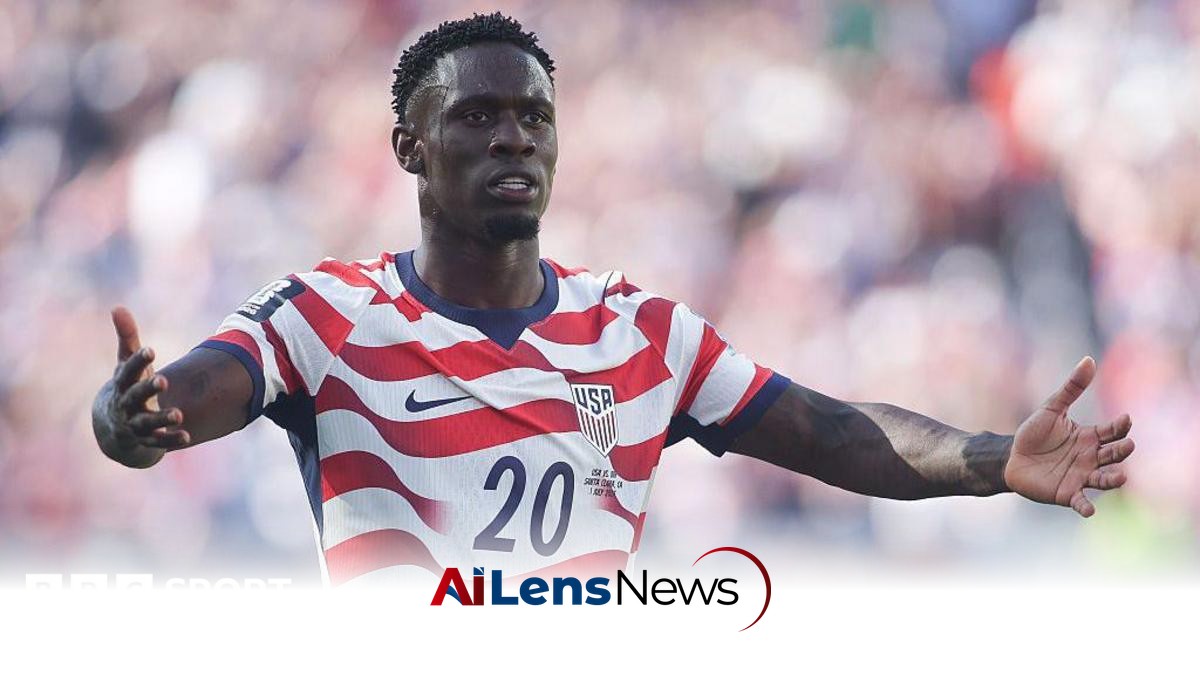


The decision to overturn the red card shown to Florian Balogun raises significant questions about FIFA's disciplinary processes and potential political influence.
New Delhi, India Jul 6, 2026 ALN: It had become one of the game's great certainties. If you are sent off at the World Cup, you will miss the next game. No ifs, no buts, no appeals.
The decision to effectively overturn the red card shown to United States' star forward Florian Balogun leaves many unanswered questions. Balogun, sent off in the last-32 win over Bosnia-Herzegovina, will now be available to play in the last 16 against Belgium on Monday. He's the US's top scorer at the tournament with three goals.
There have been 189 red cards in the history of the World Cup, and only two players have not served a suspension. The other came in 1962, when Brazil's Garrincha was sent off against Chile in the semi-final but played in the victory over Czechoslovakia in the final.
Back then, however, there was no automatic ban. It was decided by committee with evidence given by the officials. The FIFA disciplinary committee's decision in 1962 was shrouded in allegations of political interference. It may well be the case again.
Given the well-established close relationship between the White House and FIFA, questions will be asked because of what is a highly unusual decision in favor of the co-hosts. Multiple reports say that US President Donald Trump called FIFA president Gianni Infantino earlier this week to ask for the red card to be reviewed. The BBC has not yet confirmed these reports.
Does it set a troubling precedent, too? Why has Balogun been given a reprieve, but the other 11 players sent off at this World Cup have all served a suspension? Will it lead to more appeals in a bid to cut suspensions even when red cards were justified under the rules? When it says "misses next match" on the television coverage following the World Cup's next red card, should we not be so sure it happens?
Here, we break down the decision, what we know, and the possible repercussions.
There is one overriding question many people are now asking. How? FIFA's disciplinary code states that Balogun should receive a ban of "at least two matches for serious foul play". Indeed, the World Cup rules do not allow teams to appeal against a red card.
FIFA's statement offered no reason or explanation for suspending Balogun's ban. It just cited "article 27 of the FIFA disciplinary code". Article 27 allows FIFA "to fully or partially suspend the implementation of a disciplinary measure". It is a wide-ranging rule that allows FIFA to effectively make whatever decision it wants without having to meet any other criteria. Article 27 has never before been used at a World Cup.
BBC has asked why this happened. But we were not provided with any reasoning. We were simply directed to Cristiano Ronaldo's suspended ban before this tournament. Under FIFA's disciplinary code, Ronaldo should have received a three-match ban for elbowing Dara O'Shea during Portugal's 2-0 qualifying defeat by the Republic of Ireland in November.
He served one match in the final qualifier against Armenia - but the remaining two games of the ban were suspended. Ronaldo's red card, though, was received in qualifying. It was not a red card at a World Cup.
There have been many cases of players being shown some leniency before a tournament, not just Ronaldo. See France's Laurent Koscielny in 2014, or Ecuador's Moises Caicedo and Argentina's Nicolas Otamendi before this World Cup. At least with Ronaldo, we were given some justification, with FIFA saying it had taken into account that "he had no red cards in his other 225 international appearances". With Balogun, we did not even get that.
It has left a vacuum of information which can only lead to speculation. Why was this a special case? What factors were taken into account? Who made the decision?
BBC has been told there are no suggestions that the referee asked for the suspension to be removed, or that video assistant referee protocol was not respected. In England, the Association would publish the full written reasons. The United States have the right to ask FIFA to publish them; Belgium do not.
"It absolutely stinks," Gary Neville said on ITV. "There should be a review process in place, there should be a process for it to be overturned, but if there's no process and somehow FIFA from nowhere have decided to let a player play, I would be absolutely raging if I was Belgium."
Belgium are, of course, furious. They issued a statement on Sunday saying they were "astonished" that Balogun had been cleared to play. The Belgian FA referenced several regulations, workshop presentations, and pre-tournament co-ordination meetings. They are adamant that the decision contradicts the tournament regulations which state that a player "will automatically be suspended from their team's subsequent match". In effect, they say FIFA used its disciplinary code to override the competition regulations.
Was Balogun's red card harsh? Absolutely. The striker was challenging Tarik Muharemovic and accidentally brought his foot down on the ankle of the Bosnian. Harsh does not mean it was an incorrect decision, or that it was so egregious that FIFA simply had to step in.
Should FIFA now rescind any suspension after a red card from an accidental act? Coaches will be making the argument - precedent has been set, now let's have consistency. Intent was taken out of the laws many years ago, and only the result of a challenge is meant to be considered.
Take Xavi Simons' red card against Liverpool last December. The Tottenham forward did not mean to stand on the back of Virgil van Dijk's leg, but he did, and it was judged to endanger the safety of the opponent. Tottenham's then-head coach Thomas Frank bemoaned the automatic three-match ban, but the club decided against appealing, believing they had no chance of success.
The Balogun decision adds to some concerns within the domestic leagues from decisions at this World Cup. It is felt that the lack of yellow cards, some of the implementation of VAR, as well as the interpretation of new laws, is impossible to replicate at league level. And fans will expect it to be the same.
By repealing Balogun's ban, it can only make life more difficult for them. Why can't the Association show clemency just like FIFA did? Surely excessive bans like that suffered by Simons should be looked at?
As the controversy unfolds, the involvement of political figures adds another layer of complexity. Reports suggest that President Trump’s intervention may have influenced FIFA's decision-making process, raising eyebrows about the integrity of the disciplinary system.
As the situation develops, the ramifications of this decision will likely echo throughout the tournament and beyond, prompting discussions about fairness and consistency in the application of rules.
In conclusion, the Balogun decision not only impacts the immediate future of the tournament but also sets a precedent that could affect how disciplinary actions are perceived in the world of .
To learn more about the latest developments in Football (Soccer), stay updated with our exclusive reports and analyses on AiLensNews.

