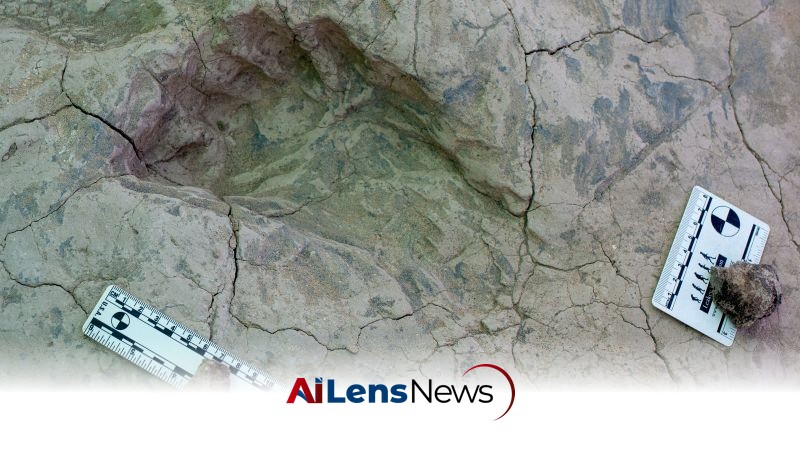


Recent analysis of fossil footprints indicates that the extinct hominin 'Nutcracker Man' was significantly taller and heavier than earlier estimates suggested.
Washington DC, United States Jul 29, 2026 ALN: Scientists have recently made significant advancements in understanding the anatomy and social behavior of "Nutcracker Man," an extinct hominin scientifically referred to as Paranthropus boisei. This species, which thrived in eastern Africa between approximately 2.3 million and 1.2 million years ago, is known for its distinctively large teeth and powerful jaw muscles, adaptations that suggest a diet consisting primarily of tough plant material. The new findings stem from meticulous analysis of fossil footprints discovered in a site located in Kenya, known as East Turkana's Koobi Fora Formation.
The newly analyzed footprints have led researchers to revise previous estimates regarding the physical stature of P. boisei. Earlier studies indicated that male specimens of this species averaged around 4.2 feet (131 centimeters) in height and weighed approximately 108 pounds (49 kilograms). However, the fresh analysis of 21 newly identified footprints suggests that Nutcracker Man was likely taller and heavier than previously believed, with estimates indicating that these hominins could have stood up to 6 feet (1.8 meters) tall and weighed as much as 165 pounds (75 kilograms). This revelation not only challenges long-held perceptions of P. boisei but also opens new avenues for understanding the physical capabilities and adaptations of this species.
The footprints themselves provide a unique glimpse into the social dynamics of P. boisei. Researchers identified patterns in the footprints that indicated a group of eight individuals traversed the area simultaneously, suggesting they were traveling together. This finding implies that P. boisei may have exhibited complex social behaviors, which could include cooperative foraging or group defense against predators. The site in question, rich with fossilized evidence, serves as a snapshot of hominin behavior and interaction with their environment, according to Kevin Hatala, the lead author of the study and an associate professor of biology at Chatham University in Pittsburgh.
Hatala emphasized the importance of these footprints, stating that they provide invaluable anatomical and behavioral insights. He posited that the group of adult males observed in the footprints might have been moving along the lakeshore, potentially motivated by the presence of dangerous animals like hippos, which could explain the absence of females and juveniles in that particular group. This interpretation highlights the possible social structures of P. boisei and their strategies for survival in a challenging environment.
Patricia Kramer, a professor in the anthropology department at the University of Washington, echoed the significance of these findings. Although she did not participate in the study, she acknowledged the importance of the new analysis and its contribution to understanding the trackways at Koobi Fora. Footprints are considered vital fossils, as they encapsulate both the anatomical features and behavioral patterns of ancient species, offering a direct link to their daily lives.
The footprints in question date back to approximately 1.4 million years ago and were likely formed in shallow lake water, where the sediment was soft enough to capture detailed impressions. Initial discoveries of seven tracks were made in 1978, under the direction of Anna Katherine "Kay" Behrensmeyer, a senior research geologist and curator at the Smithsonian's National Museum of Natural History. Subsequent excavations in 2016 and 2023 unearthed an additional 14 footprints, alongside tracks from other animals such as antelope and hippos, enriching the context of the ecosystem in which P. boisei lived.
P. boisei was not the only hominin species inhabiting the area near Lake Turkana during this period. It coexisted with Homo erectus, another prominent ancestor of modern humans. Research conducted in 2024 suggested that fossil footprints found in Kenya's Turkana Basin were made by both H. erectus and P. boisei within days of each other. Although the exact nature of their interactions remains unclear, the evidence points to a shared habitat, highlighting the complexity of hominin evolution during this era.
Homo erectus is particularly notable for being one of the earliest relatives of Homo sapiens to exhibit body proportions similar to those of modern humans. This adaptation facilitated upright walking, which was crucial for survival in diverse environments. In contrast, P. boisei displayed physical characteristics that aligned more closely with those of our tree-dwelling primate ancestors, including adaptations for a diet rich in fibrous plant material rather than the more varied diet likely consumed by H. erectus.
The footprints left by P. boisei exhibit similarities to those made by H. erectus and modern humans, yet there are distinct differences that set them apart. Previous research into hominin footprints from the early Pleistocene period revealed that P. boisei tracks had flatter arches compared to those of H. erectus and modern humans. While this does not necessarily imply that P. boisei had flatter feet, it suggests that their locomotion differed in significant ways. Hatala noted that the angle of the big toe in P. boisei footprints was more pronounced compared to the configurations typically seen in modern humans, further indicating variations in movement and foot structure.
The researchers took great care to account for variations in substrate conditions when analyzing the footprints, as the impressions can differ dramatically based on the type of ground and its moisture content. Hatala explained that they conducted extensive experiments to replicate the conditions of the mud in which these Early Pleistocene footprints were preserved, allowing for a more accurate interpretation of the findings.
While the current analysis has shed light on the physical characteristics and potential behaviors of P. boisei, further research is necessary to fully understand how the species' unique toe angles and arch heights influenced its lifestyle. Kramer expressed caution in attributing specific significance to these morphological traits, noting that there are multiple effective ways to navigate environments as a biped. Nonetheless, she emphasized the need for thorough analyses like this one, which can provide deeper insights into the evolutionary pathways of hominins.
In summary, the recent findings regarding Nutcracker Man's size, social behavior, and coexistence with other hominins contribute to a more nuanced understanding of human evolution. As researchers continue to uncover and analyze fossil evidence, they are piecing together the complex tapestry of our ancestral past, revealing the intricate relationships and adaptations that have shaped the lineage leading to modern humans.
To learn more about the latest developments in Research & Discoveries, stay updated with our exclusive reports and analyses on AiLensNews.

