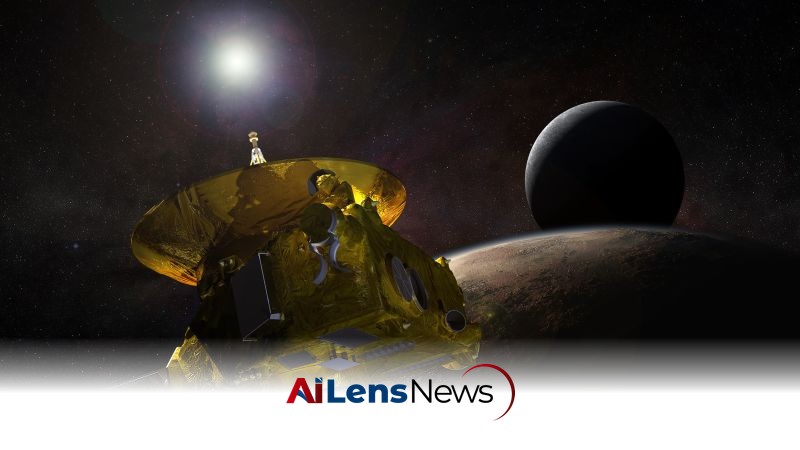


NASA's New Horizons spacecraft has awakened from hibernation to continue its groundbreaking mission in the Kuiper Belt, gathering vital data about distant celestial bodies.
Washington DC, United States Jul 17, 2026 ALN: A groundbreaking mission that explored Pluto and distant solar system objects in unprecedented detail has awakened from its longest sleep ever — and it’s 5.9 billion miles (9.5 billion kilometers) from Earth.
NASA’s New Horizons spacecraft went into a planned hibernation mode on August 7, 2025, and woke up on June 23 using commands stored on its main computer. This hibernation marked a significant milestone in the mission, as it allowed the spacecraft to conserve energy and resources while traveling vast distances through the solar system.
The mission’s flight controllers at the Johns Hopkins University’s Applied Physics Laboratory in Laurel, Maryland, confirmed that New Horizons is in great shape and ready to transmit a stream of science data gathered during hibernation from its location in the region of icy objects known as the Kuiper Belt. This region is a vast expanse of space filled with many small, icy bodies that are remnants from the solar system's formation over 4.5 billion years ago.
Pluto is the largest of thousands of frozen, rocky bodies called trans-Neptunian objects, or TNOs, that exist in the Kuiper Belt at the edge of our solar system. The exploration of these distant objects provides critical insights into the early solar system, helping scientists understand the processes that led to the formation of planets and other celestial bodies.
The spacecraft is currently engaged in capturing data about the rotation rates, orientations, and shapes of frozen objects that orbit in the Kuiper Belt. Understanding these characteristics is essential for piecing together the history of our solar system and the processes by which planets and other bodies formed from the primordial material present in the early solar system.
The measurements provide insights into how planets are born from dust and pebbles, said Pontus Brandt, New Horizons project scientist at the Johns Hopkins Applied Physics Laboratory. “There seems to be more paired, snowman-shaped bodies, like Arrokoth, out there than anyone expected,” Brandt wrote in an email. “Are such binaries the most common planetesimal and is this how larger planets have been built in our own and other stellar systems? These are very deep questions that New Horizons can help answer.”
One of the primary scientific goals of the New Horizons mission is to enhance our understanding of the Kuiper Belt and its objects, which can shed light on the conditions and processes that existed during the formation of the solar system. The spacecraft also measures the distribution of gas in the outer heliosphere, the expansive, protective bubble formed by a steady stream of particles that release from the sun called the solar wind. This research is crucial for understanding how our solar system interacts with the interstellar medium beyond its boundaries.
Meanwhile, an instrument called the Pluto Energetic Particle Spectrometer Science Investigation is measuring galactic cosmic rays, extremely fast particles created when stars explode. These particles pose one of the more severe threats for human activities in space, Brandt said, but the boundary of the heliosphere acts as a shield to protect our solar system from 70% of them. New Horizons’ data could help scientists learn more about how this puzzling shielding works, he said, potentially leading to advancements in our understanding of space weather and its implications for future space missions.
Another instrument, the Venetia Burney Student Dust Counter, has collected data that has thrown New Horizons’ team a curveball, Brandt said. The team expected dust abundance to be high within the Kuiper Belt due to the significant presence of small objects. However, New Horizons has traveled beyond the known boundary of the Kuiper Belt — and it’s still in a dusty environment. This unexpected finding suggests that the Kuiper Belt could simply be much more extended than what scientists previously thought.
“I have a hunch that we have just scratched the surface of what the entire solar system really looks like,” Brandt wrote. “We have to remember that there are likely hundreds of unexplored dwarf planets and thousands of smaller objects out there.” This revelation underscores the potential for future discoveries that could reshape our understanding of the solar system and its formation.
The Nancy Grace Roman Space Telescope, expected to launch at the end of August, can use its powerful observational tools to see what exists beyond the Kuiper Belt, Brandt added. This upcoming mission will complement the findings from New Horizons and could provide a more comprehensive view of the outer solar system.
Hibernation periods have been the key to New Horizons’ long-lived success since it launched and embarked on its trek across the solar system in January 2006. The spacecraft was specifically designed to endure long periods of inactivity, which is essential for missions that travel such vast distances.
During these sleep periods, New Horizons remains in a largely unpowered but stable mode, while its flight computer keeps close tabs on the spacecraft’s condition and sends back a weekly beacon to flight controllers. This careful monitoring ensures that any potential issues can be addressed promptly, maintaining the spacecraft's health and functionality.
“Every status report through this hibernation period was ‘green,’ meaning all was well aboard New Horizons each and every week,” Alice Bowman, the New Horizons mission operations manager at the Applied Physics Laboratory, said in a statement. This consistent performance underscores the reliability of the spacecraft's design and the effectiveness of the mission team’s management strategies.
Meanwhile, the instruments continue collecting and storing data to send back once New Horizons is awake again. Hibernations extend the spacecraft’s lifespan and conserve resources during long cruises. New Horizons has hibernated more than 20 times since 2007, sometimes for days or even months, according to NASA. This innovative approach allows the mission to maximize its scientific output while minimizing the risk of equipment failures and resource depletion.
New Horizons is currently in its second continued mission, which is set to conclude in 2029. However, the mission could go on if the spacecraft is healthy and can continue to collect valuable science data, according to Becky McCauley Rench, New Horizons program scientist at NASA. The potential for an extended mission is particularly exciting, as it allows for the possibility of discovering new celestial objects and gathering more data that could significantly advance our understanding of the solar system.
If the mission lasts beyond 2029, New Horizons may follow in the historic steps of the Voyager probes, as the spacecraft’s current trajectory will take it outside the heliosphere and into interstellar space. This would mark a monumental achievement in space exploration, allowing humanity to gather data from regions of space that have never been directly observed before. The implications of such a journey could be profound, potentially leading to new insights about the nature of the universe and our place within it.
To learn more about the latest developments in Space & Astronomy, stay updated with our exclusive reports and analyses on AiLensNews.

