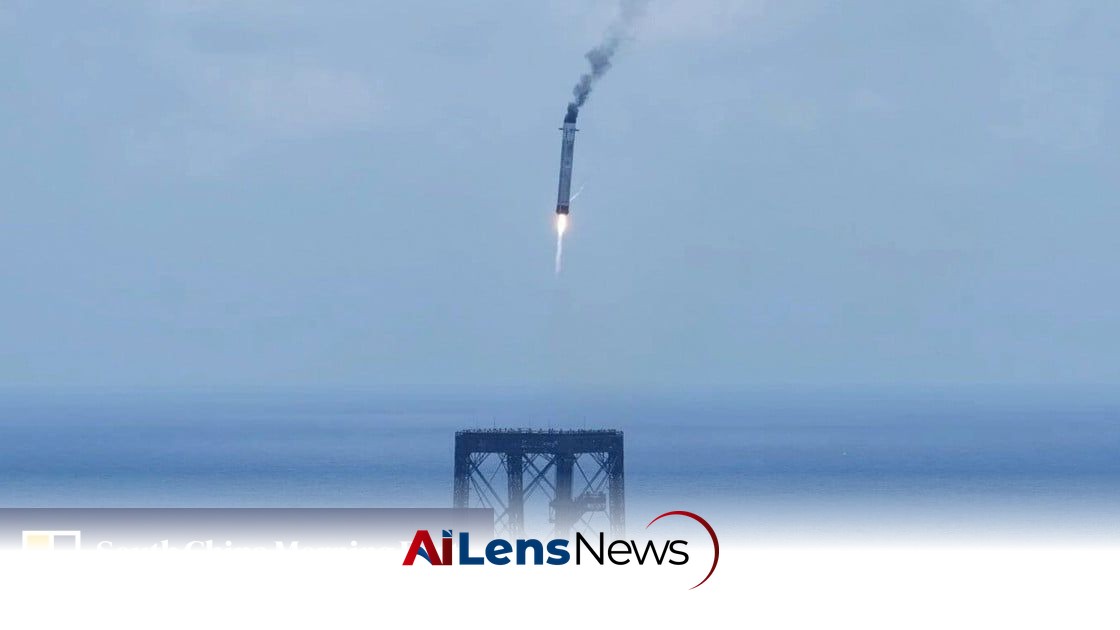


China's successful recovery of a reusable rocket booster has sparked intense online discussions about the future of the space race, particularly in relation to SpaceX.
London, United Kingdom Jul 11, 2026 ALN: China’s successful recovery of a reusable rocket has sparked widespread discussion across social media platforms, igniting a debate that encompasses both national pride and the implications for global space exploration dynamics. As the world watches, reactions vary from admiration for China's rapid advancements in space technology to concerns about the potential for a more competitive and intense space race, particularly with the United States.
This event occurs at a pivotal moment for the satellite sector, which is experiencing a surge in demand driven by the need for global internet coverage and other commercial applications. The growing interest in satellite constellations, especially for internet services, has made the ability to launch and recover rockets more critical than ever. As nations and private companies race to establish their presence in this burgeoning market, China's achievement could signal a significant shift in the balance of power in space exploration.
On Friday, China made history by becoming only the second nation, after the United States, to successfully achieve the controlled recovery of an orbital-class rocket booster. This milestone was marked by the successful retrieval of part of its Long March-10B reusable rocket during its inaugural flight. The Long March-10B is part of China's ambitious plans to enhance its capabilities in space exploration and satellite deployment, which are crucial for its strategic and economic interests.
What sets China's approach apart from that of its American counterpart, SpaceX, is its innovative recovery method. While SpaceX has gained notoriety for its use of autonomous drone ships to recover rocket boosters at sea, China's Long March-10B utilized a unique sea-based net-and-cable system. This first-of-its-kind technology allows for a more adaptable recovery process, potentially increasing the efficiency and success rate of future missions. The footage released by state news agency Xinhua, showing the booster being captured mid-air by a moving net, has captivated audiences and showcased China's technological ingenuity.
The ability to reuse rocket boosters is crucial in reducing the costs associated with space missions. Traditionally, launching rockets has been an expensive endeavor, with significant costs incurred for each launch. By reusing components of rockets, agencies can lower these expenses, making ambitious projects such as large-scale satellite constellation deployments, deep-space exploration, and manned lunar missions more financially feasible. This economic efficiency is particularly important as nations like China and the United States compete for dominance in the increasingly lucrative space industry.
In the context of global space exploration, the implications of China’s achievement extend beyond mere technological prowess. As countries invest more in their space programs, the prospect of a new space race looms large. The United States, historically a leader in space exploration, may find itself challenged not only by China’s advancements but also by the increasing capabilities of private companies like SpaceX. This competition could spur further innovations and breakthroughs in technology, but it also raises concerns about the militarization of space and the potential for geopolitical tensions to escalate.
The competition in space is not merely about technological superiority; it also encompasses economic interests, national security, and international prestige. The United States has long viewed its leadership in space as a reflection of its technological prowess and democratic values. In contrast, China's advancements in space technology are often seen as a demonstration of its growing global influence and capabilities. The rivalry may lead to a scenario where both nations ramp up their investments in space technology, leading to accelerated advancements, but also increased risks of conflicts over space resources and strategic advantages.
Moreover, the success of China’s Long March-10B could inspire other nations to enhance their own space programs. Countries that have been historically reliant on partnerships with established space powers may now feel emboldened to invest in their own capabilities, leading to a more fragmented and competitive global landscape. This could result in a proliferation of technologies and methodologies as nations experiment with different approaches to space travel and satellite deployment. The rise of emerging space powers could alter the dynamics of international relations and foster new alliances or rivalries.
As the commercial demand for satellite internet grows, the implications of China’s technological advancements become even more pronounced. Major companies are investing billions into satellite constellations to provide internet services globally, particularly in underserved regions. The ability to launch and recover rockets efficiently will be a key factor in determining which companies can successfully deploy these constellations and dominate the market. As competition heats up, the stakes for both nations and private companies will only increase, potentially leading to rapid advancements in satellite technology and launch capabilities.
In addition, China's success may have broader implications for international collaboration in space exploration. Historically, space exploration has often been a cooperative endeavor, with countries working together on projects like the International Space Station (ISS). However, as nations pursue their own interests and capabilities, the potential for collaboration may be hindered by competition and nationalistic priorities. The ISS, once a symbol of international cooperation, may face challenges as nations prioritize their own space ambitions over collaborative efforts.
The implications of China's advancements in space technology are also felt in the context of climate change and global challenges. The ability to deploy satellites for Earth observation, environmental monitoring, and disaster management is crucial in addressing pressing global issues. As nations develop their space capabilities, the potential for collaboration in these areas may be impacted by competitive interests, which could hinder progress in addressing global challenges.
In conclusion, China's recent achievement in recovering a reusable rocket booster marks a significant milestone not only for its space program but also for the global landscape of space exploration. As reactions continue to unfold online and in the media, the ramifications of this development will likely be felt for years to come. The race for dominance in space is intensifying, and as nations like China push the boundaries of technology, the future of space exploration remains uncertain yet full of potential. The world will be watching closely as the dynamics of this new space race evolve, shaping the future of exploration, innovation, and international cooperation in ways that are yet to be fully understood.
To learn more about the latest developments in Space & Astronomy, stay updated with our exclusive reports and analyses on AiLensNews.

