

Political tensions threaten scientific collaboration, impacting projects like CERN and SESAME. The need for continued cooperation is crucial for global scientific progress.
Abu Dhabi, United Arab Emirates Jul 12, 2026 ALN: The fathers of CERN, the European laboratory for particle physics near Geneva, which was conceived in the late 1940s, had two aims. The first was to enable the construction of large facilities that are beyond the means of the members individually. The second was to show that countries that had recently been at war could work together, and build bridges between them. These aims were shared by the founders of SESAME, which is also an accelerator-based facility, albeit on a much smaller scale with very different scientific goals, based in Jordan. The scientific and political benefits of these projects were fulfilled, but they are currently under threat. Political factors have led CERN’s governing body to close the door to Russian scientists. Remarkably, SESAME has continued to function although some of its members, which include Iran, Israel, and Palestine, and also Cyprus and Turkey, are in states of conflict. But, unfortunately, it has suffered seriously from sanctions which have prevented Iran from paying its dues. Meanwhile, the benefits of some other forms of scientific collaboration, such as that which enabled data sharing between Russian and other scientists studying the warming in the Arctic, which has a global impact on the climate, are being lost.
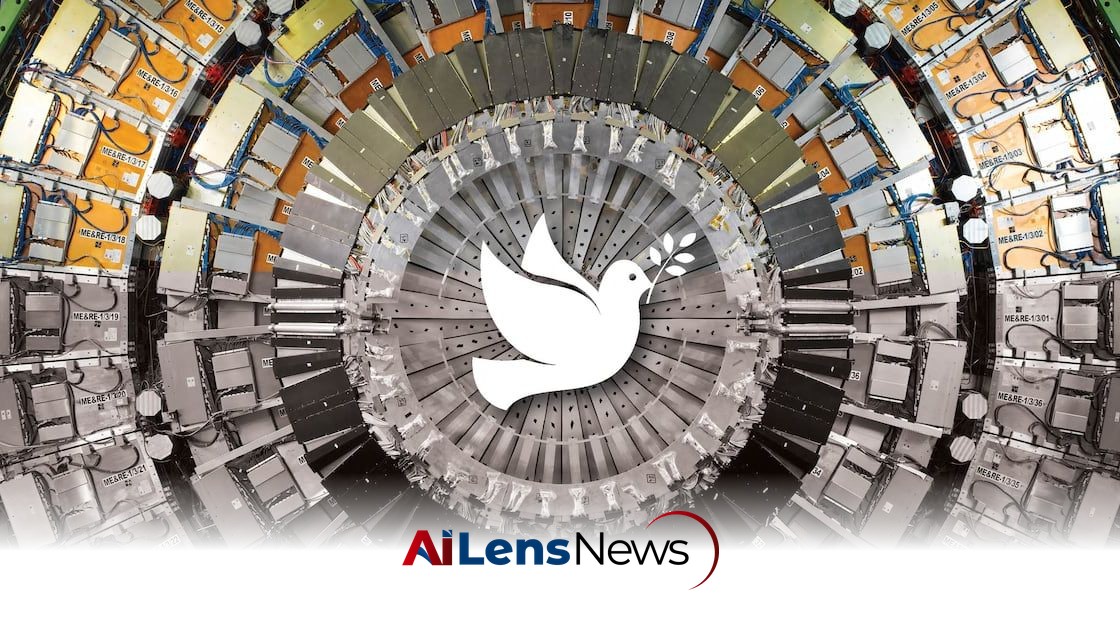
At the heart of CERN’s flagship project, the Large Hadron Collider (LHC), there is a roughly circular tunnel 27 kilometers in length housing powerful electromagnets steering bunches of protons around the ring in opposite directions. These protons are brought into head-on collision at the center of giant detectors, which physicists use to analyze the debris of the collisions, in a quest to understand better the constituents of matter and the forces that control their behavior, and cast light on how the universe evolved into its present state. Only 91 of CERN’s 2,769 permanent staff are research physicists. They work in collaboration with other physicists visiting temporarily. There are currently 7,866 users with home bases in CERN’s 25 member states, and 4,532 based in 58 non-members, who contribute to the cost of the detectors.
Throughout the Cold War and after, CERN was a model for sustaining humanity’s shared scientific interests in spite of politics. Russians had been working at CERN since the 1960s, while some European scientists participated in experiments in Russia. But following the invasion of Ukraine in 2022, CERN’s governing body decided not to renew the collaboration agreement with the Russian government that allowed scientists affiliated with Russian organizations to work at CERN.
Barred doors have harmed the careers of these scientists, whose fluctuating numbers peaked at around 800, and it has damaged CERN as Russia was contributing hardware as well as manpower to the ongoing upgrade of the LHC. It has also ended human contacts that lead to better mutual understanding, which are particularly valuable in times of conflict.
This value is exemplified by a story told by a Pakistani physicist who wanted to take a group of technicians to work in one of the big collaborations at CERN. They demurred as it would involve working with Israelis, but he insisted. After a few weeks, they came to him and said that they were impressed by the Israeli technicians’ skills, and they were “nice guys.” Collaboration builds professional respect, which breeds tolerance of other people’s beliefs.
The LHC is the first genuinely global high-energy physics project in terms of the experiments. The experimental collaborations attract expertise from around the world, and contributions from non-member states (NMS) enabled the construction of better detectors than would otherwise have been possible. The collider itself cannot be regarded as a global project: certain NMS made useful contributions to its cost, but the bulk came from the member states (MS).
Collaboration builds professional respect, which breeds tolerance of other people’s beliefs
Following full exploitation of the LHC, CERN aspires to build a much larger collider in a new 90 km tunnel, which would (like the LHC tunnel) house an electron-positron collider (that would produce Higgs bosons in unprecedented numbers), followed by a proton-proton. This Future Circular Collider (or FCC as it has been called) will be supported by existing infrastructure, which would make it much cheaper to build at CERN than anywhere else in the world. Nevertheless, with a price tag for the material cost of the first stage of some 11.6 billion Swiss francs ($14.3 billion), it could not possibly be funded from the members’ regular contributions, which amounted to 1.2 billion francs in 2025. The hope of obtaining the missing funds from all the non-member countries whose physicists work, or in the case of Russia would like to work, at the LHC has been jeopardized by the invasion of Ukraine and other political developments. However, many countries not affected by these developments could contribute, the European Union may provide some funding, and CERN has so far obtained pledges from philanthropists to provide 0.86 billion CHF. I hope this will allow mankind’s age-old quest to understand the laws that govern the universe to continue.
SESAME, whose members are currently Cyprus, Egypt, Iran, Israel, Jordan, Pakistan, Palestine, and Turkey, today has 2,315 registered users, of whom 1,893 have home bases in the eight members. The rest are based in 65 other countries, and there is a budget-constrained staff of 69 (which is not enough). The users stay in the on-site hostel (which was funded by Italy), and speak over meals and on shifts if working on adjacent experimental stations. Officials of the members and observers meet at the SESAME Council.
At SESAME’s heart is an electron accelerator 133 meters in circumference. As the electrons are steered around the ring, the electric field that surrounds all electrically charged particles cannot respond instantly as their directions change. Some of the energy in this field keeps going straight-on resulting in a cone of electromagnetic radiation that is emitted tangentially to their orbits. This ‘synchrotron-light’ is focused on materials, enabling studies on scales from atoms to viruses, including some of particular interest to the Middle East, for example on diseases that are prevalent in the region and agriculture, and archaeological artifacts. There are some fifty synchrotron-light sources in the world but SESAME is the only one in the region. Many have higher energy, which allows them to reach shorter distance scales. But SESAME is a 3rd generation facility, meaning that it is equipped with special devices that enhance the emission of radiation, and is capable of doing Nobel Prize-winning work.
Apart from sanctions which have prevented Iran from contributing to SESAME, political issues have only threatened the working of SESAME on a few occasions. The most serious was when Israeli commandos intercepted a Turkish ship taking aid to Gaza on May 31, 2010, while the SESAME Council was meeting in Cairo. This provoked strong feelings, but wise words from the Turkish delegate eased the tension. The major problem that SESAME has faced is a lack of funds. Members joined without expecting to pay construction costs. When I became involved as SESAME’s president in 2008, there was a design and a building but no money to put anything in it. It got built anyway, thanks to Iran, Israel, Jordan, and Turkey agreeing to contribute $5 million each, in addition to their regular contributions (Egypt would likely have joined in, but the responsible minister changed while the special contributions were being agreed; this was the only direct impact on the project of the 2011 uprisings across much of the Arab world), and there were also cash and in-kind contributions from observers, especially the EU, Germany, Italy, Switzerland, and the UK, and extra contributions from Jordan.
To learn more about the latest developments in Research & Discoveries, stay updated with our exclusive reports and analyses on AiLensNews.

