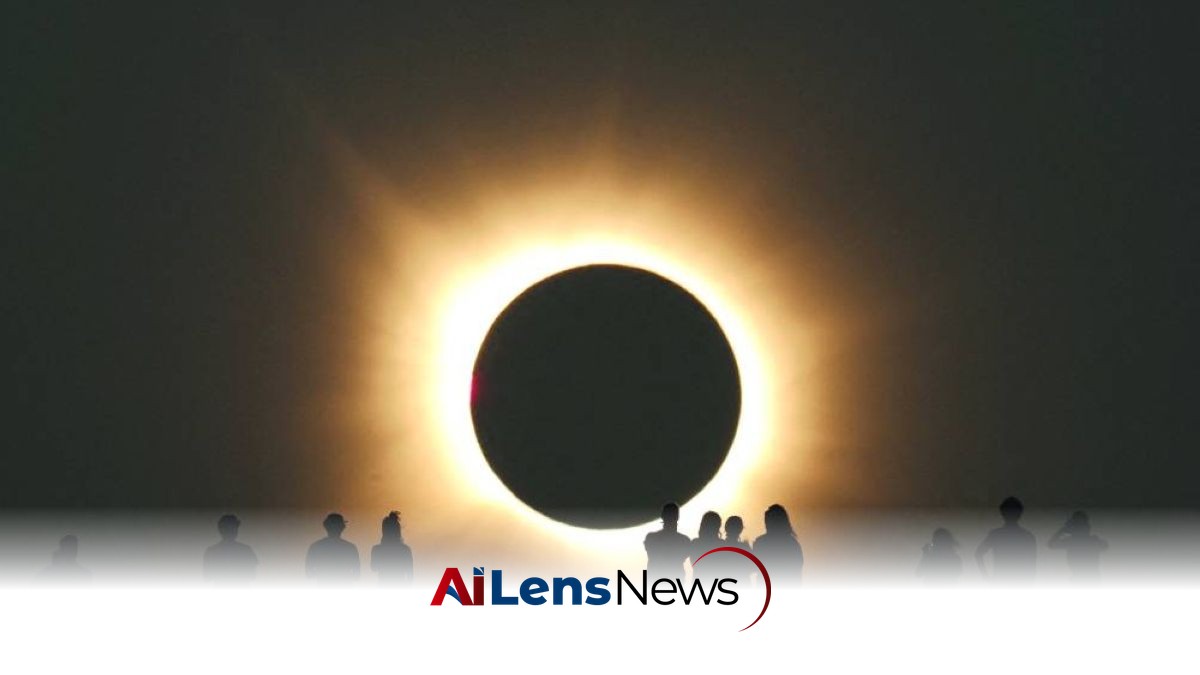



A total solar eclipse captivated millions in Spain, transforming daylight into darkness for a brief moment as the Moon obscured the Sun.
Doha, Qatar Aug 13, 2026 ALN: A large part of Spain switched from daylight into total darkness Wednesday as the Moon covered the Sun, captivating thousands of spectators across the country. The total eclipse lasted less than two minutes in Lodoso, near Burgos, to the delight of the many people observing the phenomenon using special spectacles for safety, as reported by an AFP journalist present at the scene. This celestial event, which occurs when the Moon completely obscures the Sun, is a rare occurrence that draws significant attention and interest worldwide.
Authorities had anticipated that up to 6 million visitors would flock to the areas within the eclipse's path across the northern part of Spain and the Balearic Islands. Juan Cruz, Spain's Secretary of State for Science, expressed hope that the event would inspire a new generation of astrophysicists. "I hope that tonight will see the emergence of a wonderful generation of astrophysicists," he stated, emphasizing the significance of such a unique moment in time.
Millions of people turned their gaze towards the heavens Wednesday to witness one of nature's greatest spectacles — a rare total solar eclipse — as it swept towards mainland Europe to briefly turn day into night. The phenomenon began at 1700 GMT in the remote Arctic north of Russia, where the Moon was expected to blot out the Sun, leaving only the shimmering glow of its outer corona visible. Following this, parts of Greenland and Iceland were set to be enveloped in the arc of the eclipse's shadow.
Excitement was particularly palpable in Spain, where tourists and locals alike thronged the streets of normally quiet villages to experience the dramatic natural phenomenon. The eclipse's narrow path cut across the Iberian Peninsula, extending from the northern Atlantic coast down to the Mediterranean Sea in the south. This marked a significant event for Spain, as mainland Europe had not experienced a total solar eclipse for 20 years, and the last one in Spain occurred more than a century ago.
Interestingly, Iceland's capital, Reykjavik, has not seen a total solar eclipse since 1433, making the anticipation for the event even more intense. Many individuals were eager to witness this rare occurrence, including Yenny Guevera, a 50-year-old Peruvian living in France, who shared her excitement, stating, "It's the first time and it's the last time, the only time I'm going to see an eclipse." This sentiment resonated with many spectators, highlighting the emotional connection people have with such celestial events.
Mercedes Bua, a 51-year-old engineer waiting for the eclipse's passage in a park in Colmenar Viejo, expressed her artistic curiosity, stating, "I like painting and I really like light. So I find it interesting to see how it's going to look." This reflects not only the scientific interest surrounding the eclipse but also its impact on art and culture, as many individuals seek to capture the moment through various forms of expression.
As the event approached, supplies of special viewing glasses were in high demand, as a partial eclipse was also expected to be visible for millions more in most of Europe, Canada, the northern United States, and northwest Africa. This surge in interest highlighted the widespread appeal of solar eclipses, which have captivated humanity for centuries. Throughout human history, eclipses have stirred amazement, fear, and reverence, as they appear to momentarily halt the normal course of nature.
The shadow or "umbra" cast by the alignment of the Sun and Moon creates a strange twilight during which temperatures drop, shadows appear at unusual angles, and some animals exhibit altered behavior, such as going to sleep. This temporary alteration of the environment adds to the mystique of solar eclipses, making them a subject of fascination and study for scientists and enthusiasts alike. However, the phenomenon is fleeting; in parts of Russia and Greenland, the total eclipse lasted under two-and-a-half minutes, while in Spain, it was expected to last less than two minutes just before sunset. The partial eclipse, which occurs as the Moon begins and finishes crossing the Sun's path, dimming its light, was projected to last around one hour and 45 minutes.
Lucie Green, a British solar physicist who has traveled the world to witness eclipses, described the experience as "a moving experience." She planned to observe the eclipse from a boat off the island of Mallorca, highlighting the lengths to which enthusiasts will go to ensure they do not miss this rare opportunity. The event was also to be livestreamed by both NASA and the European Space Agency, providing a platform for scientists and the public alike to engage with the phenomenon in real-time.
For scientists, the eclipse presents a rare opportunity to study the Sun's atmosphere and its outermost layer, as researchers seek to uncover secrets about solar winds and the Sun's magnetic field. The scientific community views eclipses as valuable events for advancing knowledge in solar physics and understanding the intricate workings of our star. However, weather conditions in some regions posed a challenge; rain could potentially spoil the occasion in the Westfjords region of northwest Iceland. Scientist and astronomer Saevar Helgi Bragason expressed his mixed feelings of excitement and heartbreak due to the unfavorable weather forecast but remained hopeful that the skies would clear long enough to witness the eclipse from his home.
In contrast, Spain was fortunate to have clear skies forecast for the event, although concerns about high temperatures and the risk of wildfires lingered. The phenomenon had sparked what some referred to as "eclipse fever" in Spain, with government predictions estimating that nearly 450,000 extra tourists could bring a significant economic boost of approximately 347 million euros (around $400 million). This influx of visitors would not only benefit local economies but also foster a sense of community and shared experience among those witnessing the eclipse.
To ensure the event proceeded smoothly, nearly 25,000 police officers were mobilized, as stated by Interior Minister Fernando Grande-Marlaska. This level of security underscores the importance placed on the event and the need to manage the large crowds expected in the areas along the path of totality. British astrophysicist and science communicator Graham Jones noted the uniqueness of Spain's geographical position, stating, "The path of totality is very narrow. It's only a couple of hundred kilometers wide. That's what's so special about Spain. The path of totality really goes across the Spanish peninsula." This geographical aspect made Spain an ideal location for viewing the eclipse, contributing to the surge in tourism and interest surrounding the event.
Looking ahead, another total eclipse is scheduled to cross southern Spain and northern Africa in August 2027, while an annular eclipse — when the Moon is not sufficiently large to completely blot out the Sun, creating a so-called "ring of fire" — is expected to visit the Iberian Peninsula in 2028. These future events provide additional opportunities for both scientists and the public to engage with and celebrate the wonders of the cosmos, ensuring that the fascination with solar eclipses will continue to endure for generations to come.
To learn more about the latest developments in Environment & Climate, stay updated with our exclusive reports and analyses on AILensNews.

