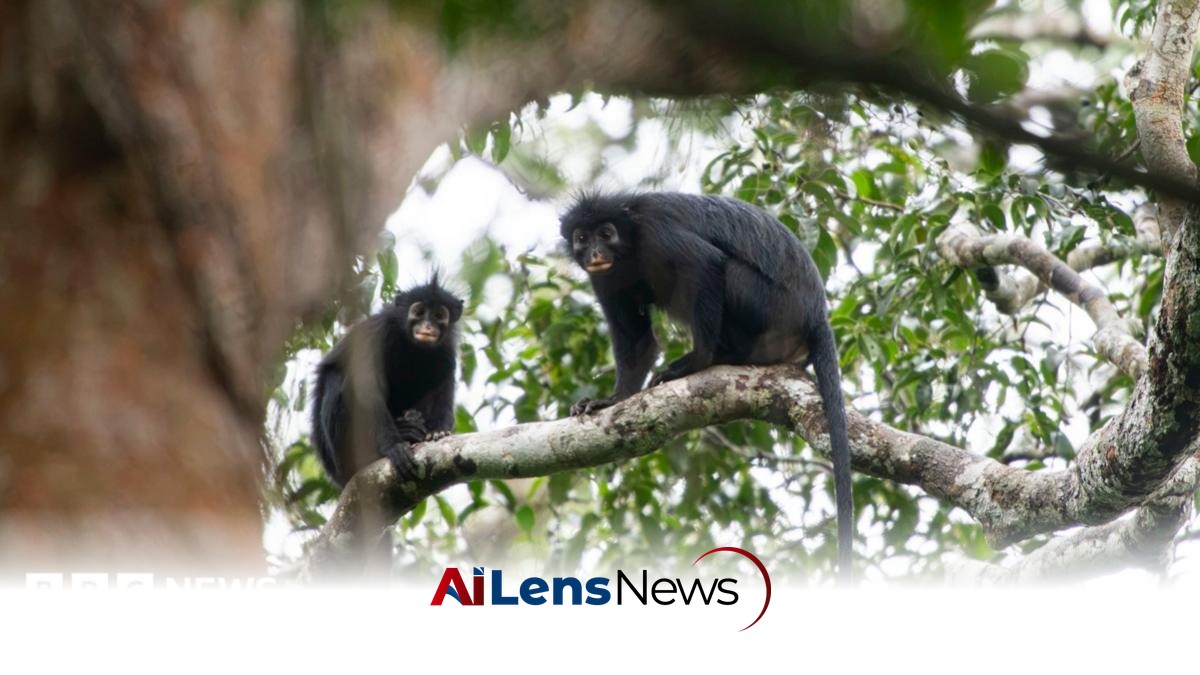


A previously unknown monkey species with striking orange lips has been confirmed in the Democratic Republic of Congo, marking a significant discovery in primate research.
New Delhi, India Jul 16, 2026 ALN: A monkey that has striking pinkish-orange lips and a black face - and lives in the forests of the Democratic Republic of Congo - has been confirmed as a new species.
The black-furred primate was spotted and photographed hidden away in the high tree canopy of dense tropical forests in Lomami National Park, in the central east of the country. This discovery adds to the rich biodiversity found within the DRC, a country known for its vast rainforests and unique wildlife.
Conservationists working in the region first reported seeing this unusual-looking animal back in 2008. However, they captured just one blurry photograph, which left many questions unanswered regarding the identity and classification of the species. The initial sighting sparked interest among researchers and conservationists, but it wasn't until another sighting occurred ten years later that an international team was mobilized to find and study the monkey in greater detail.
The team’s efforts culminated in the confirmation that this primate is indeed a previously unknown species, now scientifically recognized as Colobus congoensis. This discovery is significant as it marks only the fifth African monkey species to be identified in the last 75 years, highlighting the ongoing potential for new discoveries in the realm of primatology and conservation.
Junior Amboko, a PhD student at Florida Atlantic University, played a leading role in the search, which involved a combination of audio recordings, photography, and detailed genetic studies. The findings were published in the journal PLoS One, contributing to the growing body of knowledge surrounding the biodiversity of the region. Amboko expressed the emotional impact of the discovery, stating it was an "amazing feeling" to look into the face of an animal that so few people knew existed.
In the context of biodiversity studies, "discovering" a species means officially recording and confirming that it has evolved to be genetically distinct from other species. While many local people were already aware of the monkey's existence and referred to it by a common name - Likweli - the scientific community had yet to classify it formally. Amboko noted that the monkeys were "kind of shy" and tended to hide high in the trees, making them elusive and difficult to study.
As part of their research, the team conducted interviews in 52 villages located near the monkeys' habitat. Interestingly, only residents from eight of these villages had ever seen the monkeys, suggesting that their population may be limited and that they inhabit a specific niche within the forest ecosystem.
The research team, which included experts from the DRC, the US, and Germany, assigned the animal the Latin name Colobus congoensis in recognition of the natural diversity found in the country. This nomenclature reflects the importance of preserving biodiversity and understanding the ecological roles that different species play within their s. The monkey belongs to the larger group of colobus monkeys, which are known for their unique characteristics, including the absence of thumbs.
Professor Kate Detwiler from Florida Atlantic University emphasized the ecological significance of colobus monkeys, stating, "These are really important African monkeys that don't have thumbs. They're these herbivores of the canopy that are a critical part of the ecosystem. We think they have a lot to do with processing seeds and germination in the forest." This highlights the intricate relationships between species and their s, where the loss of any one species can have cascading effects throughout the ecosystem.
Furthermore, Professor Detwiler speculates that the monkeys' unusual, bright facial markings could serve as visual signals to other animals, potentially playing a role in attracting mates or enabling individuals to identify one another. This aspect of their behavior underscores the complexity of animal communication and social structures within primate species.
In addition to their striking appearance, the monkeys are known for their distinctive "roaring" calls. Amboko noted that while researchers often hear them, they do not always see them, further emphasizing the challenges of studying this secretive species. Their elusive nature and limited visibility may contribute to their vulnerability, as they are hunted for meat in the region. The researchers hope that now that Colobus congoensis is classified as a distinct species, it can receive official protection under conservation laws.
The implications of this discovery extend beyond mere classification. The recognition of Colobus congoensis as a distinct species brings attention to the need for conservation efforts in the DRC, a country that faces significant al challenges, including deforestation, habitat loss, and poaching. By understanding and protecting this newly identified species, conservationists can work to preserve the delicate balance of the ecosystems in which they reside.
Despite the promising discovery, the researchers acknowledge that there is still much to learn about this newly described, secretive species. They plan to carry out a more detailed survey to estimate their population and study their behavior in greater depth. This ongoing research is crucial not only for the survival of Colobus congoensis but also for the broader understanding of primate diversity and conservation in the Democratic Republic of Congo.
In conclusion, the discovery of the monkey with distinctive orange lips represents a significant advancement in our understanding of biodiversity in the DRC. It serves as a reminder of the importance of continued exploration and research in remote areas, where new species may still be waiting to be discovered. The work of conservationists and researchers is vital in ensuring that these unique creatures are protected and that their habitats are preserved for future generations. As scientists delve deeper into the mysteries of the natural world, they uncover not only new species but also the intricate connections that bind all living beings within their ecosystems.
To learn more about the latest developments in Biology & Life Sciences, stay updated with our exclusive reports and analyses on AiLensNews.

