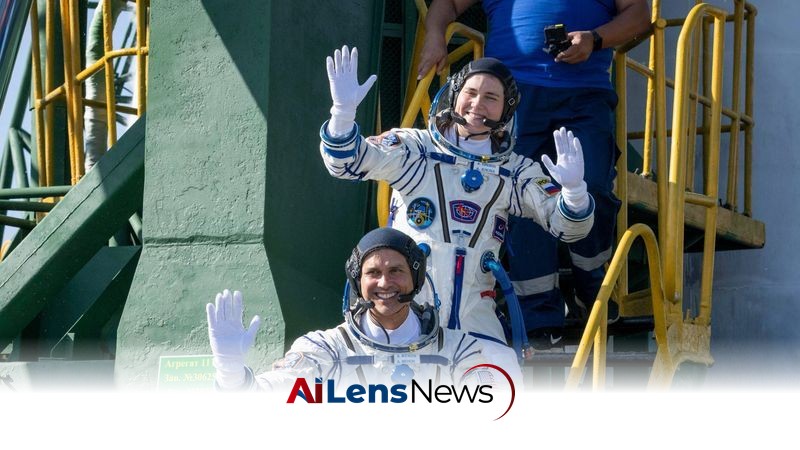


Anil Menon, a NASA astronaut, has commenced his eight-month journey to the International Space Station, marking a significant milestone in his career.
New Delhi, India Jul 14, 2026 ALN: Anil Menon, a NASA astronaut, has officially embarked on an eight-month mission to the International Space Station (ISS). This journey not only highlights his dedication to space exploration but also underscores the collaborative efforts between NASA and its international partners. The ISS, which has been continuously inhabited since November 2000, serves as a microgravity laboratory where astronauts from various countries conduct scientific research that is not possible on Earth. This mission is part of a broader initiative to maintain a human presence in space while fostering international cooperation in scientific endeavors.
Menon expressed his pride in serving the United States Space Force and emphasized the importance of this mission in a post on social media platform X. He stated,
‘Proud to serve the United States Space Force and fly to the International Space Station today in support of NASA and our international partners!’
This mission is particularly significant as it represents a continuation of NASA's commitment to advancing scientific research and international cooperation in space. The ISS serves as a unique laboratory for conducting experiments that can benefit life on Earth and enhance our understanding of space. Research conducted on the ISS spans various fields, including biology, physics, astronomy, and materials science. For instance, experiments on the ISS have led to advancements in medical technology and materials that are used in everyday life.
Moreover, the ISS plays a crucial role in preparing for future deep space missions, including those aimed at Mars and beyond. The knowledge gained from long-duration missions aboard the ISS helps scientists understand the effects of microgravity on the human body, which is essential for planning future missions that may last several years. The microgravity environment of the ISS allows researchers to study phenomena that cannot be replicated on Earth, leading to breakthroughs in various scientific disciplines.
Anil Menon, who has a background in medicine and engineering, was selected as a NASA astronaut in 2020. His diverse skill set and experience make him a valuable asset for this mission. Before joining NASA, Menon served as a flight surgeon for NASA's Human Research Program, where he was responsible for ensuring the health and safety of astronauts during missions. His medical expertise is particularly relevant for monitoring the health of crew members during long-duration spaceflight, as well as for conducting medical research on the ISS.
Menon’s journey reflects the increasing involvement of individuals from various professional backgrounds in space exploration. The selection of astronauts with diverse skills and experiences is part of NASA's strategy to enhance mission success and innovation. As space exploration continues to evolve, the need for specialists in various fields, including medicine, engineering, and technology, becomes increasingly important. This diversity not only enriches the missions but also prepares NASA for the complex challenges of future explorations.
The mission also highlights the collaborative nature of modern space exploration. NASA works closely with international space agencies and partners to ensure the success of missions to the ISS. This cooperation is vital for sharing knowledge, resources, and expertise. The ISS is a collaborative project involving five space agencies: NASA (United States), Roscosmos (Russia), ESA (European Space Agency), JAXA (Japan), and CSA (Canadian Space Agency). Each agency contributes to the operation and research conducted on the station, fostering a spirit of teamwork and unity in the pursuit of scientific discovery.
International collaboration in space exploration has far-reaching implications. It not only enhances the scientific output of missions but also fosters diplomatic relations among countries. The ISS serves as a platform for nations to work together toward common goals, demonstrating that collaboration can lead to significant advancements in science and technology. The partnerships formed through the ISS have often translated into other areas of cooperation, showcasing the potential of science as a bridge between nations.
As Menon settles into life aboard the ISS, he will participate in various scientific experiments and contribute to ongoing research efforts. His work will not only advance scientific knowledge but also inspire future generations to pursue careers in science, technology, engineering, and mathematics (STEM). The presence of astronauts like Menon, who come from diverse backgrounds, serves as a powerful message to young people about the possibilities that exist in the fields of science and technology. The importance of role models in STEM cannot be overstated, as they provide tangible examples of success and innovation to aspiring scientists and engineers.
During his time on the ISS, Menon will be involved in a range of activities, including conducting experiments that require microgravity conditions, performing maintenance on the station, and participating in educational outreach efforts. These outreach activities are crucial for engaging the public and promoting interest in space exploration. By sharing his experiences and the importance of scientific research, Menon hopes to inspire others to consider careers in STEM fields. Engaging the public through social media and educational programs is a key strategy for NASA, as it helps demystify space exploration and fosters a sense of shared adventure.
In conclusion, Anil Menon's eight-month mission to the ISS marks a significant milestone in his career and reflects the collaborative spirit of international space exploration. His journey will undoubtedly contribute to the ongoing advancements in space science and technology. As the world looks to the future of space exploration, missions like Menon's are essential for building a foundation for human exploration beyond low Earth orbit, paving the way for future missions to the Moon, Mars, and beyond. The continued investment in space research and international cooperation will be critical in addressing the challenges that lie ahead in humanity's quest to explore the cosmos. As we venture further into space, the lessons learned from the ISS and missions like Menon's will be invaluable in shaping the future of human spaceflight.
To learn more about the latest developments in Space & Astronomy, stay updated with our exclusive reports and analyses on AiLensNews.

