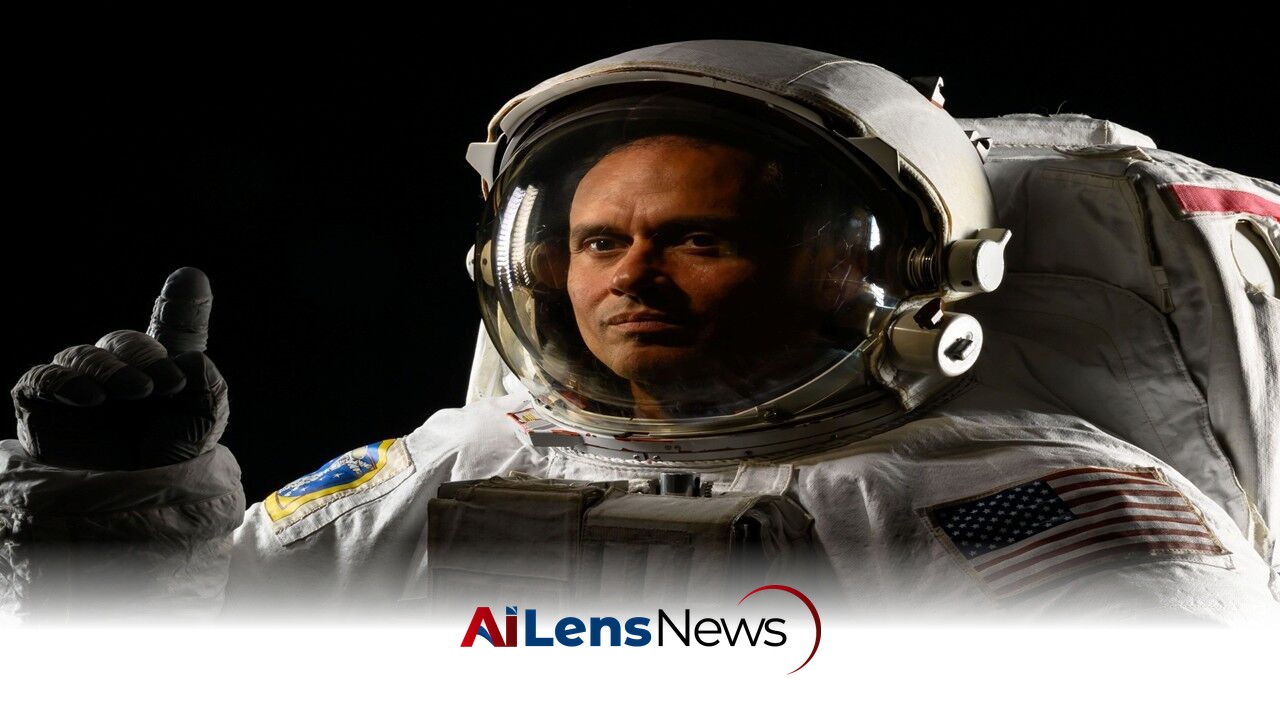


Anil Menon, an Indian-origin NASA astronaut, successfully docked at the ISS aboard Soyuz MS-29, marking the start of his eight-month mission focused on scientific research.
New Delhi, India Jul 15, 2026 ALN: Indian-origin NASA astronaut Anil Menon arrived safely at the International Space Station (ISS) after launching aboard Russia's Soyuz MS-29 spacecraft, beginning his first spaceflight on an eight-month mission focused on scientific research and technology demonstrations.
Menon, along with Roscosmos cosmonauts Pyotr Dubrov and Anna Kikina, reached the orbiting laboratory after the Soyuz spacecraft docked with the ISS's Prichal module at 1:52 p.m. EDT, following a three-hour, two-orbit journey from the Baikonur Cosmodrome in Kazakhstan. The Soyuz MS-29 mission is a testament to the long-standing collaboration between space agencies, particularly between NASA and Roscosmos, which has been crucial for the continued operation of the ISS since its inception.
The trio had lifted off earlier at 10:47 a.m. EDT (7:47 p.m. local time) aboard the Soyuz MS-29 spacecraft. Their arrival increases the station's crew to 10 for about the next two weeks, a period that marks a busy time for the ISS as crew members engage in various scientific experiments and maintenance activities. The ISS, a joint project involving space agencies from multiple countries, serves as a platform for international collaboration in space exploration and research.
Before launch, Menon posted on X: "Proud to serve the United States Space Force and fly to the International Space Station today in support of NASA and our international partners!" His enthusiasm reflects the growing role of astronauts in promoting space exploration and the importance of international partnerships in achieving scientific goals in space.
In another message ahead of liftoff, he wrote: "Excited to launch aboard Soyuz MS-29 from Kazakhstan and begin an eight-month mission supporting NASA and Expedition 74/75. Grateful for the NASA community, friends, family, and loved ones and excited for tomorrow." These sentiments highlight the personal sacrifices that astronauts make as they embark on missions that require extensive training and preparation.
Following the scheduled hatch opening, the new arrivals were to be welcomed aboard by Expedition 74 crew members: NASA astronauts Jessica Meir, Jack Hathaway and Chris Williams; European Space Agency astronaut Sophie Adenot; and Roscosmos cosmonauts Sergey Kud-Sverchkov, Sergei Mikaev and Andrey Fedyaev. This welcoming process is a crucial part of ensuring operational continuity aboard the ISS, as new crew members must quickly integrate into ongoing scientific projects and daily routines.
NASA said Menon, Dubrov and Kikina will remain aboard the orbital laboratory until April 2027. This is Menon's first journey into space and the second mission for both Dubrov and Kikina, illustrating the diverse experiences and backgrounds that astronauts bring to their missions. Menon's unique perspective as an Indian-origin astronaut contributes to the broader narrative of inclusivity in space exploration, emphasizing the importance of representation in STEM fields.
During his stay aboard the ISS, Menon will conduct scientific research and technology demonstrations aimed at advancing human space exploration and benefiting life on Earth. His work will include refining the in-space production of semiconductor crystals to enable large-scale manufacturing of components needed for high-performance computers, artificial intelligence systems, and improved medical devices. This research has significant implications for both space missions and terrestrial applications, as advancements in semiconductor technology can lead to breakthroughs in various fields, including computing and healthcare.
He also will perform ultrasound using augmented reality and artificial intelligence methods that could eliminate the need for medical support from Earth on future space missions. This innovation could revolutionize space medicine, allowing astronauts to conduct complex medical procedures independently, thereby enhancing the feasibility of long-duration missions to destinations such as Mars.
NASA said Menon will also serve as a test subject in studies examining how blood flow changes in space and will test bioprinting vascular constructs in microgravity to improve understanding of the aging process and advance therapeutic developments. These studies are vital for understanding how human physiology adapts to space environments, which is essential for the health and safety of astronauts on long-term missions.
NASA announced that Expedition 75 is scheduled to begin on July 26 following the departure of Williams, Kud-Sverchkov, and Mikaev after completing their eight-month science mission aboard the orbital outpost. A change-of-command ceremony is scheduled for July 25, when station command will transfer from Kud-Sverchkov to Meir. Such ceremonies are significant as they symbolize the continuity of leadership and the collaborative spirit that characterizes life aboard the ISS.
Menon's mission drew congratulatory messages from several organizations and supporters. The American Board of Emergency Medicine (ABEM), where Menon is a board-certified emergency physician, also congratulated him on "a successful launch to the International Space Station" and wished the crew "a safe and successful mission." This recognition underscores the importance of interdisciplinary skills in space exploration, as medical expertise is crucial for maintaining crew health during missions.
The International Space Station has maintained a continuous human presence for more than 25 years, serving as a unique laboratory for research that cannot be conducted on Earth because of microgravity. The scientific work carried out aboard the station supports advances in medicine, engineering, biology, and materials science while helping prepare for future missions to the Moon and Mars. The ISS serves as a proving ground for technologies and systems that will be essential for humanity's next steps in space exploration, including the Artemis program, which aims to return humans to the Moon and eventually send astronauts to Mars.
As Menon embarks on this exciting journey, his contributions to scientific research and technology development will not only enhance our understanding of space but also have far-reaching implications for life on Earth. His mission exemplifies the spirit of exploration and innovation that drives humanity's quest to explore the cosmos, highlighting the collaborative efforts of nations working together to push the boundaries of science and technology.
To learn more about the latest developments in Space & Astronomy, stay updated with our exclusive reports and analyses on AiLensNews.

